

What’s the Best Payment Setup for a Scottsdale or Tempe Farmers Market or Artisan Vendor?
The short answer: you need a lightweight, mobile-friendly payment terminal with reliable offline capability — and a processing setup that keeps your fees low enough that selling a $12 jar of honey or a $40 handmade candle actually pencils out. If you’ve been relying on Square because it seemed like the easiest option, this article is worth reading before your next market day.
Farmers markets, artisan pop-ups, and outdoor craft fairs are booming all over the Valley. From the Scottsdale Farmers Market near Old Town to the Tempe Marketplace events, the Downtown Phoenix market, and weekend markets in Gilbert and Mesa, local vendors are showing up in bigger numbers every season. That’s great for small makers and growers — but it also means you need a payment setup that can actually keep up with the pace of a busy Saturday morning without dropping a connection, overcharging you per transaction, or locking you into a contract you didn’t fully understand.
Why Square Isn’t Always the Right Fit for Market Vendors
Square is easy to set up, and that’s genuinely useful when you’re just starting out. But once you’re doing consistent volume at markets, a few Square limitations start to add up:
- Flat-rate pricing doesn’t scale well. Square charges a flat 2.6% + $0.10 per tap or swipe. On high-ticket handmade goods, that’s manageable. But if you’re running dozens of small transactions — $8 soaps, $15 jams, $6 bags of roasted nuts — that flat rate can quietly eat into your margin more than a traditional interchange-plus pricing model would.
- Account holds and freezes happen without warning. Square is a payment facilitator, not a dedicated merchant account. If their risk algorithms flag your volume as unusual — especially during a busy snowbird-season market weekend — they can hold your funds. That’s not a hypothetical; it happens regularly to vendors who have a great day at a market and then can’t access their deposit.
- Offline mode is limited. Square’s offline mode accepts transactions, but it comes with caps and a clear disclaimer that transactions may be declined once you reconnect. At an outdoor market with spotty cell coverage, that’s a real problem.
- No dedicated support. When something goes wrong mid-market, you’re troubleshooting via app or waiting on hold. There’s no local rep who knows your account.
None of this means Square is a bad product — it’s just built for convenience at low volume, not optimized for a vendor who’s serious about their market business.
What Actually Works at an Outdoor Market in the Phoenix Metro
The two things that matter most when you’re set up under a tent at a Scottsdale or Tempe market are connectivity independence and speed at the point of sale. Here’s what to look for:
A 4G/LTE or 5G-Enabled Terminal — Not One That Relies Solely on Your Phone’s Hotspot
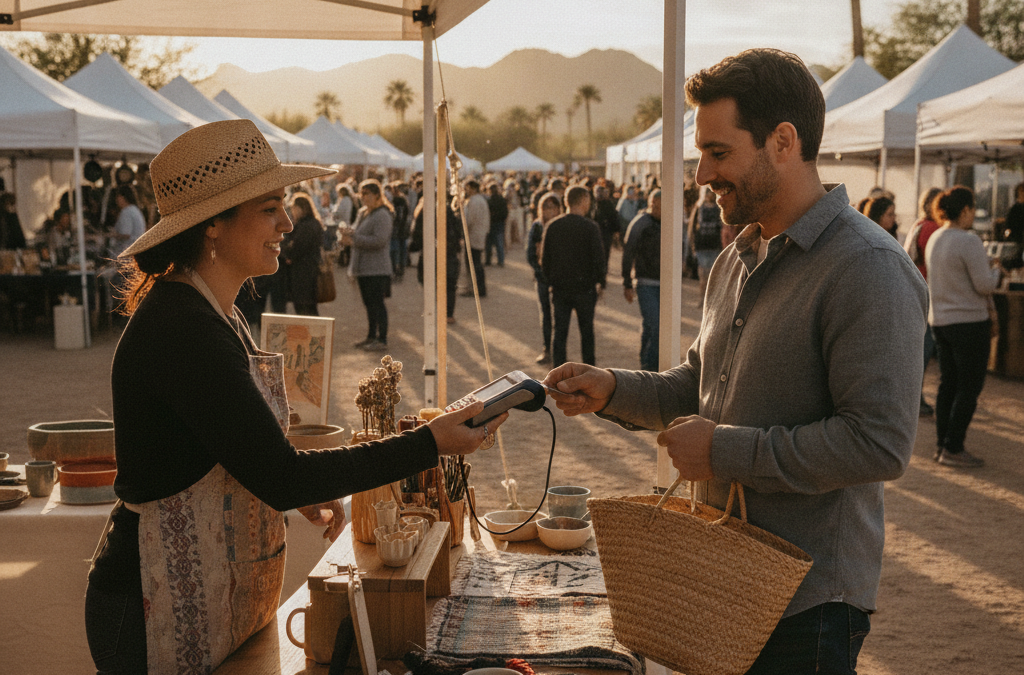
Using your phone as a hotspot works until it doesn’t — your battery dies, the network gets congested during peak market hours, or your data plan throttles you. A dedicated mobile terminal with its own cellular data connection is far more reliable. The Clover Flex is one of the best options for this use case. It’s a handheld, all-in-one device with a built-in receipt printer, customer-facing screen, and 4G connectivity. It’s compact enough for a small table setup, durable enough for outdoor use, and fast enough that you’re not holding up a line during the morning rush.
For vendors with the lowest transaction volume — or those who want a true backup — the Clover Go is a Bluetooth card reader that pairs with your phone. It handles chip, swipe, and tap, and it’s priced accordingly. It’s a solid starter or secondary device, just not a primary solution if you’re running a serious booth.
Store-and-Forward Offline Processing
This is the feature that most market vendors don’t know to ask about — and it’s one of the gaps you won’t find explained clearly on most competitor sites. Store-and-forward means that if your connection drops, your terminal keeps accepting payments locally and queues them to process once connectivity is restored. Unlike Square’s offline mode, a proper store-and-forward setup on a dedicated merchant account gives you more control over transaction limits and risk settings. Ask any processor you’re considering exactly how their offline mode works, what the per-transaction cap is, and what happens if a card is declined after the fact.
Cutting Your Per-Transaction Costs as a Market Vendor
One angle that’s almost completely missing from competitor content aimed at market and craft vendors is how Zero Cost Processing — specifically a cash discount program — can make a real difference for this business type.
Here’s the basic idea: instead of paying 2–3% per transaction out of your pocket, you post two prices at your booth — a card price and a slightly lower cash price. Customers who pay cash get the discount; customers who pay by card pay the listed price, which already accounts for processing costs. Done right and disclosed clearly, this is fully compliant and legal in Arizona. For a market vendor doing $2,000–$5,000 in a weekend, eliminating or sharply reducing processing fees is meaningful money.
A surcharge program (where a fee is added to card transactions at checkout) is another option, but cash discount tends to feel more natural to customers at a market setting — it frames it as a reward for cash rather than a penalty for card. Learn more about how Zero Cost Processing works and whether it makes sense for your booth setup.
Inventory Tracking for Multi-SKU Vendors
If you sell twenty or more different products — different sizes, scents, flavors, or designs — you need a POS that lets you build out a simple product catalog and track what’s selling. The Clover Flex handles this well. You can load your SKUs in advance, ring up items by name or barcode, and pull a sales report at the end of the day to see exactly what moved. That kind of data helps you plan production, restock smarter, and stop guessing which items to bring more of.
This is also useful if you split time between multiple markets — say, Scottsdale on Saturday and Chandler or Gilbert on Sunday. Centralized reporting across both days gives you a clearer picture of your actual margin per product and per market.
What to Look for in a Local Payments Partner — Not a National Platform
The farmers market and artisan vendor category is almost completely ignored by the larger local processors in the Phoenix metro. Most of their content is aimed at restaurants, retailers, or contractors. That’s a gap — because market vendors have specific needs that national platforms handle poorly and that local reps can actually solve.
When you’re evaluating a payments partner as a market vendor, ask these questions:
- Do I get a dedicated merchant account, or am I a sub-merchant under an aggregator?
- How does offline mode work, and what’s the transaction limit?
- Is there a long-term contract, or can I cancel if the business changes?
- What does next-day funding look like — do my weekend sales hit my account by Monday?
- Is there a local rep I can actually reach if something goes wrong at a market?
At Good Payments Merchant Services, the answer to that last one is yes — you can reach Zoltan directly, and he’s not going to route you through a call center. That matters when it’s 9 AM on a Saturday and your terminal isn’t connecting.
Frequently Asked Questions
Do I need a separate merchant account just for farmers market sales?
Not necessarily separate, but you do want a real merchant account — not a payment facilitator sub-account like Square or PayPal. A dedicated merchant account means your funds are more stable, less likely to be held, and you have more control over your processing terms.
What’s the best device for a one-person booth with a small table setup?
The Clover Flex is the most popular choice for solo market vendors — it’s handheld, has a built-in printer for receipts, runs on 4G, and fits in a small footprint. The Clover Go works as a compact backup if you want something even smaller, paired to your phone.
Can I accept contactless payments like Apple Pay and Google Pay at an outdoor market?
Yes — any modern EMV terminal, including the Clover Flex, supports tap-to-pay contactless transactions. This is increasingly what customers expect, especially younger shoppers at artisan markets in Tempe, Phoenix, and Old Town Scottsdale.
Will a cash discount program feel weird to customers at a market booth?
Most vendors find it goes over smoothly when it’s posted clearly at the booth. A small sign that says “Cash Price / Card Price” with both amounts listed is all it takes. Many customers at local markets actually prefer paying cash anyway, so you may end up with fewer card transactions overall — and lower overall costs.
What if I do markets seasonally and don’t need processing year-round?
This is exactly why long-term contracts are a bad fit for market vendors. With Good Payments, there’s no multi-year lock-in. You can discuss a setup that fits how your business actually operates — including slower summer months when outdoor markets in the Valley thin out due to the heat.
Ready to Set Up the Right Payment System for Your Market Booth?
Whether you sell at the Scottsdale Farmers Market, a weekend pop-up in Tempe, or rotating events across Mesa, Chandler, and Gilbert, your payment setup should work as hard as you do. At Good Payments Merchant Services, we help artisan vendors and market sellers get set up with the right hardware, fair pricing, and no long-term commitments — with a local rep who’s actually reachable when you need help.
Contact us for a free rate analysis and let’s find the right setup for how you sell.