

How Should a Scottsdale or Phoenix Photography Studio, Videographer, or Creative Freelancer Set Up Payment Processing?
If you’re a photographer, videographer, or creative freelancer working in Scottsdale or anywhere across the Phoenix metro, getting paid should be the easy part of your job — but for a lot of creatives, it’s actually one of the most disorganized pieces of running their business. The good news is that setting up the right payment processing isn’t complicated once you understand what your workflow actually needs. Whether you’re collecting a deposit for a portrait session in Old Town Scottsdale, invoicing a corporate client in Phoenix for a video production project, or swiping a card at a pop-up event in Chandler, there’s a setup that fits the way you work.
Why Payment Processing for Photographers and Videographers Is Different
Creative professionals tend to operate in a hybrid way. You might have a physical studio some of the time, be out on location the rest of the time, and handle a chunk of your client communication — including invoicing — entirely online. That means a single terminal sitting on a counter doesn’t cover everything you do.
Most photographers and videographers in the Valley collect money in at least three different ways: a deposit or retainer upfront to hold the date, a final balance payment when the work is delivered (sometimes weeks later), and occasionally a same-day payment at a shoot or event. Each of those situations calls for a slightly different payment tool, and the right setup gives you all three without requiring you to juggle multiple processors or accounts.
Start With How You Actually Collect Deposits and Final Balances
For most photographers and videographers, the bulk of your revenue comes through invoices — not a card terminal. A client books you for a wedding in Fountain Hills, pays a 50% deposit online, then pays the final balance after they receive their gallery. That entire flow should live in one system that tracks both payments against the same job, sends automatic receipts, and shows you exactly what’s outstanding.
The virtual terminal and e-commerce tools available through Good Payments handle exactly this. You can send a secure payment link directly to a client by email or text. They click it, enter their card information on a secure page, and you get paid — no app required on their end, no awkward “can you Venmo me?” conversation. You can also key in a card over the phone if a client calls to pay their balance directly.
For recurring clients — think a business that books you monthly for product photography or social media content — ACH bank transfer payments are worth considering. ACH moves money directly from your client’s bank account to yours, typically at a lower cost than card processing. For predictable, repeat billing relationships, it can simplify everything and reduce the fees you’re absorbing on larger invoices.
What to Use When You’re Shooting On Location
Not every payment happens in advance. If you do headshots at a Tempe business park, photograph a real estate listing for a Paradise Valley agent who wants to pay on-site, or set up a mini-session booth at a holiday event in Chandler, you need a way to take a card right there.
A compact mobile device like the Clover Flex is built for exactly this. It’s a handheld terminal with a built-in receipt printer, touchscreen, and 4G connectivity — so it works whether you’re in a studio, a client’s backyard in North Scottsdale, or at a pop-up market in Maricopa County. It accepts chip cards, tap-to-pay, and mobile wallets, and everything syncs back to your account automatically. You’re not stuck reconciling paper receipts at the end of the day.
If you want something lighter and you’re mainly just collecting a quick card payment on the go, a wireless mobile terminal also does the job without the extra features you might not need. The key is making sure whatever you carry has strong 4G or WiFi connectivity — spotty signal is a real issue at some outdoor venues and rural properties around the Valley, so look for a device that supports store-and-forward processing, meaning it queues the transaction offline and processes it automatically when signal returns.
How Zero Cost Processing Can Help a Creative Business
Processing fees quietly eat into your margins on every transaction. For a photographer charging $2,500 for a wedding package, a typical processing rate might cost you $65–$80 on that one payment. Multiply that across your year and it adds up to real money.
A Zero Cost Processing program — either a cash discount or a compliant surcharge program — passes that cost to the client instead of absorbing it yourself. Cash discount programs give clients a small discount for paying cash or by check, while surcharge programs add a disclosed fee to card transactions. Both are legal in Arizona when implemented correctly, and many creatives across the Phoenix metro have adopted them without any real client pushback. It’s worth having a conversation about whether it makes sense for your pricing structure before assuming your clients won’t go for it.
What About a Studio Location?
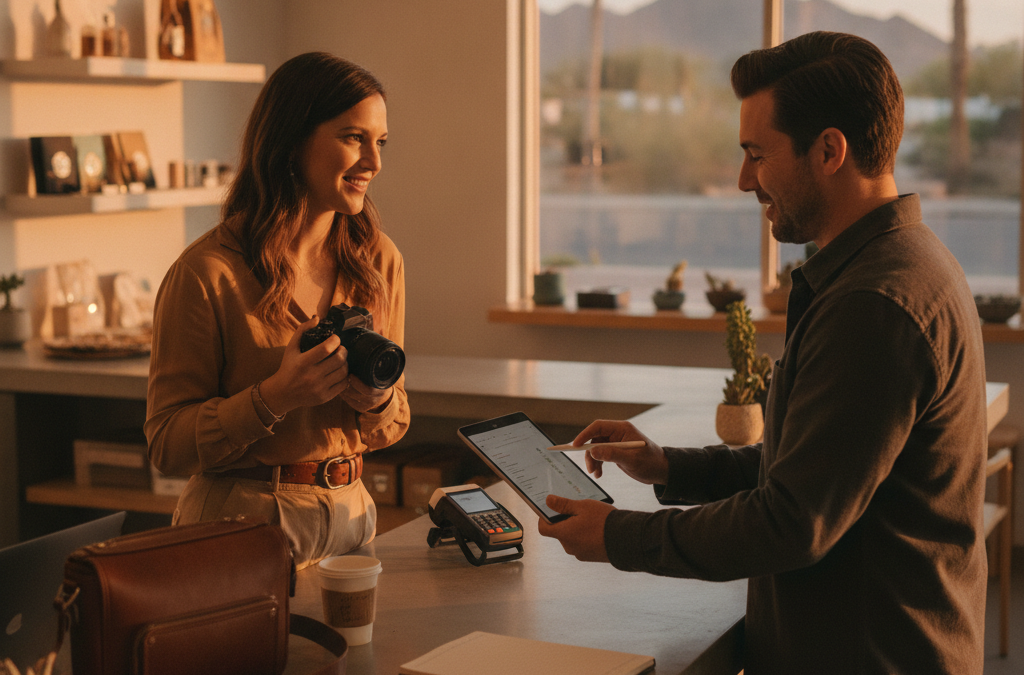
If you have a permanent or semi-permanent studio — whether that’s a dedicated space in Scottsdale, a shared creative studio in Phoenix, or a home studio where clients come to you — a compact countertop terminal or a Clover Mini gives you a clean, professional way to take payment in person. Clients can tap their phone, insert a chip card, or swipe, and you get a receipt sent to their email automatically.
A studio setup also gives you a good opportunity to manage your books more cleanly. Clover’s built-in inventory and reporting tools let you track which services you’re selling most, run end-of-day reports, and keep your payment records organized — which matters a lot at tax time.
What to Avoid When Choosing a Payment Setup
A lot of photographers start out using consumer payment apps or generic platforms because they’re easy to sign up for. The problem is those tools weren’t designed for how creative businesses actually bill. You often end up with no real invoicing, no recurring billing, inconsistent deposit tracking, and customer support that’s essentially just a help center article. When something goes wrong — a chargeback on a large project, a funding hold — you’re dealing with an automated system, not a person.
Working with a local merchant services provider means you have someone you can actually call. At Good Payments, Zoltan Hardi works directly with business owners across Scottsdale and the broader Phoenix metro — no long-term contracts, no hidden fees, and straightforward pricing you can verify before you sign anything. If your situation changes — say you add a second shooter, open a studio location, or start offering video editing subscriptions — your payment setup can grow with you without having to start over.
Frequently Asked Questions
Can I collect a deposit and a final payment through the same system?
Yes. A virtual terminal or online payment link lets you send separate payment requests to the same client and track both against the same job. You’ll know exactly what’s been paid and what’s still outstanding, and your client gets a clear receipt for each transaction.
What’s the best mobile payment device for a photographer shooting on location in Scottsdale or the Phoenix metro?
The Clover Flex is a strong choice for most photographers and videographers. It’s compact, runs on 4G, prints receipts, and handles all payment types. If you’re at an outdoor event or in a location with unreliable signal, make sure your device supports offline store-and-forward processing so transactions don’t fail mid-shoot.
Is ACH a good option for invoicing regular clients?
It can be, especially if you have repeat corporate or commercial clients on a monthly retainer. ACH typically costs less per transaction than card processing, which makes it worth considering for larger, predictable invoices. It’s not ideal for one-time clients who expect the convenience of paying by card, but for established relationships it’s a smart option.
What happens if a client disputes a charge after I’ve already delivered the photos or video?
Chargebacks are a real risk in creative services because there’s often a delay between payment and delivery. Good payment processing includes clear transaction records, timestamps, and documentation that can support your case in a dispute. Having a signed contract and delivery confirmation is your best protection — but working with a processor that offers chargeback support means you’re not navigating that process alone.
Do I need a separate merchant account for my studio and my on-location work?
No. A single merchant account can support multiple ways to accept payments — a virtual terminal for invoices, a mobile device for on-location shoots, and a countertop terminal for your studio — all reporting back to one dashboard. That’s actually one of the clearest advantages of working with a full-service provider rather than stitching together separate tools.
Ready to Get Your Payment Setup Right?
Whether you’re just starting out as a freelance photographer in Tempe or running a full-service production studio in North Scottsdale, the right payment setup makes your business look more professional, protects your cash flow, and saves you money over time. Good Payments Merchant Services works with creative professionals across Scottsdale and the entire Phoenix metro — with no long-term contracts, transparent pricing, and real local support when you need it.
Request a free rate analysis and consultation and find out exactly what your payment processing should cost and what setup makes the most sense for how you work.