
How Should a Scottsdale or Phoenix Jewelry Store, Jeweler, or Watch Dealer Set Up Payment Processing?
If you run a jewelry store, independent jeweler, or watch dealership in Scottsdale or the broader Phoenix metro, you already know that your average ticket size is not what most payment processors plan around. A $4,000 engagement ring, a $12,000 Rolex, a custom-designed anniversary piece — these are not the kinds of sales where you can afford a chargeback surprise, a processing fee that eats three percent off the top, or a terminal that freezes at the wrong moment. Getting your payment setup right matters a lot more for your business than it does for a coffee shop running $8 transactions all day.
This guide walks through what a jewelry business in Scottsdale actually needs from a payment processor — and what to watch out for before you sign anything.
Why High-Ticket Retail Like Jewelry Requires a Different Approach to Payment Processing
Most generic payment processors design their pricing and risk models around low-average-ticket businesses. When your typical sale is in the hundreds or thousands of dollars, a few things change fast.
Processing fees hit harder. Even a modest 2.5% rate on a $5,000 sale is $125 out of pocket — per transaction. If you’re doing ten or fifteen of those a week, it adds up quickly. Understanding interchange-plus pricing versus flat-rate pricing matters for a jeweler in a way it simply doesn’t for a food truck.
Chargeback risk is real. High-ticket items attract a disproportionate share of fraudulent disputes. A customer claims they never received a custom piece, or disputes a charge after picking up a repaired watch. Without the right fraud tools and documentation practices baked into your payment setup, you’re exposed.
Your processor needs to know what you sell. Some national processors flag high-ticket jewelry merchants as elevated-risk accounts and either hold funds or shut down accounts without warning. Working with a processor who understands your business type — before you’re mid-sale — matters.
The Right POS System for a Jewelry Store in Scottsdale or North Scottsdale
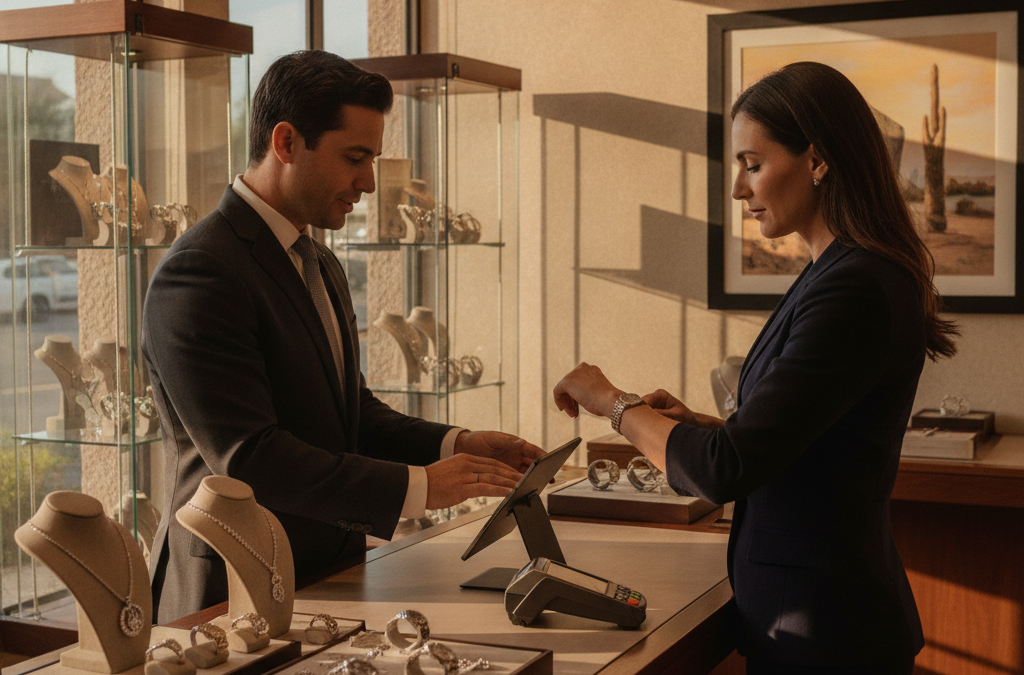
Jewelry retail is relationship-driven. You’re often walking a customer around a display case, sitting with them at a consultation table, or showing pieces one at a time. Your POS setup needs to match that experience — not feel like a fast-food counter.
The Clover POS family is a good fit for most jewelry and watch retailers in Scottsdale for a few reasons:
- Clover Station works well at a traditional checkout counter. It supports full inventory management, which is genuinely useful when you’re tracking individual SKUs for rings, earrings, bracelets, watches, and custom-order pieces at different price points.
- Clover Mini is a compact countertop option that works well in a tighter boutique space — great for jewelers in Old Town Scottsdale or smaller gallery-style showrooms where counter space is limited.
- Clover Flex is a handheld device you can carry to the customer during a consultation. Rather than making someone walk to a register, you can complete the sale right at the display case. For high-end retail, that’s a smoother experience.
All Clover devices support EMV chip, contactless tap-to-pay, and swipe — covering every card type a customer might hand you. Clover’s inventory management also supports item-level notes and photos, which can be useful for cataloging custom or one-of-a-kind pieces.
Protecting Your Business from Chargebacks and Fraud
Chargebacks are a bigger concern for jewelers than for most retailers. The dollar amounts are higher, and the documentation expectations are stricter. Here’s what actually helps:
- Always use EMV chip transactions. Swiping a card instead of dipping or tapping it shifts liability to you in a fraud dispute. Never skip the chip reader.
- Get a customer signature on high-value sales. Whether it’s a digital signature through your POS or a printed receipt, having documentation of the transaction and customer agreement is your first line of defense in a dispute.
- Use tokenization and encryption. Any processor worth working with should encrypt cardholder data at the point of capture and never store raw card numbers. This protects you and your customer.
- Keep detailed transaction records. For custom work, record the order details, any deposit amounts, and delivery confirmation. This documentation is what wins a chargeback dispute when it goes to a card network review.
At Good Payments, we walk jewelry store clients through dispute documentation practices as part of setup — not as an afterthought if something goes wrong.
Can a Jewelry Store in Phoenix or Scottsdale Use a Zero Cost Processing Program?
Yes, and for many jewelers it makes a lot of sense. A zero cost processing program — either a cash discount or a surcharge structure — passes the credit card processing fee to the customer, so the merchant keeps the full sale price on every transaction.
When your average ticket is $1,500 or $3,000, the math is straightforward. Eliminating a 2.5–3% processing fee on a $3,000 ring saves you $75–$90 on a single sale. Over a month of consistent volume, that number becomes significant.
There are right ways and wrong ways to implement these programs. Compliance with card network rules and Arizona state law matters, and signage requirements are specific. Our zero cost processing page covers how both structures work and what’s required. The short version: a properly set-up cash discount or surcharge program is legal, transparent, and something many high-end Scottsdale and Paradise Valley jewelers are using right now.
What About Deposits, Layaways, and Custom Orders?
Jewelry businesses often take partial payments — deposits on custom design work, layaway arrangements, or phased payments on higher-ticket pieces. Your payment setup should handle this without friction.
Virtual terminals and invoicing tools let you charge a deposit today and the remaining balance at pickup or delivery, without having to re-enter card information manually each time (when using secure stored credentials correctly). CardPointe’s cloud-based platform supports invoicing and recurring billing in a secure, tokenized environment — meaning you’re not storing raw card numbers anywhere.
If you do any wholesale purchasing from estate sale buyers or B2B vendors, ACH bank transfers are worth having in your toolkit. ACH fees are substantially lower than card interchange rates, and for large recurring transfers — paying a supplier, receiving a business payment — they’re the smarter option.
Snowbird Season and Tourism in Scottsdale: What It Means for Jewelry Sales
Scottsdale’s jewelry and luxury retail market sees a real seasonal swing. The snowbird influx from October through April brings a wave of higher-income buyers from northern states and Canada who are shopping, attending events, and visiting gallery and boutique districts. Old Town Scottsdale, Gainey Ranch, and the North Scottsdale corridor all see meaningful upticks in foot traffic during those months.
That means your payment system needs to handle contactless payments reliably (many Canadian visitors use tap-to-pay exclusively), process without delays during busy stretches, and support next-day funding so your cash flow doesn’t lag behind your sales volume. If you’ve ever been stuck waiting three to five business days for funds from a processor, that’s a solvable problem — not a standard you should accept.
What to Look for in a Payment Processor as a Jeweler
- Transparent, itemized pricing — you should know exactly what interchange category your transactions fall into and what margin your processor is adding
- No long-term contracts that lock you in if service doesn’t meet expectations
- A local contact who picks up the phone — not a national call center that escalates you to a different department every time
- Experience with high-ticket retail and familiarity with chargeback dispute processes
- Free or subsidized equipment on qualifying plans, with no surprise rental fees buried in fine print
- Next-day or same-day funding options for consistent cash flow
If you’re currently with a processor and you’re not sure what you’re actually paying — or if you’re in a contract you didn’t fully understand when you signed — a free rate analysis is worth doing. Reach out here and we’ll go through your current statement line by line at no cost.
Frequently Asked Questions: Jewelry Store Payment Processing in Scottsdale and Phoenix
Is a jewelry store considered high-risk by payment processors?
Not always, but high-ticket retail does attract more scrutiny from some processors. The concern is usually about chargeback volume and fraud potential on large transactions. Working with a processor who has experience with jewelry and high-ticket retail — and who sets up your account correctly from the start — prevents the fund-holds and account closures that catch merchants off guard.
What happens if a customer disputes a purchase on a custom piece I already made?
Detailed documentation is your best protection. Signed order agreements, photos of the finished piece, proof of delivery or pickup, and email correspondence showing the customer approved the design all support your case in a chargeback dispute. Your payment processor should guide you through the dispute response process and help you submit the right evidence to the card network.
Can I take a deposit now and charge the balance later without asking for the card again?
Yes, through a system that supports secure stored credentials or tokenization. This stores an encrypted token linked to the customer’s card — not the actual card number — so you can charge future installments without re-entering card data. It’s more secure than keeping a card on file manually and is standard on platforms like CardPointe.
Is a cash discount or surcharge program appropriate for a high-end jewelry store?
It’s a business decision, and many Scottsdale luxury retailers do use them. For high-average-ticket businesses, the savings are significant. The key is proper signage, transparent disclosure to customers, and a compliant setup. Some clientele in the Paradise Valley or DC Ranch market may expect to pay the same price regardless of payment method — that’s worth factoring in. We help you think through both sides before you decide.
How fast will I receive funds after a sale?
Most merchants on our plans receive next-business-day funding. Depending on your volume and account setup, same-day funding may be available. If your current processor is holding your money for multiple days, that’s not standard — it’s a problem worth fixing.