


How Should a Scottsdale or Phoenix Hotel, Resort, or Boutique Inn Set Up Payment Processing?
If you run a hotel, resort, or boutique inn in Scottsdale or anywhere across the Phoenix metro, your payment processing setup is a lot more involved than what most merchant services providers — local or national — actually talk about. You’re not just running a card at checkout. You’re pre-authorizing cards at check-in, posting incidental holds, splitting charges across folios, processing spa and restaurant tabs under the same roof, and handling late checkouts, no-shows, and refund requests on a daily basis. The right setup for your property isn’t a Square reader and a prayer. It requires a merchant account and payment infrastructure that actually understands the hospitality environment.
This is one of those topics you won’t find well-covered on most local processor websites — and it’s exactly the kind of thing that trips up hospitality operators when they set up with the wrong provider and end up with held funds, chargeback headaches, or a system that can’t handle even basic hotel billing workflows.
Why Hospitality Payment Processing Is Different
Hotels and resorts in Scottsdale — especially the larger resort properties in North Scottsdale, the boutique inns in Old Town, and the luxury retreats in Paradise Valley — operate in a payment environment that has a few unique characteristics most generic processors don’t handle gracefully.
- Pre-authorization holds: At check-in, you capture a card and place a hold for the estimated stay plus incidentals. If your processor isn’t set up for hotel-specific authorization codes, those holds can fall off before the guest checks out — leaving you exposed.
- Split folios and room charges: Guests charge meals, spa services, and retail purchases to the room. That means multiple revenue centers feeding into a single final bill. You need a system — and a processor — that can handle that cleanly.
- No-show and cancellation fees: These transactions are card-not-present by definition and carry higher dispute risk. Without the right policies and processor support, chargebacks on no-show fees can be a real drain.
- Multi-point payment: The front desk, the restaurant, the pool bar, the spa — each is its own transaction point, and they all need to work together without creating a reporting nightmare for your accounting team.
What Most Local Processors Don’t Tell You About Hotel Merchant Accounts
Here’s something competitors rarely explain clearly: hotels are classified under their own Merchant Category Code (MCC 7011 — Hotels and Motels), and the interchange rates and processing rules for that category are different from retail or restaurant accounts. If you’re set up under the wrong MCC — or if your processor doesn’t understand hotel authorization workflows — you’re going to run into problems that show up as unexpected fees, funding delays, or disputes you can’t win.
This is where working with a local merchant services specialist, rather than signing up through a national platform’s self-serve portal, actually makes a difference. When you call Good Payments, you’re talking to someone who can look at your specific property setup, your average transaction size, your revenue mix across departments, and your seasonality — and build a processing account that fits how your business actually works.
Seasonal Cash Flow: What Scottsdale and Phoenix Hospitality Operators Know Better Than Anyone
Snowbird season is real, and if you operate a hotel or inn in the Valley, you already know what it does to your volume. From roughly October through April, Scottsdale sees a significant surge in occupancy — tourists from colder states, winter travelers, spring training visitors rolling in from across the country. That means higher transaction volume, more card-not-present bookings coming through your OTA channels, and a spike in dispute risk as guests book and sometimes cancel last-minute.
Then summer arrives and things quiet down considerably. A processor that flags your account for “unusual volume” spikes during peak season — without understanding the hospitality seasonality of Maricopa County — can actually create funding holds right when you need your cash flowing fastest. That’s a problem that comes up more than you’d think with national processors who don’t know the local market.
Next-day or same-day funding matters a lot during peak occupancy stretches. Make sure you ask your processor directly what the funding timeline is and whether volume spikes trigger any holds or reviews.
The Right Hardware and Software Setup for Hotel and Resort Properties
For most hotel and resort operations, you’re going to need more than a single terminal. Here’s how to think about the different payment points on your property:
Front Desk
The front desk is your primary card capture point. A countertop terminal or an integrated POS station with a customer-facing PIN pad is typically the right fit here. If your property management system (PMS) supports payment integration — and most modern ones do — you’ll want a processor and gateway that can connect directly so front desk staff aren’t double-entering card data. The CardPointe platform integrates with a wide range of PMS and reservation systems and supports tokenization, which means guest card data is stored securely and can be charged later for room folios without re-swiping.
Restaurant, Bar, and Poolside
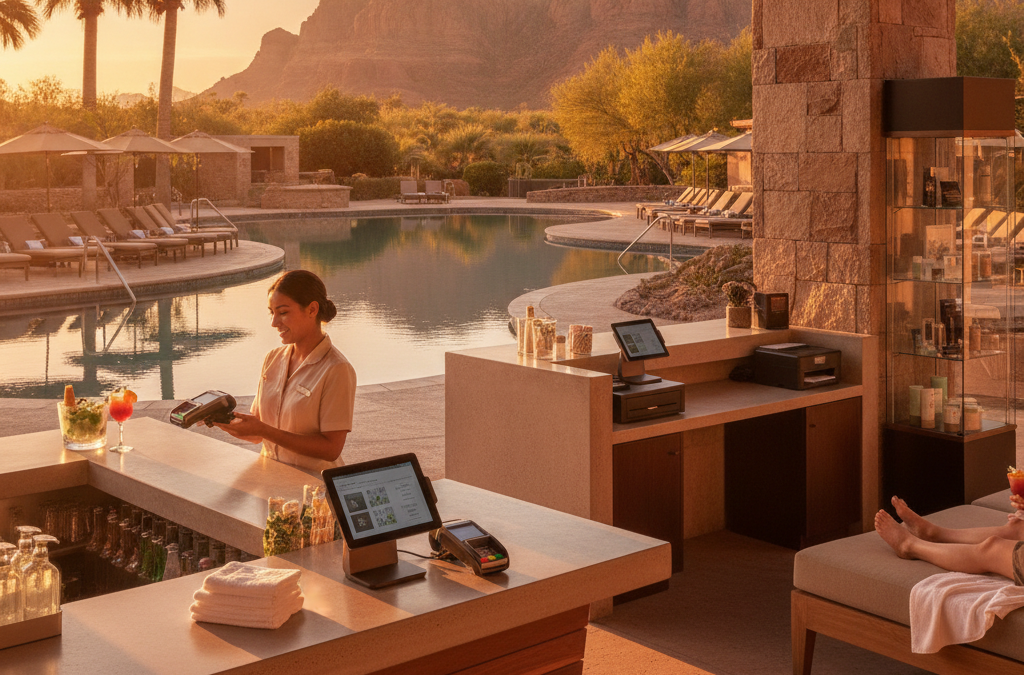
If your property has food and beverage service, those points need their own payment infrastructure. Wireless terminals or mobile POS devices work well for poolside and outdoor service areas where running cable isn’t practical. For a more permanent restaurant setup, a full POS system with table management, tip adjustment, and kitchen routing makes more sense. The Clover family of POS systems is flexible enough to handle both — a Clover Station at the bar, a Clover Flex at poolside — all tied back to the same merchant account and reporting dashboard.
Spa and Retail
Spa services and on-property retail (gift shops, sundries) are typically separate revenue centers, but they should feed into the same consolidated reporting so you can see total property performance in one place. Whether you’re running a boutique gift shop at a Tempe extended-stay property or a full-service spa at a North Scottsdale resort, the payment setup should be consistent and centrally reported. Learn more about the Clover family of POS systems to see which device fits which department on your property.
Online Bookings, Virtual Terminals, and Card-Not-Present Transactions
A significant portion of hotel revenue comes in before a guest ever sets foot on your property — through your website, OTA platforms, or direct phone bookings. For direct bookings on your website, you need a payment gateway that integrates cleanly with your booking engine and processes card data securely. For phone reservations, a virtual terminal lets your front desk staff key in card numbers manually without needing a physical card present.
Both scenarios carry higher interchange rates and higher dispute risk than in-person swipes or taps — that’s just the nature of card-not-present processing. Your processor should be explaining this to you and helping you set up policies (clear cancellation terms, booking confirmations with cardholder authorization language) that protect you in a dispute. If your current processor hasn’t had that conversation with you, that’s a gap worth addressing.
What to Look for in a Local Merchant Services Partner for Your Property
- Experience with hospitality-specific MCC setup and hotel authorization workflows
- Clear explanation of interchange rates for card-not-present vs. card-present transactions
- Next-day or same-day funding without volume-triggered holds
- Integrated gateway options that connect with your PMS or booking system
- Transparent pricing with no long-term contracts — hospitality is already a contract-heavy industry; your processor shouldn’t add to that
- Someone who actually picks up the phone when your terminal goes down at 9 PM on a Friday during spring training weekend
That last point isn’t a joke. Hospitality never sleeps, and your payment support shouldn’t either.
Frequently Asked Questions
Can a small boutique inn in Scottsdale use Square or a basic reader for payment processing?
Technically, yes — but Square isn’t designed for hotel billing workflows. Pre-authorization holds, folio charges, and no-show fees don’t fit neatly into Square’s model, and their support for disputes in the hospitality category is limited. A dedicated merchant account set up correctly for hotel operations will serve you better and cost you less in the long run.
What is a pre-authorization hold and how does it affect my guests?
A pre-authorization is a temporary hold placed on a guest’s card at check-in to cover the estimated room charges plus incidentals. The hold reduces their available credit but doesn’t actually charge the card until checkout. If the hold is processed correctly under hotel authorization codes, it stays in place through the stay. Processed incorrectly, it can drop off early — leaving you exposed for unpaid charges.
How do I handle chargebacks from guests who dispute their stay charges?
Chargebacks in the hospitality industry often come from guests claiming services weren’t as described, disputing no-show fees, or simply not recognizing a charge from your property name on their statement. The best protection is documentation — signed registration cards, clear cancellation policies at time of booking, and itemized folios. Your processor should be helping you understand what evidence to retain for disputes, not just processing transactions and leaving you to figure it out.
Can a resort in Phoenix or Scottsdale use a cash discount or surcharge program?
Yes, and for high-volume properties it can represent meaningful savings. A properly implemented surcharge or cash discount program passes card processing costs to guests who pay by card, while cash-paying guests get a discount. There are compliance rules around how this is disclosed and applied — a local specialist can walk you through whether it’s appropriate for your property and how to implement it correctly. See how Zero Cost Processing works for Arizona businesses.
Does my property management system (PMS) need to integrate with my payment processor?
For anything larger than a very small inn, yes — integration between your PMS and payment gateway significantly reduces manual entry errors, speeds up checkout, and makes reconciliation much cleaner. Most modern PMS platforms support payment gateway integration, and the CardPointe platform connects with a wide range of them. Ask your processor specifically whether they support your PMS before signing anything.
Ready to Get Your Hotel or Resort Set Up the Right Way?
Whether you’re running a boutique inn in Old Town Scottsdale, a resort property in Paradise Valley, an extended-stay hotel in Mesa or Chandler, or a vacation inn near Tempe’s ASU corridor, Good Payments Merchant Services can set you up with a hospitality-appropriate payment processing solution — no long-term contracts, no hidden fees, and with someone local you can actually reach when something comes up.
Reach out through our contact page to request a free rate analysis and a conversation about what the right setup looks like for your property. We’re based in Scottsdale and we know the Valley — seasonality, tourism swings, and all.