


How Should a Scottsdale or Phoenix Food Truck Owner Set Up Payment Processing?
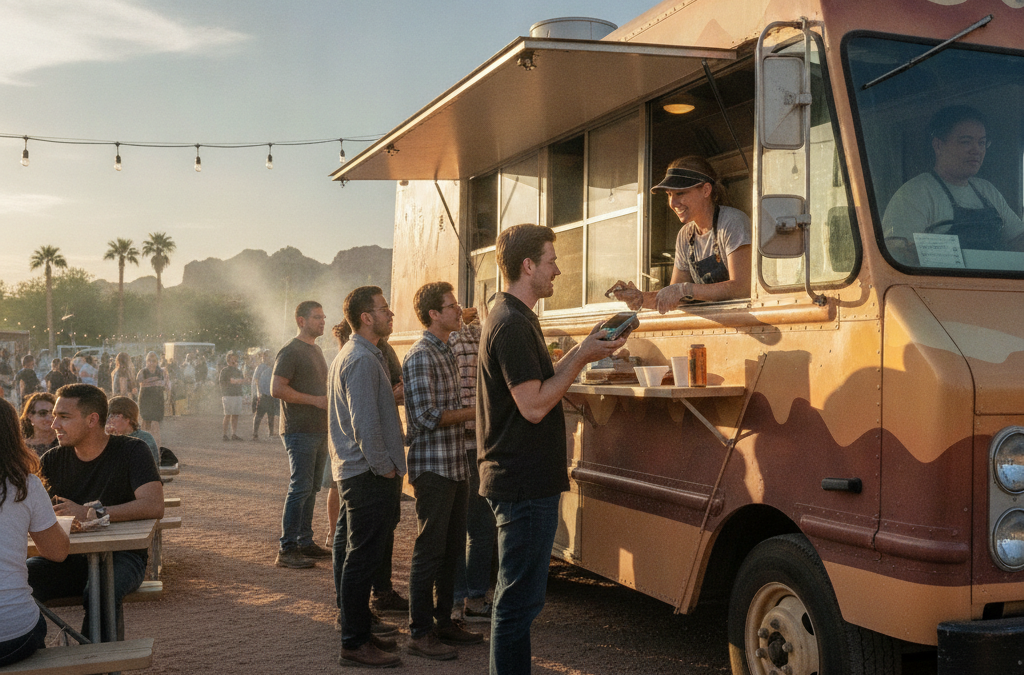
If you’re running a food truck in Scottsdale, Phoenix, or anywhere across the Valley of the Sun, your payment setup needs to work fast, stay reliable in the Arizona heat, and keep up with your schedule — whether you’re parked at a Tempe brewery lot on a Wednesday night or slammed at the Chandler Jazz Festival on a Saturday afternoon. The short answer: you need mobile payment hardware that processes offline when connectivity drops, rates that don’t eat into already-tight margins, and a local support person you can actually reach when something goes wrong at lunch rush. This guide walks you through exactly how to build that setup.
Why Food Trucks Have Unique Payment Processing Needs
Food trucks aren’t just small restaurants — they’re a completely different operating model. You’re moving between locations, working outdoor events, dealing with spotty WiFi at private venues, and handling a high volume of small-dollar transactions in a short window of time. That combination creates specific problems that a generic merchant account or a basic Square reader won’t always solve cleanly.
Across Maricopa County, the food truck scene has exploded over the last several years. Old Town Scottsdale, Gilbert’s Heritage District, the streets around Arizona State University in Tempe, and Mesa’s food truck parks all see heavy traffic. More trucks means more competition — and that means your payment experience at the window matters more than ever. A slow reader, a declined tap, or a terminal that’s offline at the wrong moment costs you sales and frustrates customers who already waited in line.
The Hardware Question: What Device Actually Works for a Food Truck?
This is where most food truck owners start — and where a lot of them end up with the wrong tool. The most important things to look for in a food truck payment terminal are battery life, connectivity options, and durability. You’re not in a climate-controlled store. You’re in a 110-degree Phoenix summer, and your terminal needs to hold up.
Here’s a practical breakdown of the main options:
- Clover Flex: A handheld all-in-one device that runs on WiFi or 4G/LTE, accepts chip, swipe, tap, and contactless payments, and has a built-in receipt printer. For food trucks doing moderate to high volume, this is often the best fit. It also integrates with inventory and reporting tools through the Clover App Market. See the full Clover device lineup here.
- Clover Go: A compact Bluetooth card reader that pairs with your phone or tablet. It’s lightweight and low-cost, making it a smart backup or a solid starting point for a newer truck with lower daily volume.
- Wireless terminals: If you want something more traditional — a dedicated terminal rather than a smart device — a 4G wireless terminal with store-and-forward capability is a strong choice. These connect over cellular rather than relying on event WiFi that may or may not be reliable.
The Connectivity Problem Nobody Talks About — And How to Solve It
Here’s a gap that most competitor websites either gloss over or skip entirely: what happens when your internet connection drops mid-service?
At an outdoor festival in Phoenix or a private corporate event in North Scottsdale, you’re often dependent on event WiFi that’s shared with hundreds of other vendors and thousands of attendees. It gets saturated fast. If your payment terminal can’t handle that, you’re either turning customers away or manually taking down card numbers — neither of which is a good situation.
The solution is store-and-forward processing (sometimes called offline mode). This feature lets your terminal accept and store transactions locally when there’s no connectivity, then batch and transmit them automatically once the connection is restored. Not every terminal or processor supports this, so it’s worth asking about specifically before you sign anything.
Cellular-connected terminals — running on 4G or 5G — are another strong option for this exact reason. Instead of relying on venue WiFi at all, you’re using your own dedicated data connection. For food trucks that move around frequently or work events across Maricopa County, that independence is worth a lot. Learn more about wireless and mobile payment options here.
Why Square Alone May Not Be Enough for a Busy Truck
Square is where a lot of food truck owners start, and it makes sense — it’s easy to set up and there’s no upfront cost. But as your truck grows, Square’s limitations start to show. The flat-rate pricing (2.6% + $0.10 per swipe, or more for keyed transactions) adds up fast on high-volume days. Their customer support is largely automated, which is a problem when your reader won’t connect at 11:45 AM on a busy Friday. And if your account gets flagged or frozen for any reason, resolution can take days.
A local merchant services provider offers something Square simply can’t: a real person who knows your account. If something breaks the morning of a big catering event in Chandler, you want to be able to call someone who picks up the phone — not submit a support ticket and hope for a same-day response.
Cash Discount and Zero Cost Programs for Food Trucks
Food trucks typically run on thin margins. Food cost, fuel, commissary fees, permits, staff — it adds up fast. Processing fees can feel like another cut of every sale you already barely made enough on.
A zero cost processing or cash discount program can change that math significantly. Under a properly structured cash discount program, customers who pay with cash receive a small discount, while card-paying customers pay a slightly higher listed price that offsets the processing cost. Done right and disclosed correctly, this is completely legal and increasingly common across the Valley — you’ll see it at food trucks, pop-ups, and quick-service spots from Mesa to Gilbert to Phoenix.
For food trucks specifically, this model works well because transactions are small and frequent. Eliminating or significantly reducing processing fees on those transactions can put real money back into your pocket at the end of a weekend event. See how zero cost processing works for small businesses.
What About Seasonal Volume Swings?
Phoenix-area food truck operators know the calendar matters. Snowbird season — roughly October through April — brings heavy foot traffic to Old Town Scottsdale, outdoor events throughout the East Valley, and festivals across the metro. Summer is a different story: it’s slower, hotter, and sometimes you’re leaning on private events, corporate catering, and indoor locations to keep revenue steady.
Your payment setup should account for that flexibility. You don’t want to be locked into a long-term contract or high monthly minimums that hurt you during slower months. Look for a processor with no long-term contracts, straightforward month-to-month pricing, and the ability to scale up or down as your volume changes.
What to Ask Before You Sign Up with Any Processor
- Does the terminal support offline or store-and-forward processing?
- What connectivity options does the device support — WiFi only, or 4G/5G cellular as well?
- Is there a long-term contract, and what are the early termination terms?
- What are the actual interchange fees and markup structure — not just the headline rate?
- Do you offer a zero cost or cash discount program, and how is it structured?
- What’s your support process if my terminal fails during a busy service?
- How quickly do funds deposit into my account?
Frequently Asked Questions: Food Truck Payment Processing in Scottsdale and Phoenix
Can I use a mobile card reader if I don’t have reliable WiFi at my location?
Yes — and you should plan for exactly that. A 4G or 5G cellular terminal eliminates your dependence on venue WiFi entirely. Store-and-forward processing is also a good safety net if you’re in an area with spotty coverage. Ask your processor specifically about both options before signing up.
Is Square a good long-term solution for a food truck in the Phoenix metro?
Square works fine as a starting point, but its flat-rate pricing gets expensive as your volume grows. It also lacks the local support and contract flexibility that most growing food truck operators eventually need. A local merchant services provider can often beat Square’s effective rate once you factor in monthly volume.
What’s the best POS device for a high-volume food truck at a festival?
The Clover Flex is a popular choice — it’s handheld, has a built-in printer, runs on cellular, and handles chip, tap, and swipe payments. For higher-volume operations with multiple service windows, you might also consider a Clover Mini at a fixed window paired with a Flex for walk-up service.
Can a food truck in Arizona legally pass processing fees to customers?
Yes, with proper disclosure. A cash discount program — where cash customers receive a small discount off the posted price — is legal and widely used across Arizona. A surcharge program, where a fee is added to card transactions, is also legal in Arizona with proper disclosure at the point of sale. Your processor should walk you through the compliance requirements before you implement either.
How fast will I receive funds from card transactions?
Most merchant accounts through Good Payments offer next-day funding for transactions settled before the daily cutoff time. Some qualifying accounts can receive same-day funding. Compare this to some processors that hold funds for 2–3 business days, which can create real cash flow problems for a food truck operator covering weekly commissary and supply costs.
Ready to Set Up Payment Processing for Your Food Truck?
Whether you’re just launching your first truck in Scottsdale or expanding to private events and catering across the Phoenix metro, Good Payments Merchant Services can help you find the right hardware, pricing structure, and support setup for the way you actually operate. No long-term contracts, no surprise fees, and a local rep you can actually reach when it matters. Reach out today for a free rate analysis and equipment consultation.