How Should a Scottsdale or Phoenix Farmer’s Market Vendor or Craft Fair Seller Set Up Payment Processing?
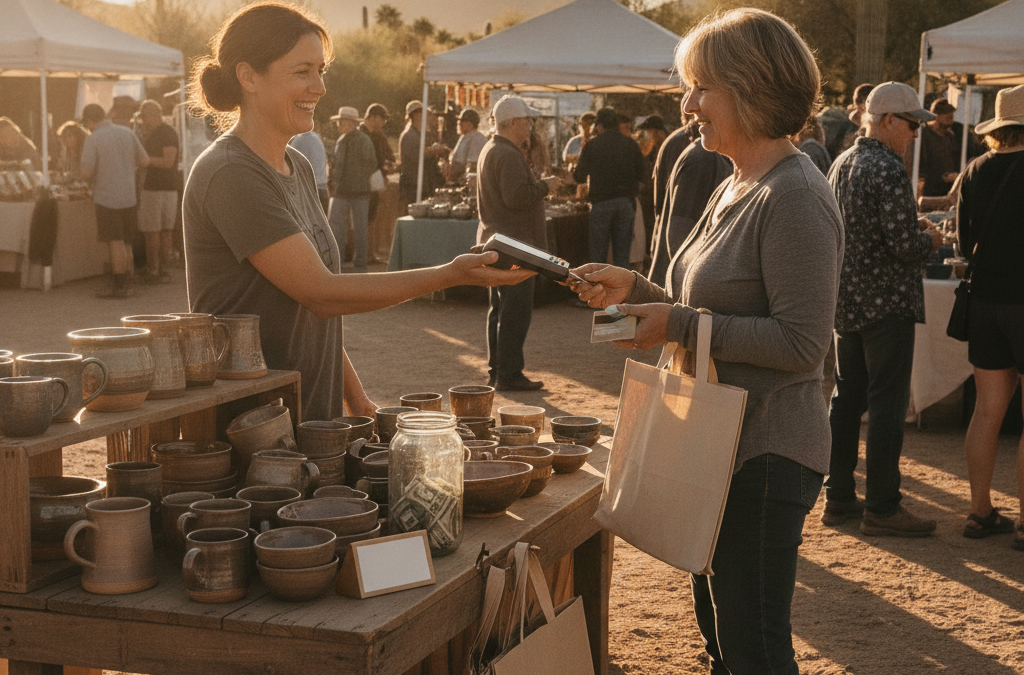
If you sell handmade goods, fresh produce, baked items, art, or anything else at farmer’s markets or craft fairs in Scottsdale or the broader Phoenix metro, here’s something you already know: customers rarely carry cash anymore. Whether you’re set up at the Old Town Scottsdale Farmers Market on a Saturday morning, the Gilbert Farmers Market, or a pop-up art fair in Tempe or Chandler, the vendors who accept cards consistently outsell the ones who don’t. The question isn’t whether to take cards — it’s how to do it in a way that actually makes sense for a small, event-based business.
This guide is written specifically for market and craft fair vendors across Maricopa County who want a reliable, affordable payment setup without overpaying in fees or getting locked into equipment and contracts that don’t fit the way they work.
Why Your Payment Setup Matters More Than Most Vendors Realize
Most vendors selling at outdoor events start with whatever is easiest — usually a consumer app they downloaded in five minutes. That’s understandable. But once you’re doing consistent volume at markets across the Valley, those quick-start solutions often cost you more than you think, and they create real problems when things go wrong on a busy Saturday.
Here are the situations that trip up event vendors most often:
- No cell signal, no sale. Outdoor markets — especially in areas like Cave Creek, Fountain Hills, or the edges of North Scottsdale — can have spotty LTE coverage. If your reader requires a live connection to process, you’re dead in the water when signal drops.
- Account holds and freezes. Consumer-facing apps like Venmo, Cash App, or even early-stage Square accounts flag sudden spikes in card volume. If you have a great weekend at a holiday craft fair and run $3,000 in sales you don’t normally see, some processors will freeze your funds while they “review” the activity.
- Flat-rate fees add up fast. A 2.6% + $0.10 flat rate sounds simple, but on $5,000 in monthly market sales, that’s $140 or more going straight to fees — every single month.
- No receipt options or inventory tracking. Tapping a dongle is fine for one-off sales, but if you sell multiple SKUs — say, different sizes of a product, different flavors, or tiered pricing — you need something that helps you track what sold and what didn’t.
What Actually Works for Outdoor and Event Vendors in the Phoenix Metro
The good news is that there’s no shortage of options. The key is matching the right hardware and account type to how you actually operate. Here’s how to think through it.
Mobile Readers with a Real Merchant Account
A dedicated merchant account — as opposed to a shared aggregator account like you get with consumer apps — gives you your own underwritten processing account. That means your funds aren’t pooled with millions of other users, your risk of a freeze is dramatically lower, and you typically get access to better pricing on interchange-plus or tiered rate structures.
Pair that with a compact mobile reader and you have a serious setup that fits in a small market bag. The Clover Go is a good example — it connects via Bluetooth to your phone or tablet, accepts chip, tap, and swipe, and works with a real merchant account behind it. You get receipts, basic reporting, and the reliability of a business-grade payment platform rather than a consumer app.
Wireless Terminals with Store-and-Forward
If you do higher volume — say, you’re running a busy booth at a large craft fair in Mesa or a holiday market that draws serious crowds — a dedicated wireless terminal gives you more flexibility. Many modern terminals support store-and-forward, which means if your connection drops, the terminal holds the transaction locally and submits it automatically when signal is restored. That’s a meaningful feature for outdoor events where WiFi is inconsistent.
Check out the wireless and mobile terminal options for a look at what fits different vendor setups. Some vendors also use a small Clover Flex, which functions as a full POS device in a handheld form factor — inventory, receipts, tipping, and reporting all in one unit you can hold in your hand or set on your booth table.
Cash Discount Programs for Market Vendors
This is one of the most underused tools for farmer’s market and craft fair vendors, and almost no local competitor has covered it from the event vendor angle. A cash discount program works by building the cost of card acceptance into your posted price and offering a small discount to customers who pay with cash. Done correctly, it’s fully compliant and can effectively bring your card processing cost to near zero.
For a vendor selling handmade goods or specialty foods, this can make a real difference — especially during the busy snowbird season (roughly October through April) when market attendance spikes and your card volume goes up accordingly. You’re not penalizing card users; you’re giving cash customers a small break, which is a distinction that matters for compliance and customer perception. Learn more about how this works on the Zero Cost Processing page.
What the Big Platforms Don’t Tell You
Square is the default recommendation you’ll find in most Facebook groups and vendor forums, and it’s not a bad starting point. But there are some real limitations worth knowing if you’re a serious market vendor:
- Square’s flat rate doesn’t adjust for card type. A business rewards card costs you the same as a basic debit card — even though the actual interchange is very different. With interchange-plus pricing through a dedicated processor, you pay closer to the actual cost of each transaction.
- Square holds more authority over your account than most vendors realize. If their automated systems flag something unusual, funds can be held for days or longer with minimal recourse.
- Square’s offline mode has improved, but it comes with limits and doesn’t guarantee approval — it just queues the transaction and hopes it clears.
None of that means Square is unusable. For a vendor just starting out with low volume, it can work fine. But as your business grows — especially if you’re doing multiple markets a week across Scottsdale, Gilbert, and Chandler — you’ll likely outgrow it.
Practical Questions to Ask Before You Pick a Setup
- How many markets do I do per month, and what’s my average monthly card volume? This determines whether flat-rate pricing or interchange-plus makes more financial sense for you.
- Do I have reliable cell coverage at my markets? If not, offline processing capability is non-negotiable.
- Do I need inventory tracking or just a simple tap-and-go reader? The more SKUs you carry, the more a basic reader is going to frustrate you.
- Am I going to be doing this long-term, or is this seasonal? Snowbird season brings huge foot traffic to Phoenix metro markets from roughly October through April. If you’re operating year-round, you want a setup built for it.
- Is there a long-term contract? There shouldn’t be. Any local processor worth working with — and Good Payments Merchant Services specifically — does not require long-term contracts.
Frequently Asked Questions
Can I use my phone as a payment terminal at a Scottsdale farmer’s market?
Yes — with the right reader and merchant account, your phone can function as a full point-of-sale device. You’ll need a Bluetooth-connected card reader (like a Clover Go) paired with a real merchant account, not just a consumer payment app. This gives you business-grade processing with access to proper support if something goes wrong.
What happens if I lose cell signal mid-market in a spot like Cave Creek or Fountain Hills?
If you’re on a terminal or device with store-and-forward capability, the transaction is saved locally and submitted automatically when your connection returns. Not all readers support this — it’s worth confirming before you buy or sign up for any processing solution.
Is Square really free for small vendors, or are there hidden costs?
Square doesn’t charge a monthly fee on its base plan, but the flat-rate transaction fees (typically 2.6% + $0.10 for in-person payments) add up quickly on higher volume. There are also costs for advanced features, hardware, and premium plans. For vendors doing consistent volume, a dedicated merchant account with interchange-plus pricing is usually cheaper overall.
Can I offer a cash discount at my booth without confusing customers?
Yes — many vendors across the Valley do this successfully. The key is clear signage at your booth showing your standard price and the cash discount price. When it’s communicated transparently, most customers take it in stride. A compliant cash discount program can dramatically reduce or eliminate your processing costs.
Do I need separate payment processing for each market or event I attend?
No. One merchant account and one mobile reader travels with you to every event — whether that’s a weekly market in Gilbert, a one-time holiday craft fair in Chandler, or a pop-up at a venue in Old Town Scottsdale. Your account and processing rate stay the same regardless of where you sell.
Ready to Get Set Up the Right Way?
Whether you’re a first-time market vendor trying to figure out your first card reader, or you’ve been selling at Valley events for years and you’re tired of losing money to flat-rate fees, Good Payments Merchant Services can help you find a setup that actually fits how you work. No long-term contracts, no runaround, and a real person — Zoltan Hardi — who picks up the phone when you have a question on a busy Saturday morning.
Reach out for a free rate analysis and let’s figure out what makes sense for your business. Contact us here or give us a call at (480) 745-0981.