How Should a Scottsdale or Phoenix Brewery, Winery, or Distillery Set Up Payment Processing?
If you run a craft brewery, winery, or distillery in Scottsdale or anywhere across the Phoenix metro, you already know your business doesn’t fit neatly into one category. You’re part bar, part retail shop, part manufacturer — and on busy weekends, maybe part event venue too. Your payment processing setup needs to be just as flexible. A generic setup built for a coffee shop or a nail salon isn’t going to cut it. This guide breaks down exactly what to look for and what to avoid so you’re not overpaying or stuck with a system that slows down a packed taproom on a Saturday afternoon.
Why Craft Beverage Businesses Have Unique Payment Needs
Breweries, wineries, and distilleries in the Valley tend to run several revenue streams at once — taproom pours and flights, to-go bottle or can sales, merchandise, online wine club or bottle club subscriptions, event ticketing, and sometimes wholesale orders to restaurants and retailers. Each of those revenue streams ideally runs through a payment setup that keeps things organized and doesn’t charge you a different rate every time the transaction type changes.
The craft beverage scene here has grown considerably over the past few years, from established spots in Tempe and Chandler to newer operations out in Cave Creek, Peoria, and North Scottsdale. Some of Arizona’s most popular breweries and tasting rooms are right along the Loop 101 corridor, pulling in both locals and visitors during snowbird season — which means high-volume months where your system absolutely cannot afford downtime or complicated checkout flows.
Most of the competitor processors serving the Phoenix area don’t address craft beverage businesses specifically. You’ll find plenty of generic restaurant and retail content, but nothing that accounts for the hybrid nature of a taproom — where you might need tableside ordering and tipping features in one part of the room, and a straight retail checkout counter in another. That’s the gap we’re filling here.
The Right POS Setup for a Taproom or Tasting Room
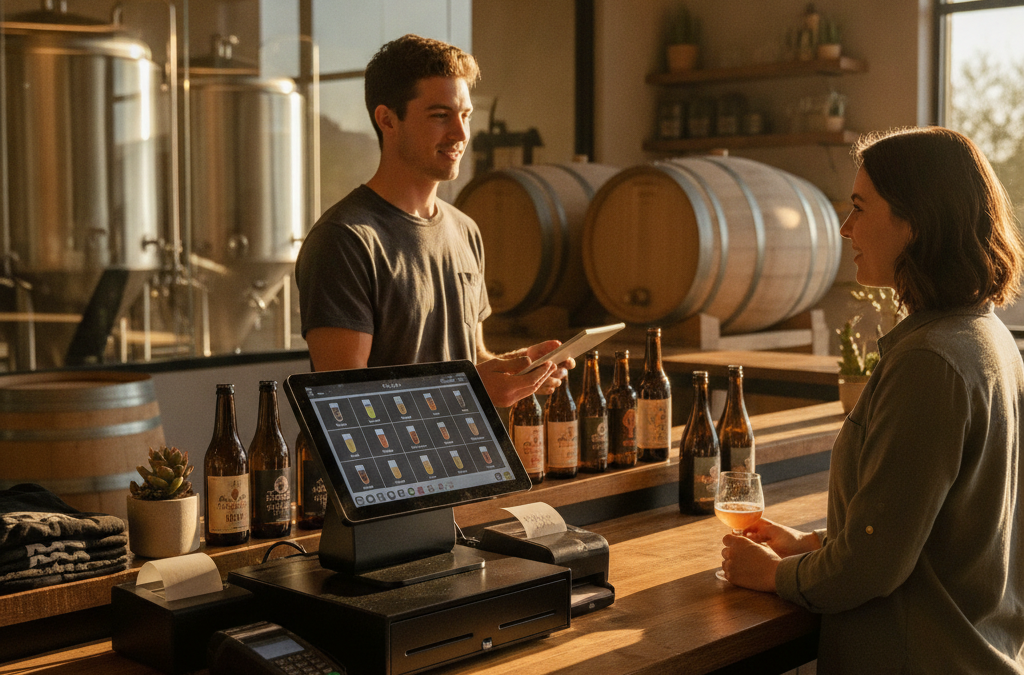
Your taproom is fundamentally a food-and-beverage operation, which means you need a POS that handles open tabs, table or seat assignments, tip prompts, and fast order entry. The Clover POS family is a strong fit for this environment. Here’s how to think about which device makes sense where:
- Clover Station: A full countertop setup with a customer-facing display — ideal for your main bar or tasting counter where staff are ringing up flights, merchandise, and bottle sales all from one spot. It handles high transaction volume cleanly and supports the Clover App Market for add-ons like tip management and loyalty programs.
- Clover Mini: A compact touchscreen terminal that works well as a secondary station or in a smaller taproom with limited counter space. If you run a satellite retail area selling merchandise alongside your bar, a Mini keeps lines from backing up.
- Clover Flex: A handheld device that’s perfect for tableside or patio service. If your outdoor space fills up during the cooler months — and in Scottsdale and Gilbert, those patio months are prime season — your staff can take orders and process payments tableside without making guests walk to the bar.
All of these devices support EMV chip, tap-to-pay, and swipe. They also integrate with inventory tracking, employee clock-in/clock-out, and real-time sales reporting, which matters when you have part-time pouring staff and need to track who sold what on a given shift.
Handling Online Sales: Wine Clubs, Bottle Clubs, and Subscriptions
If you sell wine, spirits, or beer online — or run a monthly club where members pay recurring fees — you need more than just a taproom terminal. You need an e-commerce or virtual terminal setup that handles recurring billing cleanly and keeps cardholder data secure.
ACH payments are worth serious consideration here. Bank-to-bank transfers carry much lower fees than card transactions, and for predictable monthly club charges, they make a lot of sense. A wine club member who signs up for a quarterly shipment is exactly the kind of recurring billing scenario where ACH can save you real money over time compared to running a card every cycle. It’s one of the more underused tools in the craft beverage world, and most processors don’t bring it up unprompted.
For online bottle sales and club sign-ups, you’ll want a proper payment gateway integrated into your website — not just a PayPal button or a bolted-on plugin that creates headaches during peak ordering periods. A good setup includes tokenization, which means customer card data is stored securely so repeat purchases are frictionless without putting you at compliance risk.
Zero Cost Processing: Worth Considering for High-Volume Taprooms
Credit card processing fees add up fast in a high-volume taproom. If you’re running a busy weekend and processing thousands of dollars in card transactions, you’re handing a meaningful percentage of that revenue to your processor. A Zero Cost Processing program — either a cash discount or a compliant surcharge program — lets you pass that cost to customers who pay by card, while offering a lower price to cash-paying customers.
This is increasingly common in the Valley’s craft beverage scene, especially among smaller operations in Mesa, Chandler, and Cave Creek where margins are thinner. Done correctly and disclosed properly, it’s a legal and transparent way to protect your bottom line. It’s not right for every business — some taprooms prefer the customer experience of flat, card-friendly pricing — but it’s worth having a real conversation about the numbers before you decide.
Wholesale and B2B Payments: Don’t Overlook ACH
If your brewery or distillery sells wholesale to restaurants, bars, or retailers across Maricopa County or beyond, you’re probably used to invoicing on net terms and chasing checks. ACH payment processing is a cleaner alternative — you can send invoices and collect payment electronically, directly from your buyer’s bank account, at a fraction of the cost of a card transaction. For larger wholesale orders, that fee difference is significant.
The CardPointe Suite handles this well, including cloud-based invoicing and multi-location reporting that’s useful if you eventually expand to a second taproom or distribution point. You can track revenue across locations from one dashboard, which matters as more Valley craft beverage businesses start thinking about growth.
What to Avoid: Generic National Setups That Don’t Fit Your Operation
Square is popular for a reason — it’s easy to start with. But if you’re running a serious taproom with tableside service, open tabs, inventory tied to your barrel program, and an online club, you’ll hit the ceiling of what Square can do. It’s also a flat-rate model, which means you pay the same percentage whether a customer taps their debit card or puts a $500 case on a premium rewards card. As your volume grows, that flat rate gets expensive.
Toast is built for restaurants and has strong hospitality features, but it locks you into their proprietary hardware and longer contracts. If your concept evolves — say you start doing private events or want to add an outdoor retail kiosk — you may find yourself constrained by what Toast allows within its ecosystem.
What most Scottsdale and Phoenix craft beverage businesses actually need is a processor who picks up the phone, understands the hybrid taproom model, and sets you up with equipment and rates that fit — without locking you in. No long-term contracts. No surprise fees six months in. Free equipment on qualifying plans. That’s the kind of setup worth asking about.
Frequently Asked Questions
Can a brewery in Scottsdale or Phoenix use the same POS for the bar and the retail bottle shop?
Yes — with the right system. Clover, for example, lets you set up different order types and product categories on the same account, so your bartender and your retail counter can both run from the same reporting dashboard. You can also assign different tax rates if your state requires different handling for on-premise versus off-premise sales.
Is alcohol retail considered high-risk for payment processing?
Standard taproom and tasting room sales are generally processed as normal retail or restaurant transactions and aren’t considered high-risk by most processors. Where it gets more complex is if you’re doing significant online direct-to-consumer alcohol shipping — some processors and card networks are more cautious there depending on state compliance. It’s worth discussing your specific business model upfront so there are no surprises.
How should a winery in North Scottsdale handle wine club billing?
The cleanest setup is a combination of a secure payment gateway for card-on-file recurring charges and ACH for members who prefer bank transfer. Both options reduce the friction of manual invoicing, and tokenized card storage keeps you PCI compliant without requiring members to re-enter their information every cycle.
What’s the best mobile payment option for a distillery doing off-site events or markets?
A wireless terminal or the Clover Flex with a 5G or WiFi connection is your best bet. Look for store-and-forward capability, which lets the device queue transactions if you temporarily lose signal — useful at outdoor events across the Valley where connectivity can be spotty. See the wireless and mobile payment options available through Good Payments for specifics.
Are there long-term contracts required for craft beverage businesses?
Not with Good Payments. Month-to-month agreements, no early termination fees, and free equipment on qualifying plans — those are standard here. If you’ve been burned by a prior processor that locked you in and then changed rates on you, that experience is unfortunately common in the Phoenix area, and it’s exactly what we’re set up to be an alternative to.
Ready to Set Up the Right Payment System for Your Brewery or Winery?
Whether you’re pouring flights in Old Town Scottsdale, running a tasting room in Cave Creek, or growing a wholesale operation out of Gilbert, Good Payments Merchant Services can help you build a payment setup that actually fits how your business runs. You’ll work directly with Zoltan Hardi — a local specialist, not a call center — and you’ll get a straight answer on rates, equipment, and whether a cash discount program makes sense for your volume.
Reach out today for a free rate analysis and consultation. There’s no pressure and no obligation — just a real conversation about what’s going to work best for your operation. Contact Good Payments Merchant Services here and let’s talk through your setup.