
How Should a Scottsdale or Gilbert Personal Chef, Meal Prep Service, or Private Dining Business Set Up Payment Processing?
If you run a personal chef service, weekly meal prep operation, or private dining business in Scottsdale or Gilbert, you already know your payment situation is more complicated than a typical restaurant. You’re collecting deposits weeks in advance, billing weekly subscription clients, accepting payment in someone’s kitchen, and occasionally invoicing corporate clients for large private events. That combination doesn’t fit neatly into any one tool — and most processors never bother to explain how to piece it together properly. Here’s a straightforward breakdown of what actually works for businesses like yours.
Why Generic Payment Setups Don’t Work for Personal Chefs and Meal Prep Services
Most payment processors are designed with a simple transaction in mind: customer shows up, swipes a card, done. Your business doesn’t work that way. You might bill a Gainey Ranch client weekly for their meal plan, collect a 50% deposit from a DC Ranch household booking a private dinner party, and send an invoice to a North Scottsdale corporate office for a catered lunch. Those are three completely different payment types — and using a single Square reader taped to your phone doesn’t cut it for all three.
The other problem is that generic platforms like Square hold funds when they see unusual transaction patterns. A $1,200 charge from a new client for a private chef event looks suspicious to an algorithm that’s used to seeing $15 coffee transactions. Fund holds or sudden account terminations are real risks when your transaction profile doesn’t fit a standard retail mold.
Working with a local payments specialist who actually understands your business model — and can set you up with the right combination of tools — saves you from those headaches.
The Core Payment Scenarios You Need to Cover
1. Recurring Weekly or Monthly Billing for Meal Prep Clients
If you’re delivering prepped meals to clients in Chandler or Gilbert on a weekly schedule, manual billing every week is a time drain and a source of awkward client friction. The right setup here is a virtual terminal with recurring billing capability — your client’s card gets securely stored (tokenized) and charged on your schedule automatically. You get predictable cash flow; they don’t have to do anything after the initial setup.
Virtual terminals and e-commerce solutions through Good Payments support recurring billing with proper tokenization, so card data is never sitting exposed in your files. This is the kind of feature that most competitors skim over, but it’s fundamental for a subscription-style meal prep operation.
2. Deposits and Final Payments for Private Events
Private dining and personal chef bookings in Paradise Valley or North Scottsdale often involve high-ticket totals. A typical private dinner for eight might run $800 to $2,000 or more. Collecting a deposit upfront protects you; collecting the balance the day of the event is standard. You need a system that handles both cleanly — ideally with a virtual terminal you can access from your phone or laptop to send a payment link, and a mobile reader you can bring on-site for the final charge.
3. On-Site Card Collection in a Client’s Home
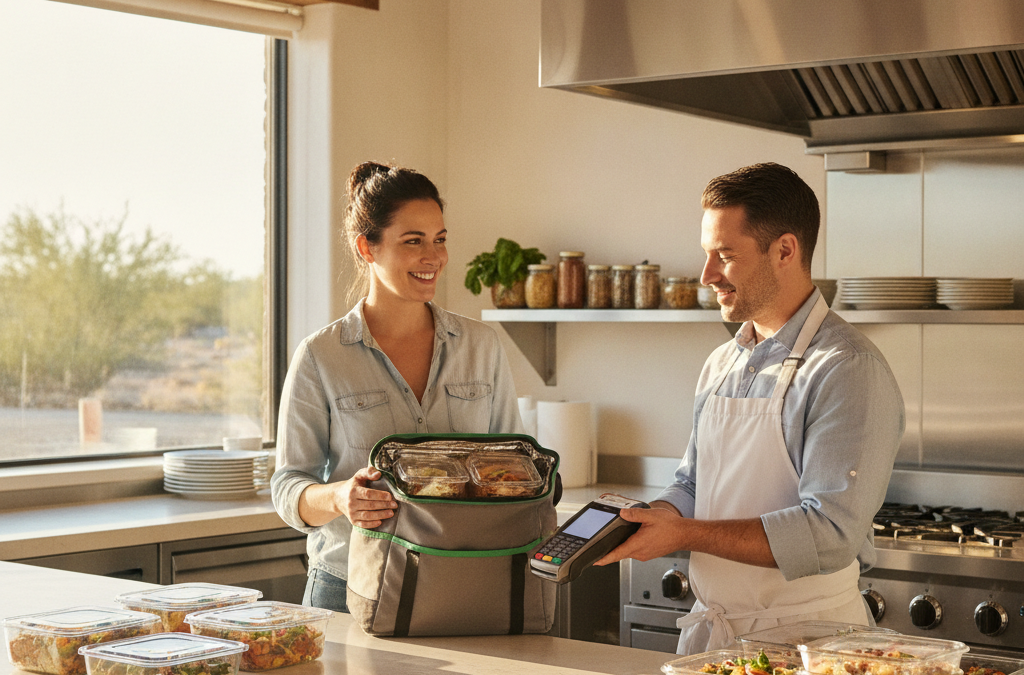
You’re not going to carry a countertop terminal into someone’s kitchen. What you need is a compact, reliable mobile reader that works over WiFi or 5G, with a solid offline store-and-forward mode for those older Scottsdale homes with spotty connectivity. The Clover Flex or a wireless mobile terminal handles this well — it’s small, professional-looking, and accepts chip, tap, and swipe.
4. ACH for Larger or Recurring B2B Invoices
If you’re billing a Maricopa County business or corporate account for regular catered lunches or executive meal plans, ACH bank-to-bank transfers are worth considering. The fees are significantly lower than card processing on larger ticket amounts, and many businesses prefer paying recurring invoices via ACH anyway. A good merchant account setup includes ACH as an option alongside card processing, so you’re not leaving money on the table for your higher-volume B2B work.
What the Snowbird Season Means for Your Cash Flow
This one’s specific to the Phoenix metro and something national processors never think about. Snowbird season — roughly October through April — drives real demand for private chef services across Scottsdale, Paradise Valley, and the surrounding communities. Seasonal residents want home-cooked meals and private dining experiences without the hassle of restaurants. That means your booking volume and average ticket size can spike significantly in the fall and taper off through the summer months.
If you’re on a payment platform that holds funds or flags unusual volume spikes, you could get caught during your busiest period. A properly structured merchant account with a local processor who knows your business handles seasonal swings without issue. It’s also a good time to think about locking in clients on recurring billing plans before the season starts, so your cash flow stays predictable even when individual bookings fluctuate.
Should You Use a Cash Discount or Surcharge Program?
Processing fees on a $1,500 private chef booking add up fast. A cash discount or surcharge program lets you pass the cost of card acceptance on to clients who pay by card, while offering a slight discount to cash-paying clients. For a personal chef business, where most transactions are planned in advance (not impulse purchases), this can work reasonably well — clients are usually fine with it as long as you communicate it upfront.
There are compliance rules around surcharge programs that vary by state, and Arizona has its own considerations. A program that’s set up correctly protects you; one that’s slapped on without proper disclosure creates problems. Good Payments sets up these programs the right way, with signage guidance and transparent client communication baked in. Learn more about how zero cost processing works for service businesses.
What to Look for in a Local Payment Processor
A few things matter specifically for personal chefs and meal prep operators in the Valley:
- No long-term contracts. Your business model may evolve. You shouldn’t be locked into a three-year agreement with a processor that doesn’t fit anymore.
- Recurring billing support. Not every processor offers this cleanly. Ask specifically whether the virtual terminal supports tokenized card storage and automated recurring charges.
- Honest underwriting. Some processors flag personal chef and private dining businesses as high-risk due to high ticket sizes and advance deposits. A good local processor will underwrite your account properly from the start so you don’t get funds held mid-season.
- Responsive support. If something goes wrong the night of a private dinner in DC Ranch, you need a real person you can call — not a chatbot.
- Transparent pricing. Know exactly what you’re paying per transaction and per month. No surprise fees buried in fine print.
Frequently Asked Questions
Can I store a client’s card on file and bill them automatically each week for a meal prep subscription?
Yes — this is exactly what a virtual terminal with recurring billing is built for. The card is tokenized (encrypted) so it’s stored securely, and you set up the billing schedule. Your client authorizes it once, and the rest is automatic. This is a core feature of the payment platforms Good Payments sets up for meal prep businesses in Scottsdale, Gilbert, and across the Valley.
What happens if a client disputes a charge after a private dinner event?
Chargebacks happen occasionally in any service business. The best protection is documentation — a signed service agreement, a clear deposit and cancellation policy, and email confirmation of the event. On the processing side, proper fraud and chargeback protection tools help you respond effectively to disputes. Good Payments walks clients through this during setup so you’re not scrambling when it happens.
Is Square a reasonable option for a personal chef business?
Square works fine for low-volume, simple transactions. But for a personal chef charging large deposits, running recurring billing, and processing high-ticket events, Square’s risk algorithms can create fund holds at inconvenient times. A dedicated merchant account through a local processor gives you more stability, better underwriting, and lower effective rates on higher-volume months.
Do I need a POS system, or is a virtual terminal enough?
For most personal chef and meal prep businesses, a virtual terminal plus a compact mobile reader covers the bases. A full POS system is more than you need unless you’re running a brick-and-mortar meal prep storefront. That said, something like a Clover Flex gives you a screen, a receipt printer, and card acceptance in one device — which works well if you want a more polished on-site payment experience.
How quickly can I get set up with a merchant account in Scottsdale?
Typically 24 to 72 hours once your application and basic business documents are in. Good Payments handles the setup locally, so there’s no waiting on a national call center. Same-day and next-day funding options are available on qualifying accounts.
Ready to Get Your Payment Setup Right?
Whether you’re a solo personal chef working the DC Ranch and Gainey Ranch circuit or running a growing meal prep operation out of Gilbert, the right payment setup makes your business run smoother and keeps more money in your pocket. Good Payments Merchant Services works directly with service-based food businesses across Scottsdale, Phoenix, and the East Valley to build payment setups that actually match how you work — no long-term contracts, no hidden fees, and a real person you can call when you have a question.
Reach out to schedule a free rate analysis and consultation: contact Good Payments here. We’ll look at what you’re currently paying (or planning to use), walk you through what actually makes sense for your business, and get you set up fast.