

What’s the Best POS System for a Food Truck in Phoenix or Scottsdale?
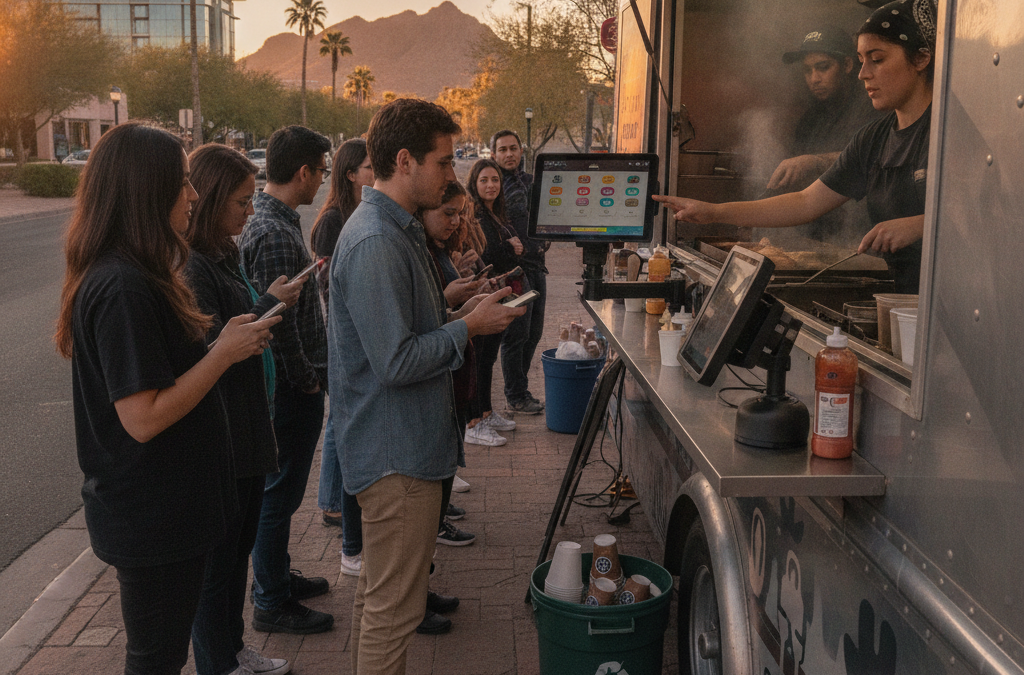
If you’re running a food truck in Phoenix or Scottsdale, the short answer is this: you need a mobile POS system that can handle heat, crowds, inconsistent WiFi, and a line of hungry customers who all want to pay differently. Most of the advice out there is written for brick-and-mortar restaurants — not for operators parked outside a brewery in Tempe on a Friday night or rolling into a corporate campus in Chandler at lunch. This guide is specifically for you.
Why Standard Restaurant POS Systems Don’t Cut It for Food Trucks
Systems like Toast are built for full-service restaurants with a fixed location, a dedicated internet connection, and a kitchen staff accustomed to table management workflows. That setup doesn’t translate to a 16-foot trailer. You don’t have a hardwired ethernet connection at every event. You’re not managing table turns — you’re managing a queue. And you probably don’t want to pay a monthly software fee that was priced for a sit-down establishment with 30 covers a night.
Square is the other name that comes up constantly. It’s easy to get started with, and for a vendor just testing the waters at a weekend market, it’s fine. But once your volume picks up, the flat-rate pricing starts to get expensive — and Square’s customer support is notoriously hard to reach when something goes wrong mid-service. If your card reader stops working at a packed Old Town Scottsdale event on a Saturday afternoon, you want to be able to call someone. Square doesn’t offer that.
The Real-World Challenges Food Trucks Face with Payments
Before picking a device, it helps to think about what actually goes wrong in the field. Here are the most common pain points food truck operators across the Valley bring up:
- Spotty WiFi and dead zones. Event venues, parking lots, and pop-up locations don’t always have reliable connectivity. If your POS can’t process offline, you’re turning customers away or taking cash only — and you lose sales.
- Heat. Phoenix summers are brutal. Consumer-grade tablets and card readers are not rated for sustained exposure to 110-degree weather. You need hardware built for commercial use.
- Speed. When there’s a line, every extra second at the window costs you. A slow POS — or one that requires too many taps to complete a sale — kills your throughput.
- Portability and battery life. You’re moving between locations. You can’t always plug in.
- Processing fees eating into thin margins. Food trucks already run tight margins. Paying 2.6% or more on every card swipe adds up fast, especially during busy snowbird season when volume spikes.
Which Devices Actually Work for Food Trucks?
When it comes to purpose-built mobile POS hardware, the Clover Flex and Clover Go are two of the most practical options for food truck operators in the Phoenix metro.
The Clover Flex is a handheld, all-in-one device with a built-in receipt printer, camera, barcode scanner, and a touchscreen display. It runs on WiFi or 4G/LTE, accepts chip, swipe, and contactless payments, and is designed for commercial use. For a food truck with moderate complexity — a menu with modifiers, employee login tracking, tip prompts — the Flex hits the sweet spot. It’s fast, durable, and gives you real reporting through the Clover dashboard that you can check from your phone between stops.
The Clover Go is a smaller card reader that pairs with a smartphone or tablet. It’s a good entry point if you’re just getting started or running a lower-volume operation — think a single-item concept or a vendor doing weekend markets in Gilbert or Mesa. It’s compact and affordable, but it has fewer built-in features than the Flex.
For operators who want to see how both options compare to their current setup, a quick free rate analysis is usually the fastest way to cut through the noise.
Offline Processing: The Feature Competitors Don’t Talk About Enough
This is one of the most important features for any mobile vendor in Maricopa County — and it’s one that most competitor websites barely mention. Store-and-forward processing allows your terminal to accept card payments even when the internet connection drops. The transactions are stored locally on the device and pushed through automatically once connectivity is restored.
This matters at events like food truck rallies, outdoor festivals, and private catering gigs where cell signal can be unpredictable. Not every mobile POS supports store-and-forward — and the ones that don’t will either decline the card or require you to collect manually and key it in later, which creates reconciliation headaches. When you’re evaluating any mobile payment solution, ask specifically: does this device process offline, and how does it handle reconciliation afterward?
The wireless and mobile terminals we set up for Valley food truck clients include WiFi and 5G connectivity options with offline capability built in — because in this market, you can’t afford to find out mid-rush that your connection dropped.
How a Cash Discount Program Can Save a Food Truck Real Money
Here’s something worth running the numbers on. If your food truck does $15,000 a month in card volume — which is conservative for a busy Scottsdale or Chandler location — you’re probably paying $375 to $500 a month in processing fees at standard rates. Over a year, that’s $4,500 to $6,000 out of pocket.
A properly structured zero cost processing program — either a cash discount or a surcharge program — passes that fee to the customer on card transactions while offering a small discount to cash-paying customers. Done right and disclosed clearly at the point of sale, it’s legal in Arizona and increasingly common across the Valley’s food truck and quick-service sector. Customers who pay cash get a break; customers who pay card cover the processing cost.
It’s not the right fit for every operator. If your average ticket is low and your customer base is price-sensitive, a surcharge can create friction. But for trucks serving corporate lunch crowds or tourist-heavy spots in Old Town Scottsdale, it’s worth a conversation. The savings can be significant.
What to Ask Before You Sign Anything
Whether you’re setting up your first food truck or switching from a processor that’s been overcharging you, here are the questions that matter:
- Is there a long-term contract, and what are the early termination fees?
- Does the hardware work offline, and how does store-and-forward reconciliation work?
- What are the actual processing rates — interchange-plus or flat rate? What’s included in the monthly fee?
- Who do I call when something breaks down at 11:30 a.m. on a Saturday?
- Can I get next-day funding so I’m not waiting days to access my sales?
These aren’t trick questions — they’re the baseline. Any processor who hedges on these or buries the answers in a contract you have to sign before getting a straight answer is one you should walk away from.
Frequently Asked Questions
Do I need a merchant account to accept card payments on my food truck?
Yes. Services like Square aggregate payments under their master account, which keeps setup simple but can lead to holds or freezes on your funds. A dedicated merchant account gives you more stability, better rates at volume, and actual recourse when something goes wrong.
Can I use a Clover device without a WiFi connection?
Clover Flex supports 4G/LTE connectivity in addition to WiFi, so you’re not dependent on a venue’s network. With the right mobile plan, you can operate independently anywhere in the Valley.
Is a cash discount program legal for food trucks in Arizona?
Yes. Cash discount and surcharge programs are legal in Arizona, provided you follow proper disclosure requirements — which means clearly posting the pricing at the point of sale. We walk every client through compliant setup before going live.
What happens to my POS if it overheats in the Arizona summer?
Consumer-grade tablets and readers have lower operating temperature thresholds and may throttle or shut down in extreme heat. Commercial POS hardware is rated for higher temps. Location matters too — keeping your terminal shaded and not leaving it in a closed truck helps extend its life significantly.
How quickly can I get set up with a new mobile POS?
For most food truck operators in the Phoenix metro, setup from approval to first transaction typically takes a few business days. We handle the application, hardware configuration, and walkthrough locally — you’re not on hold with a call center.
Ready to Set Up Payments That Actually Work for Your Truck?
Good Payments Merchant Services works with food truck operators across Scottsdale, Phoenix, Tempe, Glendale, Gilbert, Mesa, Chandler, and throughout Maricopa County. There are no long-term contracts, no bait-and-switch rates, and no runaround when you need help. Just straightforward mobile payment solutions built around how your business actually runs.
Reach out for a free rate analysis and equipment consultation — we’ll tell you exactly what you’d pay, what hardware fits your setup, and whether a zero cost processing program makes sense for your volume. Contact us here or call (480) 745-0981.