

How Should a Scottsdale or Phoenix Auto Repair Shop, Mechanic, or Tire Shop Set Up Payment Processing?
If you run an auto repair shop, independent mechanic bay, or tire shop in Scottsdale or anywhere across the Phoenix metro, your payment processing setup matters more than most business owners realize. Repair tickets often run several hundred to several thousand dollars, customers expect to pay by card or tap at pickup, and if you’re billing commercial fleet accounts, you may need ACH or invoicing tools on top of your counter terminal. Getting this right from the start saves you money on fees, reduces chargeback headaches, and keeps your checkout line moving when you’ve got four bays full and a lobby of waiting customers.
What Makes Auto Repair Payment Processing Different?
Automotive service is not a low-ticket, tap-and-go industry. A brake job in Chandler, a transmission service in Mesa, or a full set of tires in Gilbert can easily hit $800 to $2,500 or more — and those large average ticket amounts have a direct effect on your processing costs. When you’re paying a percentage on every transaction, a shop doing $80,000 a month in card volume is writing a significant check to its processor every month. That’s why the rate structure you negotiate, and the tools you use to run payments, make a real financial difference.
Beyond ticket size, auto repair shops also have to think about:
- Card-not-present transactions. Some customers authorize work over the phone before they come in, or you need to get approval remotely for additional repairs discovered mid-job. That’s a card-not-present transaction, and it carries a higher processing rate than a chip or tap payment.
- Fleet account billing. Commercial customers — delivery companies, construction firms, property management businesses across the Valley — often want to be billed monthly rather than paying per visit. ACH bank transfers are the most cost-effective way to handle that.
- Tips for detailers and service advisors. If your shop offers detailing or concierge services and your staff earns tips, you need a payment system that handles tipping cleanly at checkout.
- After-hours pickups. Customers sometimes pick up vehicles outside of business hours. A pay-by-link or virtual terminal option lets you send an invoice they can pay before or during pickup.
Which Payment Setup Works Best for a Shop in the Phoenix Area?
There’s no single answer, but here’s how to think through it based on how your shop actually operates.
Counter-Based Shops: Clover Station or Clover Mini
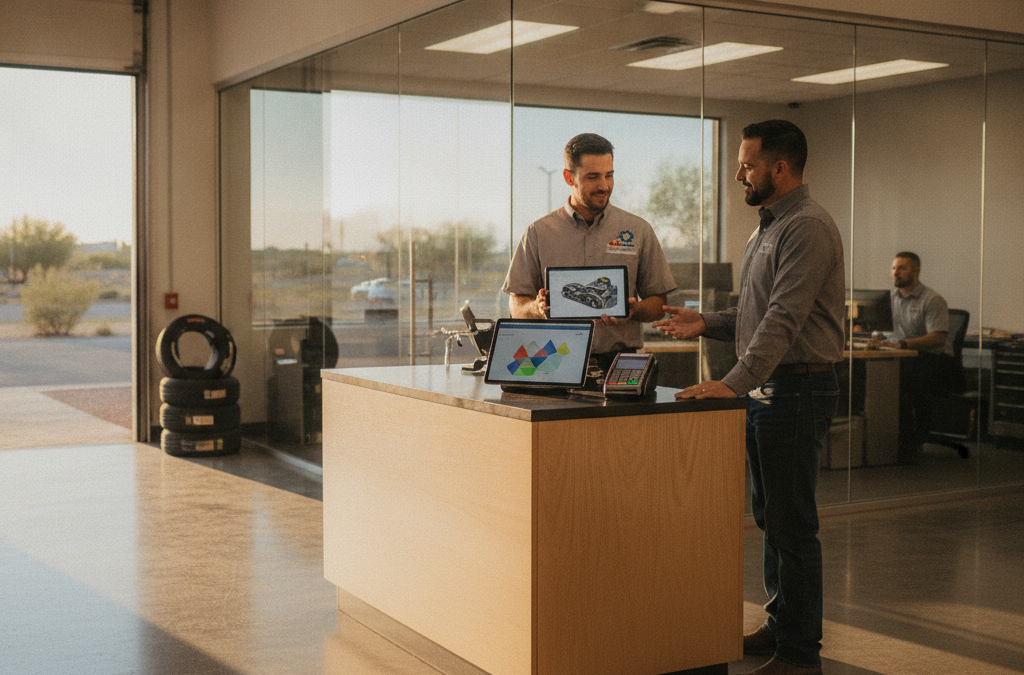
If you have a service desk where customers check in and check out, a full counter terminal makes the most sense. The Clover POS system is well-suited to auto repair because it handles invoicing, tracks open tickets, manages employees, and accepts chip, swipe, tap, and contactless payments — including Apple Pay and Google Pay. The Clover Station is the full-screen setup ideal for a busy service counter with real volume. The Clover Mini is a compact version that works well for smaller shops with less counter space. Both support customer-facing displays so customers can see the charge and sign or enter a PIN without you having to hand over a device.
Mobile Mechanics and On-the-Road Technicians
Mobile mechanics operating across North Scottsdale, Tempe, or the broader East Valley need a lightweight payment option. The Clover Flex or Clover Go is purpose-built for this — both devices pair with a smartphone or run standalone, accept chip and tap, and work over WiFi or 5G. Store-and-forward mode lets you take a payment in a parking lot or driveway and sync it when you’re back on a signal. You don’t need to tell a customer you’ll invoice them later — you close the job and collect on the spot.
Fleet Billing and Recurring Commercial Accounts
If you service fleet vehicles for local businesses in Glendale, Phoenix, or Maricopa County, ACH payment processing is worth serious consideration. ACH is a bank-to-bank transfer — fees are typically flat and much lower than card interchange rates. For a fleet account that runs $3,000 to $10,000 a month, the savings compared to running commercial credit cards can be meaningful. You set up the billing terms, the customer authorizes the ACH pull, and the money moves automatically. It also reduces the friction of chasing invoices from accounts payable contacts who aren’t in the shop.
What About Saving on Processing Fees?
This is a conversation I have with a lot of shop owners. When your average repair ticket is $600 and you’re running 100 tickets a month, you’re processing $60,000 a month in card volume. At a blended rate of 2.5%, that’s $1,500 a month going to your processor. At 3%, it’s $1,800. Those aren’t made-up numbers — that’s real money that could be going toward equipment, labor, or your own pocket.
One option a growing number of shops across the Phoenix metro are implementing is a Zero Cost Processing program — either a cash discount or a compliant surcharge program. Under a cash discount model, you post a standard price and offer a small discount to customers who pay with cash or check. Under a surcharge program, card-paying customers see a small fee added at checkout, which offsets your processing cost. Both are legal in Arizona when implemented correctly, and both essentially bring your monthly processing bill down to near zero. It’s not right for every shop — some owners prefer to absorb the cost and not deal with the conversation at the counter — but for shops with tight margins and high card volume, it’s worth understanding your options.
Red Flags to Watch for in Your Current Processing Setup
A lot of shop owners in Scottsdale, Chandler, and Mesa come to me after they’ve already been locked into a bad deal. Here’s what to watch for:
- Long-term contracts with early termination fees. A reputable processor shouldn’t need to lock you in. Month-to-month agreements protect you.
- Rates that have quietly increased. Some national processors send a notice buried in a statement addendum and raise your rates. If you haven’t reviewed your statement in a year, check it.
- Equipment lease agreements that cost more than the hardware. Leasing a terminal at $50–$80/month for 48 months is almost never the right move. Good equipment on a qualifying processing plan is a much better deal.
- Batch settlement delays. If your processor takes 2–3 days to fund your account, that’s cash flow you don’t have. Next-day or same-day funding is available and should be your standard.
FAQs: Payment Processing for Auto Repair Shops in Scottsdale and Phoenix
Can I take card payments for a repair estimate before the customer drops off their vehicle?
Yes. A virtual terminal or pay-by-link lets you collect a deposit or authorization before the customer even arrives. This is especially useful for shops handling high-cost repairs where you want some commitment upfront. The customer enters their card info on a secure page — you don’t store the number manually.
What’s the best way to handle a customer who wants to dispute a charge after picking up their car?
Chargebacks are a real issue in auto repair because repair costs can surprise customers. The best defense is documentation — a signed repair authorization, itemized invoices, and a clear written estimate the customer approved before work began. A processor with chargeback support can help you respond to disputes with the right evidence format.
I have a second location in Gilbert. Can I manage both shops from one reporting system?
Yes. The CardPointe platform supports multi-location management with centralized cloud-based reporting. You can see sales, batch totals, and transaction history across both locations from a single login — without logging in and out of separate accounts.
Is ACH a realistic option for billing my regular fleet customers?
Absolutely. ACH works well for predictable, recurring commercial accounts. It requires a written authorization from the customer, and there are rules around dispute resolution, but for fleet relationships where you have an ongoing business agreement, ACH billing is reliable, low-cost, and reduces the payment friction on both sides.
Do I need a special payment setup because I’m in auto repair specifically?
Auto repair is generally considered a standard-risk merchant category, so you shouldn’t have trouble getting approved for processing. What matters more is making sure your setup is configured for your actual workflow — large tickets, some phone or remote authorizations, possibly fleet billing — rather than just grabbing a generic retail terminal and hoping it works.
Get a Free Rate Review for Your Shop
If you run an auto repair shop, mechanic business, or tire shop in Scottsdale, Phoenix, or anywhere in the Valley, I’d be glad to take a look at your current processing setup at no charge. We’ll go through your statement, identify where you’re overpaying, and show you exactly what a switch would look like — with no long-term contracts and equipment options that actually make sense for your volume. Reach out to Good Payments Merchant Services here and let’s talk through your options.