How Should a Scottsdale or Phoenix Tattoo Shop or Body Piercing Studio Set Up Payment Processing?
Running a tattoo shop or body piercing studio in Scottsdale or Phoenix means you’re dealing with a pretty specific set of payment headaches — large custom tattoo deposits, walk-in clients who want to split a bill, artists who each need their own sales tracked, and the occasional processor who decides your business is too “risky” and freezes your account without warning. The short answer: you need a merchant account set up specifically for your type of studio, the right point-of-sale system to manage artists and appointments, and a clear plan for handling deposits and tips. This guide walks you through all of it.
Why Tattoo Shops Get Flagged as High-Risk — and What to Do About It
Here’s something most payment processors won’t tell you upfront: tattoo and body piercing businesses sometimes get quietly classified as elevated-risk merchants. It’s not because your business is shady — it’s because processors associate ink-related industries with higher chargeback rates (clients who dispute a tattoo they “didn’t like” after the fact) and in some cases lump them in with other body modification or cash-heavy businesses.
What does this mean practically? If you try to sign up with a large aggregator like Square or a generic national processor without disclosing the nature of your business fully, you may get approved initially and then have your account terminated or funds held down the road. That’s a nightmare if you’re in the middle of a busy weekend in Old Town Scottsdale.
The right move is to work with a processor who reviews your business upfront, understands the industry, and sets you up with a proper dedicated merchant account — not a shared aggregated account where you’re one complaint away from a freeze. At Good Payments, we look at your actual business model, ticket sizes, and chargeback history (or lack thereof) and find the right banking relationship for you from the start.
The Right POS Setup for a Tattoo Studio or Piercing Shop
Most tattoo shops in Phoenix and Scottsdale operate as either a sole artist, a small multi-artist studio, or a walk-in shop with both appointment and flash work. Each of those setups has slightly different needs, but here’s the core of what works well:
For a Single-Artist or Appointment-Based Studio
If you’re running your own studio or suite — especially in a spot like North Scottsdale or one of the many independent artist spaces around Tempe or Mesa — you don’t need a bulky countertop setup. A Clover Flex or Clover Mini handles this cleanly. The Flex is handheld, accepts chip, tap, and swipe, and lets clients sign right on the screen. It also handles tipping at the point of sale, which matters a lot in a studio where artists rely on tips as a meaningful part of their income.
For a Multi-Artist Shop with Walk-In Traffic
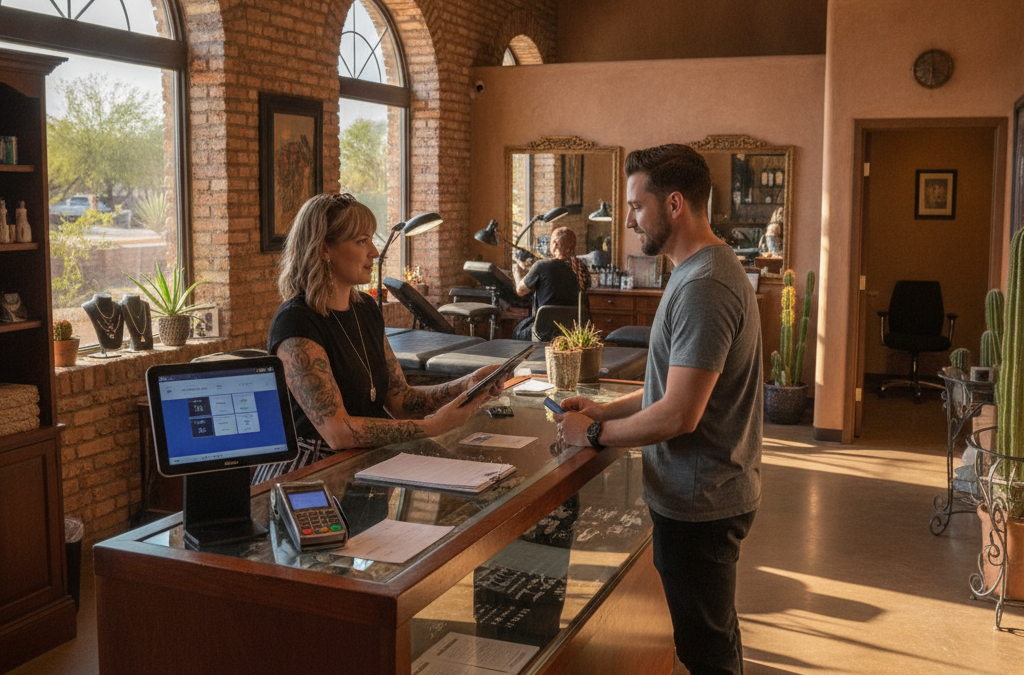
If you’ve got three or four artists working simultaneously, you’ll want something more capable. The Clover Station at the front counter handles check-in, payment collection, and end-of-day reporting. You can set up individual employee logins so each artist’s sales are tracked separately — which helps at commission time and keeps things clean for bookkeeping. The Clover family of devices also integrates with appointment apps, inventory (yes, piercing jewelry inventory), and customer loyalty programs if you want to build a repeat-client base.
For Artists Who Work Events or Conventions
Tattoo and body art conventions happen regularly across the Phoenix metro — and artists doing live work at those events need a reliable mobile payment solution. A Clover Go paired with a smartphone works for quick tap-to-pay or card-swipe transactions. For something more robust at a multi-day convention, a wireless terminal with 5G or WiFi connectivity and store-and-forward capability (meaning it queues transactions if you temporarily lose signal) is a smart backup.
How to Handle Deposits for Custom Tattoo Work
This is the section that most of your competitors’ websites completely skip — and it’s one of the most important payment questions tattoo artists actually have.
When a client books a custom piece, it’s standard practice to collect a deposit upfront — anywhere from $50 to a few hundred dollars depending on the scope of the work. That deposit holds the appointment and compensates the artist for design time if the client no-shows. The problem: collecting deposits the wrong way creates chargeback exposure.
Here’s what to do instead:
- Collect the deposit via a virtual terminal or payment link so the client can pay remotely when they book. You don’t need them in the shop for this.
- Use a written deposit policy — clearly stating it’s non-refundable for no-shows or cancellations within a certain window — and have clients acknowledge it digitally or in writing before you run the card.
- Keep the deposit transaction separate from the final session payment. This makes dispute resolution much cleaner if a chargeback ever comes up.
- Apply the deposit to the final ticket at checkout rather than refunding and re-charging.
A virtual terminal or payment link setup makes this process smooth and professional — and it creates a paper trail that’s invaluable if a client ever tries to dispute a charge.
Tips, Artist Splits, and End-of-Day Reporting
Tips are a real part of income for tattoo artists, and your POS should make collecting them easy — not awkward. The Clover system prompts for a tip at checkout with pre-set percentage options, which removes the uncomfortable pause where the client has to decide what to type in.
If your studio takes a percentage of each artist’s sales (a common booth rent or commission arrangement), the Clover’s employee reporting makes that calculation straightforward. You can pull up each artist’s daily or weekly totals without having to manually reconcile paper receipts. For shops with multiple locations across the Valley — say, one in Chandler and one in Scottsdale — CardPointe’s cloud-based dashboard lets you view reporting across both locations from one login.
Should Your Tattoo Shop Use a Cash Discount Program?
Processing fees eat into margins in any business, but in a tattoo studio where average ticket sizes can run $200–$800 or more, those fees add up fast. A zero cost processing or cash discount program is worth considering seriously.
Here’s how it works: clients who pay by card are shown a price that includes a small service fee (typically around 3–4%), while clients who pay cash get a discount equal to that fee. Done right, it’s fully compliant and completely transparent. Many studios across the Phoenix metro have already made this switch and are saving hundreds of dollars a month in processing costs.
It’s not the right fit for every shop — particularly high-end studios where the client experience is paramount and fee notices might feel off-brand. But for a walk-in flash shop or a high-volume piercing studio, it’s a legitimate way to protect your margins. Learn more about how zero cost processing works and whether it makes sense for your studio.
What to Look for in a Local Payments Partner
When you’re evaluating processors, ask these questions directly:
- Do you have experience placing tattoo shops or body art businesses with banking partners?
- Will I have a dedicated merchant account, or am I on a shared aggregated platform?
- What’s your chargeback support process if a client disputes a tattoo charge?
- Are there any long-term contracts or early termination fees?
- Can my POS handle tipping, employee tracking, and remote deposit collection?
At Good Payments Merchant Services, there are no long-term contracts, no surprise fees buried in the fine print, and free POS equipment on qualifying plans. You get a local rep — not a 1-800 number — who understands the Valley’s business environment and can actually help you troubleshoot when something comes up on a busy Saturday night.
Frequently Asked Questions
Is a tattoo shop considered high-risk for payment processing?
It depends on the processor. Some national aggregators do flag tattoo and body modification businesses as elevated-risk, which can lead to account holds or terminations. Working with a processor who reviews your business upfront and places you with the right banking partner avoids that problem entirely.
Can I collect tattoo deposits by credit card even if the client isn’t in the shop?
Yes — a virtual terminal or payment link lets you collect a deposit remotely when the appointment is booked. Just make sure your no-refund policy is acknowledged in writing before you run the charge, so you have protection if a dispute comes up later.
What POS system works best for a tattoo studio in Scottsdale or Phoenix?
For most studios, the Clover Mini or Clover Flex hits the sweet spot — it handles tipping, employee tracking, and contactless payments without being overly complicated. Larger multi-artist shops tend to prefer the Clover Station at the front counter with a Flex or Go for mobile use around the studio.
How do I track tips and artist sales separately on a shared POS?
The Clover system lets each employee log in with their own PIN, so transactions are automatically attributed to the right artist. At end of day or end of week, you can pull individual sales reports without any manual sorting.
Can I use a cash discount program in my tattoo shop without it feeling unprofessional?
Many shops pull it off just fine with clean signage and straightforward communication at checkout. The key is being upfront about it — clients generally understand that card fees are real, and many are happy to pay cash or Venmo to avoid the charge. For high-end custom studios where the client experience is more premium, it’s worth weighing the tradeoffs before committing.
Ready to Set Up the Right Payment System for Your Studio?
Whether you’re running a walk-in flash shop in Old Town Scottsdale, a custom appointment studio in North Scottsdale, or a multi-artist space somewhere along the Loop 101 corridor, getting your payment setup right from the start saves you headaches later. Good Payments Merchant Services works with tattoo shops and body art studios across Scottsdale, Phoenix, Tempe, Mesa, Chandler, and the broader Valley — with no long-term contracts, transparent pricing, and a local rep who actually picks up the phone.
Request a free rate analysis and consultation and we’ll walk you through exactly what setup makes sense for your studio — no pressure, no jargon, no surprises.