

How Should a Scottsdale or Phoenix Auto Dealer, Detailer, or Auto Service Shop Set Up Payment Processing?
If you run an auto dealership, detail shop, or repair business in Scottsdale or the broader Phoenix metro, your payment setup needs to do things that a standard retail terminal simply was not built to handle. You’re collecting large deposits on vehicle sales, billing $800 ceramic coating jobs, running split payments on repairs, and sometimes chasing customers down after the work is done. The right merchant account and payment tools can make all of that smoother — and save you real money in the process. The wrong setup can cost you hundreds of dollars a month in fees, expose you to chargebacks you can’t win, and slow down your cash flow at the worst possible time.
Why Auto Businesses in the Phoenix Metro Have Unique Payment Needs
Most processors — especially the big national ones — treat every merchant the same way. They hand you a terminal, charge you a flat rate, and leave you to figure out the rest. That works fine for a coffee shop processing $15 transactions all day. It does not work as well when you’re running a North Scottsdale auto detailing studio where the average ticket is $400, or a used car lot in Chandler where customers are putting $5,000 to $10,000 on a card. Here’s what makes the auto industry different:
- High average ticket sizes mean processing fees hurt more. A flat 2.75% rate on a $6,000 car purchase is $165 in fees on a single transaction. That adds up fast.
- Deposits, partial payments, and payment plans are common — especially at dealerships and body shops — which means you need a system that can handle split billing without a workaround.
- Remote and after-hours billing is a real need. Detailers finishing a job at a customer’s home in Gilbert or a mobile mechanic wrapping up a service call in Tempe need to collect payment in the field, not back at the shop.
- Chargeback exposure is higher than most business owners realize — especially on high-ticket items where a customer disputes a charge after the work is complete.
None of the major competitor processors in the Valley — from national brands like Square to local agents — have published any real guidance on how automotive businesses specifically should structure their payment setup. That’s a gap worth closing.
High-Ticket Transactions: How to Keep Fees from Eating Your Margin
The first thing to look at is your rate structure. If you’re paying a flat rate on every transaction — whether it’s $50 or $5,000 — you are very likely overpaying on your largest sales. Interchange-plus pricing (where you pay the actual card network cost plus a small fixed markup) is almost always more cost-effective for businesses with high average tickets than flat-rate or tiered pricing. Ask your processor to show you the actual interchange rates that apply to your transaction mix, not just the top-line rate they quote in marketing materials.
The other option — and one that’s growing quickly among auto shops across the Valley — is a Zero Cost Processing program. Under a compliant cash discount or surcharge model, card processing fees are passed to the customer, and you keep more of what you earn. For a shop running $50,000 a month in card volume, that can represent $1,200 to $1,800 per month staying in your pocket rather than going to the processor. It’s not the right fit for every auto business, but it’s worth understanding your options.
The Right Hardware for Different Auto Business Types
Not every shop needs the same setup. Here’s how to think about it based on how you actually operate:
Auto Detailing Studios and Mobile Detailers
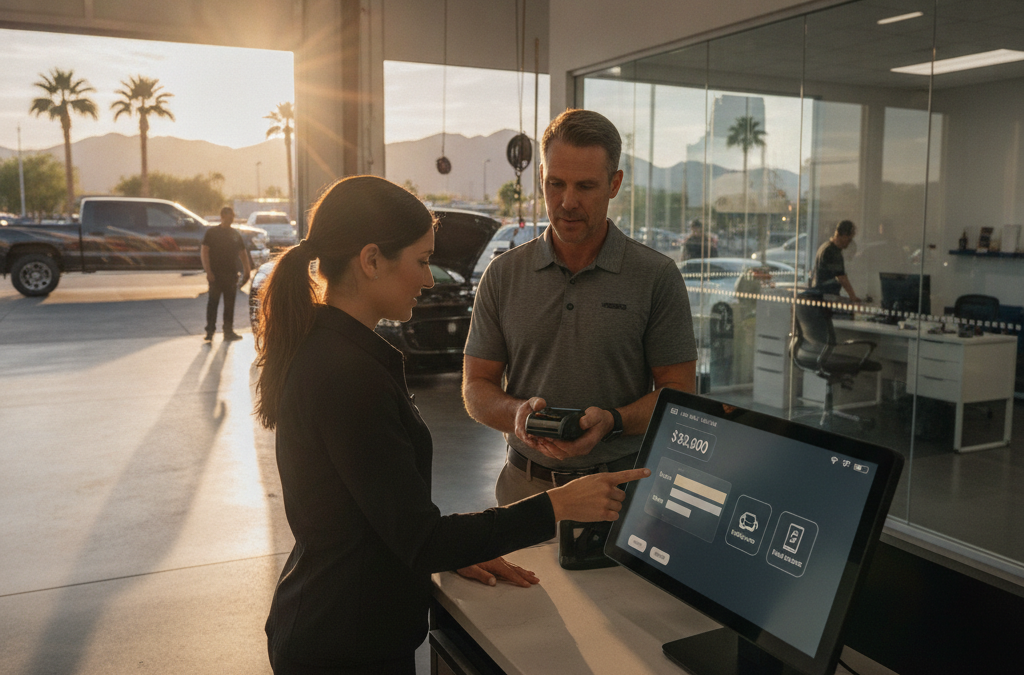
If you operate out of a fixed studio in Scottsdale or Mesa, a Clover Mini or Clover Flex at the front counter handles checkout cleanly, and can track job status, employee time, and tips in one place. If you’re a mobile detailer driving to customers in Chandler, Gilbert, or Paradise Valley, you need something that works off a cellular connection — the Clover Flex or a 4G/5G wireless terminal lets you take payment on the spot, even when you’re parked in a driveway without Wi-Fi. Store-and-forward capability means you can still process a transaction even in areas with spotty signal and it syncs once you’re back in range.
Auto Repair Shops and Service Centers
Repair shops benefit most from a setup that ties payments into your work order and customer record system. The CardPointe platform is a strong fit here — it gives you cloud-based reporting, invoicing, and the ability to send a customer a payment link via text or email so they can pay remotely before or after picking up their vehicle. That’s a real operational upgrade for any shop where customers sometimes can’t make it back in person to settle a bill.
Used Car Dealerships and Independent Lots
Dealerships have some of the most complex payment scenarios of any business: deposits, partial payments, financing down payments, and occasional full-price card transactions on vehicles. You need a processor that does not flag large transactions as suspicious and freeze your funds, a problem that Square and other aggregator-based processors are notorious for on high-ticket sales. A dedicated merchant account — not a shared aggregator account — gives you stable processing and next-day funding even on large transactions.
Protecting Your Shop from Chargebacks
Chargebacks are a real risk in the auto industry, especially on detail jobs, repairs, or car sales where a customer later disputes the charge with their bank. The best defense is a combination of signed authorizations before work begins, documented invoices, and a processor with proper dispute management support. Tokenization and point-to-point encryption also protect you from data breaches if a card number is stored in your system — something that matters especially if you keep cards on file for recurring customers.
If you’ve been burned by chargebacks before, ask your processor specifically what dispute support looks like. Many national processors hand you a web portal and wish you luck. A local rep who actually knows your business can help you build the documentation habits that win disputes before they escalate.
What to Ask Before You Sign Anything
Whether you’re setting up payment processing for the first time or switching away from a processor that’s been nickel-and-diming you, these are the questions that matter:
- Is my pricing interchange-plus, flat rate, or tiered — and can I see the actual rate on my most common transaction types?
- Are there monthly minimums, statement fees, or PCI compliance fees I should know about?
- What happens if I process a $5,000 or $8,000 transaction — will my funds be held?
- Is there a long-term contract, and if so, what are the early termination terms?
- What does chargeback support actually look like — do I get a real person or a web ticket?
- Can I take payment in the field, online, or over the phone — or only at my counter?
Good Payments works without long-term contracts. You’re not locked in, and there are no hidden fees buried in the fine print. If you want to see how your current rates stack up, a free rate analysis takes about ten minutes and gives you a clear picture.
Frequently Asked Questions
Can I use Square for my auto shop or detailing business in Scottsdale?
Square can work for very small or low-volume shops, but it’s a shared aggregator account — not a dedicated merchant account. That means large transactions can trigger fund holds, and you’re paying a flat rate that gets expensive on high-ticket sales. For most established auto shops in the Phoenix metro, a dedicated merchant account with interchange-plus pricing will save money and provide more stability.
How do mobile detailers in the Phoenix area take payment without Wi-Fi?
A 4G/5G wireless terminal or the Clover Flex with cellular connectivity lets you process cards anywhere you have a cell signal. Some terminals also support store-and-forward, which holds the transaction locally and processes it once you’re back online — useful in areas where signal is inconsistent.
Is a Zero Cost Processing program legal for auto businesses in Arizona?
Yes, both cash discount and surcharge programs are legal in Arizona when implemented correctly. The key is clear disclosure to customers at the point of sale and proper setup by your processor. It’s a common and growing option among auto shops and detailers across Chandler, Gilbert, and Tempe who want to offset processing costs without raising prices across the board.
What’s the risk of chargebacks for auto repair or detailing shops?
The risk is real, especially on higher-ticket jobs. The best protection is written authorization before work begins, detailed invoices, and before/after photos when relevant. Your processor should also be able to explain how to respond to a dispute if one comes in. Having a dedicated local contact rather than a national call center makes a meaningful difference here.
Do I need different payment setups for my front counter and my mobile techs?
Possibly. Many shops run a countertop terminal or Clover station at the front desk for in-person checkouts, plus a mobile solution for techs or detailers working off-site. Both can be tied to the same merchant account and reporting dashboard, so you see all your transactions in one place regardless of where the payment was collected.
Ready to Set Up Payment Processing That Fits Your Auto Business?
If you run an auto shop, dealership, or mobile detailing operation anywhere in the Scottsdale and Phoenix area — including Mesa, Chandler, Gilbert, Tempe, or North Scottsdale — Good Payments can put together a setup that actually fits the way you work. No cookie-cutter solutions, no long-term contracts, and no disappearing act after the paperwork is signed.
Reach out for a free rate analysis and consultation. Zoltan Hardi will personally review your current processing costs, walk you through your options, and give you a straight answer on what makes sense for your business — whether you’re a one-person detail operation or a multi-bay repair shop running serious volume.