

How to Accept Credit Cards at a Scottsdale Farmers Market, Pop-Up, or Outdoor Event
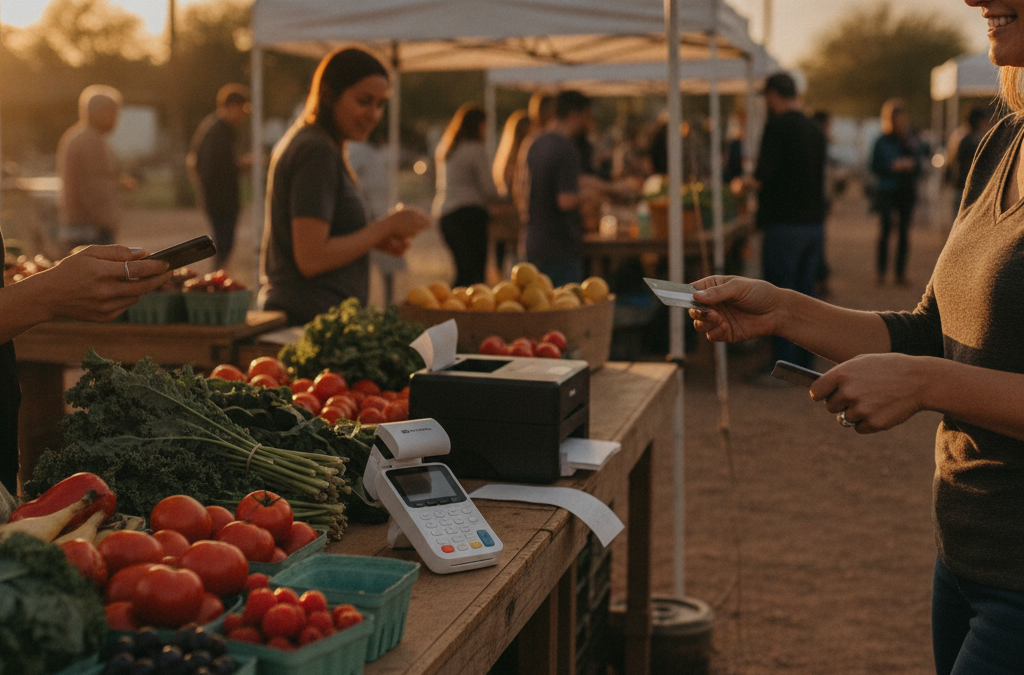
If you sell at a Scottsdale farmers market, a pop-up event in Old Town, or any outdoor market across the Phoenix metro, you already know the challenge: customers almost never carry cash anymore, but you’re set up under a tent with no landline, spotty WiFi, and triple-digit heat testing every piece of equipment you own. The good news is that accepting credit cards reliably in that environment is absolutely doable — you just need the right setup from the start, not a last-minute app downloaded the night before your first market.
This guide is for mobile and occasional sellers: farmers market vendors, artisan makers, food vendors, service providers doing pop-ups, and anyone running a booth at outdoor festivals across Maricopa County. Let’s walk through what actually works — hardware, connectivity, pricing, and the questions most processors won’t answer upfront.
Why Most Mobile Vendors End Up Overpaying (or Under-Equipped)
The default choice for a lot of first-time outdoor vendors is a free card reader from a well-known national brand. It’s easy to understand the appeal — you download the app, plug in a dongle, and you’re accepting cards in an afternoon. But that convenience comes with tradeoffs that add up fast once you’re doing real volume.
Flat-rate pricing sounds simple, but it’s almost never the cheapest option for a vendor doing consistent weekly sales. On a busy Saturday at the Scottsdale Farmers Market or the Fountain Hills Festival of Arts and Crafts, you might run a few hundred to a few thousand dollars through your reader. At a flat rate of 2.6% plus $0.10 per swipe, those fees stack up quickly — and you have no negotiating power because you’re just one of millions of users on a self-serve platform.
There’s also the connectivity issue. Free readers that rely entirely on your phone’s cellular signal can freeze or fail at crowded outdoor events where everyone is competing for the same cell tower. If your reader can’t connect, you can’t take the sale.
Hardware That Actually Works Outdoors in the Arizona Heat
Not all mobile payment hardware is built for outdoor use. Here’s what to look for — and what Good Payments actually offers for vendors in this situation.
Clover Flex — The Best All-Around Option for Market Vendors
The Clover Flex is a handheld, touchscreen device that accepts chip cards, swipe, tap-to-pay, and mobile wallets like Apple Pay and Google Pay. It has a built-in receipt printer, a long battery life, and runs on WiFi or 4G/LTE — meaning it doesn’t depend on your phone’s signal. It’s a real merchant account device, not a consumer app, so it handles high transaction volumes without freezing or flagging your account for unusual activity.
For a vendor doing a full market day — multiple transactions per hour over five or six hours — the Flex is significantly more reliable than a phone-attached dongle. It also gives you inventory tracking and sales reporting built in, so you can see at a glance what sold and what didn’t.
Clover Go — For Lower-Volume or Backup Use
If you’re just getting started or doing a smaller pop-up a few times a month, the Clover Go pairs with your smartphone and handles chip and contactless payments. It’s compact and affordable, and it connects to the same Clover backend as the Flex — so if you grow into a more permanent setup later, your data and history carry over.
Wireless Terminals with Store-and-Forward
For vendors at events where connectivity is truly unreliable — think a remote festival in Cave Creek or an outdoor market in a low-signal area — a wireless terminal with store-and-forward capability is worth asking about. Store-and-forward means the terminal queues transactions locally when it’s offline and pushes them through once connection is restored. You take the sale, give the customer their receipt, and the payment settles later. This isn’t available on every consumer app — it’s a feature of proper merchant account hardware.
Connectivity Tips for Outdoor Events Across the Valley
Cellular coverage varies a lot across the Phoenix metro. Old Town Scottsdale and Tempe generally have solid 5G coverage, but you can run into dead zones at larger festivals, especially when thousands of people are packed into the same space. A few practical tips:
- Use a dedicated mobile hotspot rather than relying on your personal phone’s data when running a card reader on the same device — splitting bandwidth between the reader and your other apps causes slowdowns.
- Test your device at the location before your first market day. Bring your reader a few days early if you can and check signal strength at different times.
- Know your backup. Whether it’s store-and-forward, a written order log, or a secondary reader on a different carrier, have a plan for when connection drops.
- Ask your processor about offline mode. Not all merchant accounts support it — make sure yours does before you’re standing in the middle of a market with no signal and a line of customers.
What This Actually Costs — And How to Reduce It
Processing fees for mobile vendors vary depending on your monthly volume, average ticket size, and the type of cards your customers use. Interchange-plus pricing (where you pay the actual card network rate plus a small markup) is almost always more cost-effective than flat-rate pricing once you’re doing consistent volume.
One option worth looking at seriously if you’re running a booth where margins are tight: a Zero Cost Processing program. Under a properly implemented cash discount or surcharge structure, customers who pay by card cover a small processing fee, and you keep your full sale amount. This is legal in Arizona, and when it’s set up correctly with proper signage and compliant pricing, it can eliminate a significant monthly processing expense for a vendor who’s running thousands of dollars through a reader on market weekends.
It’s not right for every business — some vendors in tourist-heavy spots like Old Town Scottsdale or the Fountain Hills market prefer to absorb fees and keep checkout seamless — but it’s worth understanding the option rather than just defaulting to paying 2.6% on everything indefinitely.
What Competitors Don’t Tell You About Mobile Processing for Outdoor Vendors
Most of the competitor sites serving the Phoenix metro focus their mobile payment content almost entirely on food trucks or service contractors. Farmers market and pop-up vendors are largely ignored — even though the Valley has dozens of weekly and monthly outdoor markets drawing serious foot traffic, especially during snowbird season from October through April when the Scottsdale and Fountain Hills markets see some of their biggest crowds of the year.
That seasonal swing matters for your processing setup too. If you’re running twice the transaction volume in January versus July, your processor should be able to scale with you without flagging your account or holding your funds. Working with a local merchant services provider who understands Arizona’s seasonal business patterns — and who you can actually call when something goes wrong on a Saturday morning — is genuinely different from troubleshooting a frozen reader through a chat bot.
What to Ask Before You Sign Up with Any Mobile Processor
- Does the hardware support offline or store-and-forward processing?
- What happens if my transaction volume spikes during a busy event — will my account get flagged or funds held?
- Is there a long-term contract, or can I leave without penalties?
- What are the actual rates, and are they interchange-plus or flat-rate?
- Can I upgrade to a full POS if my business grows into a brick-and-mortar location?
- Is there local support, or am I on my own with a 1-800 number?
Good Payments is based in Scottsdale and serves vendors across Maricopa County — from Gilbert and Chandler markets to events up in Cave Creek and out in Mesa. There are no long-term contracts, no hidden fees, and free equipment is available on qualifying plans. You talk to a real person, not a ticketing system.
Frequently Asked Questions
Can I use my existing Square reader at the Scottsdale Farmers Market?
Yes, technically — but Square’s flat-rate pricing may cost you more than you’d pay with a merchant account on interchange-plus pricing, especially if you’re running consistent volume every weekend. It’s worth getting a rate comparison before assuming Square is your cheapest option.
What if the cell signal is bad at an outdoor event in Fountain Hills or Cave Creek?
You’ll want a terminal with store-and-forward capability, which queues transactions offline and processes them once your connection is restored. Ask your processor specifically whether their hardware supports this — many consumer card readers do not.
Do I need a separate merchant account for outdoor events, or can I use the same one as my online store?
In most cases, one merchant account can handle both in-person and online transactions — you just need the right hardware and gateway setup. Combining them also gives you unified reporting across all your sales channels, which simplifies bookkeeping significantly.
Is a cash discount program legal for a vendor at an Arizona farmers market?
Yes. Arizona permits both cash discount and surcharge programs when implemented correctly, including proper customer disclosure at the point of sale. Market rules vary by event, so it’s worth confirming with your market organizer — but the practice is legally compliant at the state level.
What’s the best card reader for someone doing only a few pop-ups per year?
For very occasional sellers, the Clover Go is a low-cost, low-commitment option that pairs with your phone and still gives you a real merchant account backend. If you start doing markets more regularly, upgrading to a Clover Flex gives you better battery life, a built-in printer, and standalone cellular connectivity.
Ready to Set Up Mobile Payments the Right Way?
If you’re selling at markets or pop-up events around Scottsdale, Phoenix, or anywhere in the Valley and you want an honest conversation about what hardware and pricing actually makes sense for your situation, Good Payments is a straightforward call or email away. No sales pitch, no long-term commitment required just to ask questions. Reach out here to request a free rate analysis and get set up before your next market day.