How Should a Scottsdale or Mesa Nonprofit Accept Payments and Donations Without Overpaying on Fees?
If your nonprofit is based in Scottsdale or Mesa — or anywhere across the Phoenix metro — you’re likely leaving money on the table every time a supporter donates by card. Most payment processors treat nonprofits exactly like retail businesses, which means your organization is absorbing the same interchange rates, monthly fees, and PCI charges as a pizza shop. Every dollar lost to unnecessary processing fees is a dollar that doesn’t go toward your mission. The good news: with the right setup, you can dramatically reduce what you’re paying — and in some cases, get it down to near zero.
Why Most Processors Aren’t Built for Nonprofits
Here’s what almost nobody in the payments industry will tell you upfront: major card networks like Visa and Mastercard actually publish reduced interchange rates specifically for qualifying 501(c)(3) organizations. These rates are lower than what standard businesses pay. The problem is that most national processors — including big names like Square and Toast — don’t pass those rates on to you. They apply flat-rate pricing across the board, which means your nonprofit is subsidizing commercial merchants whether you realize it or not.
Regional processors and local ISOs aren’t much better if they don’t specialize in nonprofit accounts. The standard sales pitch is the same regardless of whether you run a tutoring center in Mesa or a restaurant in Chandler. If your processor hasn’t brought up nonprofit interchange categories, qualified 501(c)(3) status, or interchange-plus pricing in your setup conversation, that’s a problem worth addressing.
The Three Biggest Payment Needs for Arizona Nonprofits
Most nonprofits across Maricopa County tend to have three core payment scenarios, and each one has a different ideal setup.
1. Online Donations and Recurring Giving
This is where the most money flows — and where the most fees are often wasted. If your organization is running donation forms through a third-party platform that tacks on its own processing fee on top of standard card rates, donors are frequently being charged 3% to 5% of their gift just to get it to you.
A better setup: a direct payment gateway connected to your website, using interchange-plus pricing on a nonprofit-qualified merchant account. Virtual terminal and e-commerce solutions built for recurring billing let you process monthly pledges, annual memberships, and one-time gifts from a single dashboard — without a third-party platform skimming off the top.
Recurring billing is especially important for donor retention. When someone sets up a $50/month pledge, you want that to run reliably, auto-update when their card number changes (look for account updater features), and hit your bank account on a predictable schedule.
2. In-Person Events and Fundraisers
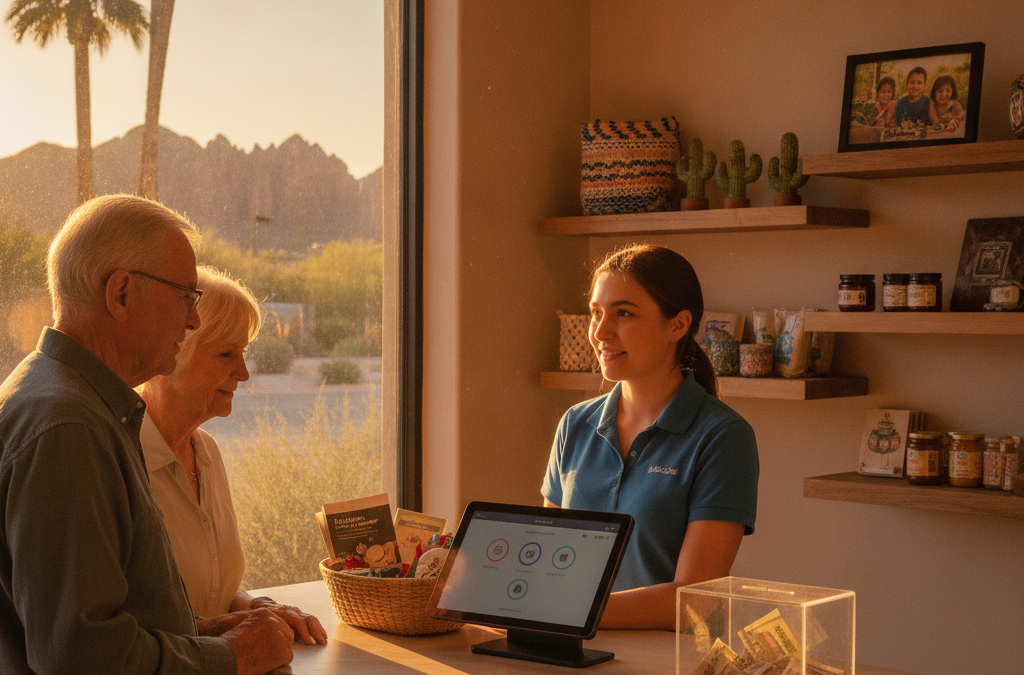
Scottsdale and the East Valley host a steady calendar of nonprofit galas, charity runs, school auctions, and community fundraising events — especially during the snowbird season from October through April when philanthropic spending picks up. Whether your event is at a venue in Old Town Scottsdale or a community center in Gilbert, you need a payment setup that’s portable and reliable.
A wireless terminal or a mobile card reader handles these situations well. Look for a device that stores transactions offline and syncs when connectivity is restored — useful in outdoor venues across the Valley where WiFi can be spotty. For larger events with multiple staff collecting payments, having two or three paired devices on a single merchant account makes reconciliation much cleaner.
3. ACH Payments for Large Donors and Institutional Grants
This is the most underutilized tool in the nonprofit payments toolbox, and almost none of the competitor sites serving the Phoenix area even mention it in the context of charitable organizations. When a major donor, a local foundation, or a corporate sponsor wants to send a significant gift — $5,000, $25,000, or more — there is no good reason to run that through a card terminal and pay 2.5% in processing fees. That’s $625 in fees on a $25,000 gift.
ACH bank-to-bank transfers cost a fraction of that — typically a flat fee or a very small percentage with a cap — and they’re perfectly suited for large recurring institutional payments. Setting up ACH on your merchant account means you can send a simple payment link or a scheduled authorization to a major donor, and the funds transfer directly without card network fees in the middle. For nonprofits doing any meaningful volume with high-dollar supporters, this alone can save thousands of dollars per year.
Should a Nonprofit Use a Cash Discount or Surcharge Program?
This is a fair question, and the honest answer depends on your donor relationships. A cash discount or surcharge program works by offsetting card processing costs — either by offering a small discount for cash/check payments or by adding a surcharge to card transactions. For a retail business or restaurant, this is increasingly common and well-accepted.
For a nonprofit, it’s trickier. Donors giving $50 or $100 often expect that 100% of their gift is going to the cause. Adding a surcharge to a donation page can create friction or frustration, even if the intent is to protect the organization’s budget. Where surcharge programs do make sense for nonprofits is at ticketed events — selling gala tickets, raffle entries, or merchandise — where a card surcharge is easier to contextualize as a transaction fee rather than a reduction to a donation.
The cleaner solution for most nonprofits is to negotiate better base rates on a nonprofit-qualified account rather than pushing costs to donors. That conversation starts with reviewing your current processing statement and understanding whether your processor is actually applying nonprofit interchange rates.
What to Look for When Choosing a Processor as a Nonprofit
- Interchange-plus pricing — Not flat rate. This ensures you’re getting the benefit of nonprofit-specific card network rates rather than a blended margin that hides them.
- No long-term contracts — Your funding and transaction volume will fluctuate seasonally. You shouldn’t be locked into a fixed monthly minimum that penalizes you during slow summers in Phoenix.
- ACH processing included — Non-negotiable if you work with major donors, grant-making organizations, or corporate sponsors.
- Recurring billing tools — Monthly pledge management, failed payment retries, and card updater features keep your giving programs running without constant manual intervention.
- Transparent monthly statements — You should be able to see exactly what interchange category each transaction settled at. If your statement is just a single line item, you have no visibility into whether you’re being overcharged.
- A local rep who actually knows your account — When you call with a question about a disputed transaction before a board meeting, you want to reach someone familiar with your setup — not a national call center.
Good Payments serves nonprofits, community organizations, and cause-based businesses across Scottsdale, Mesa, Phoenix, Chandler, Gilbert, and the broader Maricopa County area. If you’re unsure whether your current processor is set up correctly for a 501(c)(3), a free rate review will make it clear quickly.
What About Platforms Like GoFundMe Charity or PayPal Giving Fund?
These platforms have their place — they’re easy to share on social media and require no merchant account setup. But they’re not a replacement for a proper payment infrastructure. Their fee structures are designed around convenience, not cost efficiency, and they offer limited control over donor data, recurring billing, and direct deposit timing. If you’re running a small annual campaign, they may be fine. If you’re processing consistent donation volume throughout the year, a dedicated merchant account will almost certainly save you money and give you more control. You can always use both — a merchant account for your website and regular donors, and a crowdfunding platform for specific campaigns.
Frequently Asked Questions
Do nonprofits qualify for lower credit card processing rates in Arizona?
Yes. Visa and Mastercard publish specific interchange categories for qualifying 501(c)(3) organizations. These rates are lower than standard retail rates. Whether you actually receive those rates depends on your processor and how your merchant account is set up. Flat-rate processors like Square do not pass these savings through to you.
What’s the most cost-effective way to accept large donor gifts?
ACH bank transfers are almost always the best option for large gifts. Card processing fees on a $10,000 gift can easily run $200–$300. ACH fees on the same amount are typically a small flat fee or a low-percentage rate with a cap — often a fraction of the card cost.
Can a Mesa or Scottsdale nonprofit accept payments at outdoor fundraising events?
Absolutely. A wireless terminal or paired mobile card readers handle outdoor events well. Look for store-and-forward capability so transactions queue and process automatically if you temporarily lose connectivity — common at outdoor venues across the Valley.
How do we handle recurring monthly donations reliably?
A payment gateway with built-in recurring billing and a card account updater feature is the cleanest solution. The account updater automatically refreshes donor card numbers when cards expire or are reissued, which dramatically reduces failed payments and donor churn on your giving programs.
Is there a contract requirement to set up a nonprofit merchant account?
Not with Good Payments. We don’t require long-term contracts, so your organization isn’t locked in if your needs change or your transaction volume shifts between seasons. You should always ask any prospective processor directly about early termination fees before signing anything.
Ready to Stop Overpaying on Donation Processing?
If your nonprofit in Scottsdale, Mesa, or anywhere across the Phoenix metro hasn’t had a payment processing review in the last year, there’s a good chance you’re paying more than you should — on rates, on monthly fees, or both. At Good Payments Merchant Services, we review your current statement for free, explain exactly what you’re paying and why, and show you what a properly structured nonprofit account would actually cost. No pressure, no jargon, no surprises. Reach out today to schedule your free rate analysis and let’s make sure more of every dollar goes toward the work that matters.