


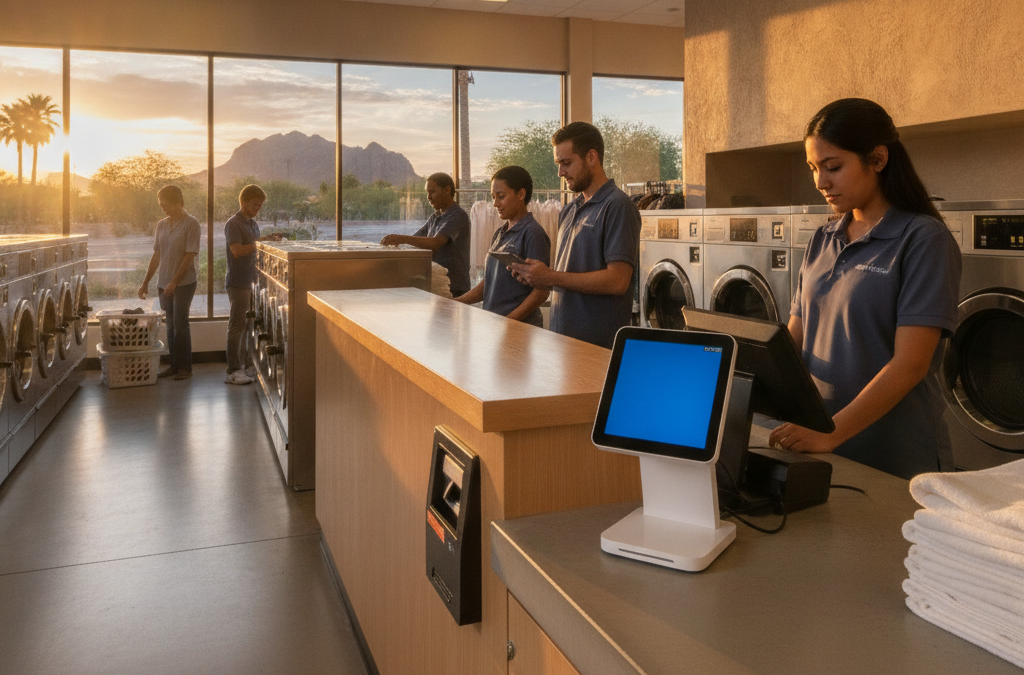
How Should a Scottsdale or Phoenix Dry Cleaner, Laundromat, or Alterations Shop Set Up Payment Processing?
If you run a dry cleaning operation, a self-service laundromat, or an alterations and tailoring shop in Scottsdale or anywhere across the Phoenix metro, the right payment setup probably looks nothing like what the big national processors are pitching you. These businesses have a unique rhythm — ticket-based pickups, high transaction volume at lower dollar amounts, loyal repeat customers, and in many cases a heavy reliance on cash. Getting the payment side right means fewer headaches at the counter, lower processing costs, and a smoother experience for your regulars. Here’s how to think through it.
Why Fabric Care Businesses Have Different Payment Needs
Dry cleaners and laundromats are often treated as generic retail by payment processors. They’re not. Consider a few things that are specific to your operation:
- Ticket-based workflows: a customer drops off, you assign a ticket, they pick up later and pay. That’s not the same flow as a straight retail sale.
- Average ticket sizes that vary wildly — from a $12 pressed shirt pickup to a $300 wedding dress cleaning or a multi-garment corporate order.
- Repeat customers who come in weekly or bi-weekly. They want speed at checkout, not a slow terminal.
- In some laundromats, you’re running a hybrid: card-activated machines in the back, a counter in the front selling detergent and doing drop-off service.
- Alterations shops often do deposit-at-drop-off and balance-at-pickup — which means you may need the ability to split a payment or hold a card on file.
None of these nuances are something Square or a generic national processor walk you through when you sign up online. You get a flat-rate account and a reader — and then you figure it out yourself.
The Right Terminal Setup for a Dry Cleaner or Alterations Shop
For a straightforward counter-based operation — a single-location dry cleaner in North Scottsdale or an alterations shop in Chandler — a reliable stand-alone terminal is often all you need. Modern terminals support chip, tap, and swipe. They’re fast, simple, and built for high-rep counter environments where you’re running transactions back-to-back during morning drop-off rushes.
If you want more functionality — like pulling up a customer’s ticket history, tracking what’s been paid, managing employee shifts, or running basic inventory on supplies — then stepping up to a Clover Mini or Clover Station makes a lot of sense. The Clover Mini sits neatly on a counter without taking up space, and it connects to the Clover App Market where you can add dry cleaning management apps that integrate directly with your POS. For shops in Paradise Valley or serving the higher-end residential neighborhoods of DC Ranch and Gainey Ranch, a polished checkout experience matters — and Clover delivers that.
Laundromats: Card-Activated Machines vs. Counter Payments
This is the section you won’t find on most competitor sites, and it’s a real question we hear from laundromat owners across Maricopa County.
If your laundromat uses card-activated washers and dryers, those machines typically connect to a proprietary card reader system provided by the machine manufacturer or a specialized laundry card company. That’s a separate ecosystem from your merchant account — and the processing fees on those card-activated systems can be surprisingly high.
For the counter portion of your business (selling laundry supplies, taking drop-off orders, accepting app-based payments), you want a merchant account that’s properly categorized for your business type. Laundromats are sometimes miscategorized by processors, which can lead to reserve holds or account flags — especially if you have spikes in volume during snowbird season when seasonal residents from up north are using local services more frequently.
Work with a local processor who understands how to set up your account correctly from the start. That’s something we take care of for every new merchant we onboard.
Should You Run a Cash Discount or Surcharge Program?
Dry cleaners and laundromats are excellent candidates for a Zero Cost Processing program — also called a cash discount or surcharge program. Here’s why it works especially well in this industry:
- You have a high volume of smaller transactions, which means processing fees add up fast even at a low per-transaction rate.
- Your customers are regulars who understand pricing. A clearly posted cash discount or card fee is easy to explain and generally accepted.
- Cash is still common in this space, so offering a discount for cash gives customers a real incentive without alienating your card-paying base.
Under a properly structured cash discount program, customers who pay with a card see a slightly higher price posted on your menu or price list, and those who pay cash get a discount. Done right and with proper signage, this is fully compliant and can eliminate or dramatically reduce your monthly processing costs. We set these programs up for shops across the Valley — from Mesa to Tempe to Phoenix — and walk you through exactly how to display pricing so you stay on the right side of card network rules.
Handling Deposits and Cards on File for Alterations
If you run an alterations or tailoring shop, you may want to collect a deposit at drop-off and charge the balance when the customer picks up. A few ways to handle this cleanly:
- Card-on-file billing: Some POS systems and payment platforms let you securely store a customer’s card and charge it when the work is complete — no need for the customer to physically return their card. This is handled through tokenization, meaning the actual card number is never stored on your system.
- Virtual terminal invoicing: If you want to email or text a payment link to a customer for pickup balance payment, a virtual terminal setup makes this easy. The customer pays remotely and you just hand over the finished garment.
- Split payments at counter: If a customer wants to pay part cash and part card, your terminal or POS should handle that without hassle.
These are features that generic flat-rate setups often don’t support well out of the box. It’s worth asking specifically about them before you commit to any processor.
What to Ask Before Signing Up with Any Processor
Whether you’re in Tempe, Chandler, or right here in Scottsdale, here are the questions every dry cleaner, laundromat owner, or alterations shop should ask before signing a merchant services agreement:
- Is there a long-term contract, and what are the early termination fees?
- Are there monthly minimums, PCI compliance fees, or statement fees that aren’t obvious upfront?
- How is my business categorized (MCC code), and is it correct for my industry?
- Can I hold cards on file securely for ticket-based pickups?
- Do you offer next-day or same-day funding?
- Who do I call when my terminal goes down on a busy Saturday morning?
That last one matters more than people realize. A national processor’s 1-800 number and a 45-minute hold time is not acceptable when you’ve got a line of customers waiting to pick up dry cleaning before work. With Good Payments, you get a local contact who actually picks up.
Seasonal Considerations for Valley Dry Cleaners
If your shop serves the snowbird crowd — those seasonal residents who flock to North Scottsdale, Paradise Valley, and the surrounding areas from October through April — you already know your business volume can swing significantly between seasons. That makes flexible, no-long-term-contract processing even more important. You don’t want to be locked into a plan sized for peak season when summer slowdown hits.
Some processors will structure your account around average monthly volume. If your volume spikes during the busy season, you may trigger flags or holds. A knowledgeable local rep will set your account up to accommodate that seasonal curve without surprises. Learn more about how we work with local businesses at our Scottsdale merchant services page.
Frequently Asked Questions
Can a dry cleaner use Square for payment processing?
Yes, but Square has real limitations for ticket-based businesses. It’s not built for deposit-at-drop-off workflows, card-on-file billing for pickups, or dry-cleaning-specific management integrations. It also charges flat rates that can be more expensive than interchange-plus pricing once your volume grows. It’s a fine starting point but many dry cleaners outgrow it quickly.
What POS system works best for a dry cleaner in Scottsdale?
A Clover Mini or Clover Station paired with a dry cleaning management app from the Clover App Market is a popular combination. It handles ticketing, customer lookup, payment splits, and employee tracking — all from one device on your counter.
Is a cash discount program a good fit for a laundromat?
It can be, especially for the counter-based portion of your business. Card-activated machines run on separate systems, but for counter transactions — drop-off service, supply sales — a cash discount program can meaningfully reduce your monthly processing costs. We can walk you through whether it makes sense for your specific setup.
How do alterations shops handle deposits and final payments?
The cleanest approach is a card-on-file or virtual terminal setup. You collect card information at drop-off, process a deposit, and charge the balance when the garment is ready — without needing the customer to bring their card in again. This is handled securely through tokenization.
Do dry cleaners need a special merchant account category?
Yes. Your account should be set up under the correct MCC (merchant category code) for laundry and dry cleaning services. Being miscategorized can lead to unnecessary reserve requirements or flagged transactions. Always confirm your MCC with your processor before going live.
Ready to Get Your Payment Setup Right?
If you’re running a dry cleaner, laundromat, or alterations shop in Scottsdale, Phoenix, Mesa, or anywhere across the Valley and you’re not sure your current payment setup is actually working for your business — let’s talk. At Good Payments Merchant Services, we review your current processing costs for free, help you identify any hidden fees, and put together a setup that fits the way your shop actually operates. No pressure, no long-term contracts, and a local rep you can actually reach. Contact us today to request your free rate analysis.