


How Should a Scottsdale or Phoenix Brewery, Winery, or Distillery Set Up Payment Processing?
If you run a brewery, winery, or distillery in Scottsdale or anywhere in the Phoenix metro, you already know that your business doesn’t fit neatly into one category. One hour you’re pouring pints at the taproom bar, the next you’re processing a large wholesale order from a distributor, and the weekend brings a ticketed tasting event with online sales coming in from out-of-state wine club members. Each of those transactions has different payment needs — and trying to run all of it through a single generic setup is exactly how craft beverage businesses end up losing money to mismatched fees, the wrong hardware, or a processor that doesn’t understand the industry.
This guide is written specifically for craft beverage producers in the Valley — breweries along the Loop 101 corridor, wine tasting rooms in North Scottsdale and Cave Creek, distilleries in Mesa and Gilbert, and everyone in between. Let’s walk through how to set up payments the right way for each part of your business.
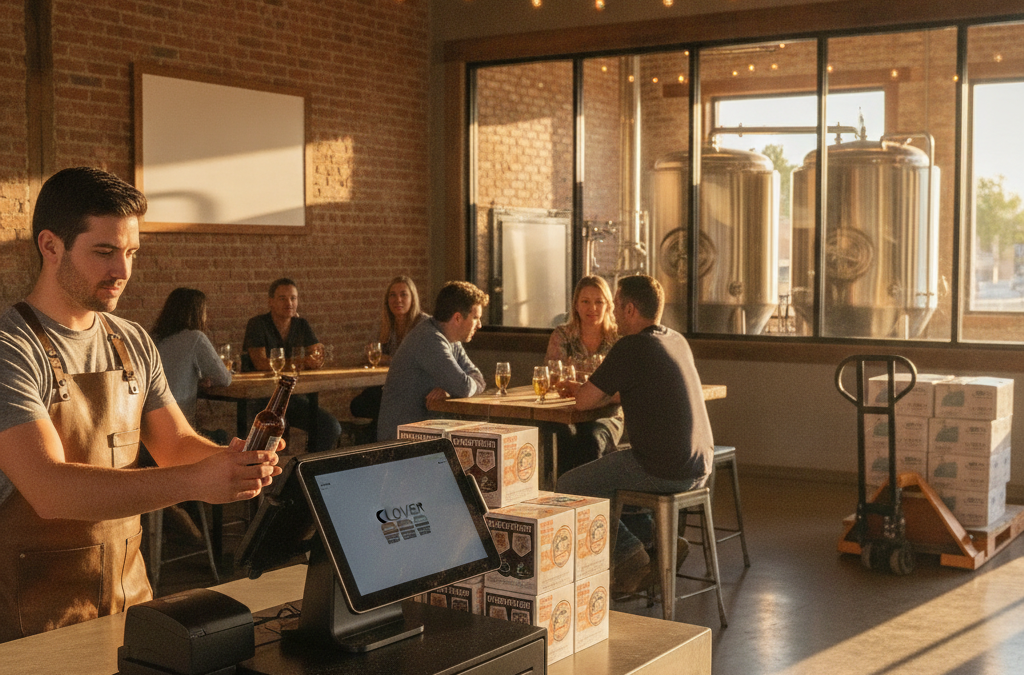
Your Taproom or Tasting Room Needs a Real POS — Not a Basic Card Reader
This is where most brewery and winery owners start, and it’s where the biggest mistakes happen. A lot of new operations grab a Square reader because it’s easy and the signup takes five minutes. That’s fine when you’re testing a concept, but once you’re running a full taproom with rotating tap lines, staff tip management, tab management, and merchandise sales alongside pint sales, you’re going to hit the ceiling on what a basic setup can handle.
What you actually need in a taproom or tasting room environment:
- Tab management — the ability to open a tab, add rounds, and close it at the end of the night without starting over
- Tip prompting on the screen — so your staff gets tipped properly on card transactions
- Inventory tracking — knowing when a keg or a bottle count is running low in real time
- Merchandise management — selling branded glassware, growlers, T-shirts, or crowlers alongside drinks
- Staff management — clocking in and out, tracking which server closed which tab
- Fast transaction speed — because nobody wants to wait at the bar while your system buffers
A Clover POS system handles all of this well for taproom and tasting room environments. The Clover Station is a solid anchor for your main bar — large screen, fast processing, receipt printer, and a customer-facing display built in. If you have table service or a patio, a Clover Flex handheld lets your staff take orders and run cards tableside without leaving the customer. For a smaller pour-only tasting bar, a Clover Mini keeps the footprint tight without sacrificing functionality.
The Clover App Market also lets you add tools specific to your operation — menu management, loyalty programs for regulars, and third-party integrations if you’re using a separate inventory system. It’s not a locked-down device; it grows with you.
Tasting Events, Beer Festivals, and Pop-Up Sales Require Mobile Payment Options
Arizona’s craft beverage scene is active year-round at outdoor festivals, farmers markets, and private events — and the snowbird season from fall through spring brings a major uptick in foot traffic to venues across Maricopa County. If you’re pouring at a tasting event in Old Town Scottsdale, setting up a booth at a Gilbert street festival, or doing a private barrel tasting at your facility, you need a payment setup that travels with you.
A wireless terminal or a mobile card reader paired with a smartphone or tablet works well for these situations. The key features to look for are WiFi and 4G/5G connectivity (so you’re not dependent on a venue’s spotty internet), contactless payment support for tap-to-pay, and store-and-forward capability — meaning the device can hold transactions locally and process them once you’re back in range if you’re somewhere with no signal. That last feature matters more than people think at outdoor Arizona events in the summer, where you’re sometimes in a tent far from any reliable network.
Online Bottle Sales, Wine Clubs, and Subscriptions Need an E-Commerce Setup
More Arizona wineries and craft distilleries are selling direct-to-consumer online, and that means you need a proper e-commerce payment gateway — not just a PayPal button. If you run a wine club with monthly shipments or a beer subscription, you need recurring billing built into your setup so charges go out automatically without you manually running cards each month.
An e-commerce or virtual terminal setup through a local merchant services provider gives you a payment gateway that integrates with your existing website shopping cart, supports tokenized card storage for recurring billing (so your customers’ card data is never stored on your server in raw form), and lets you key in orders manually for phone sales. This is also where fraud protection matters — online alcohol sales attract a higher-than-average rate of chargebacks from disputed transactions, and having tokenization and address verification working on your gateway from day one keeps that risk manageable.
Wholesale and Distributor Billing: This Is Where ACH Saves You Real Money
Here’s the section you won’t find covered on most local competitor sites, and it’s a meaningful gap for any brewery, winery, or distillery that sells to bars, restaurants, or distributors on a recurring or invoice basis.
When you’re billing a wholesale account — say, a restaurant group in Phoenix or a distributor picking up cases from your facility — running those transactions through a standard credit card terminal means you’re paying card processing fees on potentially large invoice amounts. At 2–3% per transaction, a $5,000 wholesale order costs you $100–$150 in processing fees alone. Multiply that across a dozen accounts every month and the math adds up fast.
ACH payments (bank-to-bank transfers) solve this. ACH fees are typically a flat per-transaction amount or a much lower percentage rate than card processing — often under $1 for a small fixed fee or well under 1% for larger transactions. For recurring B2B billing like wholesale accounts, distributor invoices, or wine club shipments where the customer has agreed to auto-pay, ACH is almost always the smarter choice. You can run ACH payments through a virtual terminal or billing platform, and your customers authorize the bank transfer once — then it runs automatically on the schedule you set.
If you’re not using ACH for your wholesale or high-volume recurring accounts, you’re leaving money on the table every single month.
Zero Cost Processing for Taproom Retail Sales
If your taproom sells merchandise, packaged product (cans, bottles, crowlers), or retail wine alongside pours, a cash discount or surcharge program can offset most or all of your card processing costs on those retail sales. Under a compliant surcharge or cash discount program, card-paying customers cover the processing fee — meaning your net on the sale is the same whether someone pays cash or taps their Amex. For a business that moves a lot of packaged product, the savings can be several hundred dollars a month.
These programs have specific compliance rules — different rules apply in different states, and the disclosure requirements matter. A local payments specialist can walk you through what’s allowed in Arizona and set it up correctly so you’re not exposed to chargebacks or card brand violations. Learn more about how these programs work at the Zero Cost Processing page.
What to Look for in a Payments Partner for Your Craft Beverage Business
Most national processors and big-box providers don’t specialize in the nuances of brewery or winery operations. They’ll hand you a generic restaurant setup and leave you to figure out the rest. What you want is a local merchant services provider who:
- Actually picks up the phone when your card reader goes down on a Friday night before a big event
- Understands that your business runs across multiple revenue channels — taproom, events, online, wholesale — and can set up the right solution for each
- Doesn’t lock you into a long-term contract with early termination fees
- Can provide next-day or same-day funding so your cash flow doesn’t lag behind your sales
- Will audit your current processing statement and show you exactly what you’re paying before you sign anything
That’s exactly how Good Payments Merchant Services works with craft beverage businesses across Scottsdale, Chandler, Cave Creek, and the broader Phoenix area. No hidden fees, no long-term commitments, and a real person to call when something needs to get fixed fast.
Frequently Asked Questions: Payment Processing for Arizona Breweries, Wineries, and Distilleries
Can I use Square for my taproom?
You can, especially in the early stages. But Square’s flat-rate pricing becomes expensive as your volume grows, its tab management is more limited than a dedicated restaurant or bar POS, and customer support is mostly self-serve. Once you’re doing consistent taproom volume, a Clover-based setup through a local provider usually saves money and gives you more functionality.
Do I need a separate merchant account for my online wine club versus my taproom?
Not necessarily — but your payment gateway for online sales and your taproom POS should be integrated or at least managed under the same provider relationship so your reporting is consolidated. A good local provider can set this up so you’re seeing all your revenue channels in one place.
Are brewery or winery merchant accounts considered high-risk?
Most domestic craft brewery and winery taproom accounts process without issue through standard merchant accounts. Online alcohol sales can be flagged by some processors due to age verification and shipping complexity, so it’s worth being upfront with your provider about the full scope of your sales channels. A knowledgeable local processor will know how to structure your account correctly from the start.
How does ACH work for wholesale distributor billing?
Your wholesale customer provides their bank routing and account number and authorizes you to pull payments. You initiate the transfer through your virtual terminal or billing platform on the invoice due date. Funds typically settle in 1–3 business days. The per-transaction cost is a fraction of what you’d pay running a card, which makes it the right choice for large or recurring B2B invoices.
What’s the best POS setup for a small tasting room that doesn’t have full bar service?
For a smaller pour-only tasting room in the Scottsdale or Cave Creek area, a Clover Mini or a Clover Flex is usually the right fit — compact, easy to use, handles tips and contactless payments, and doesn’t take up the whole counter. If you’re also selling retail bottles or merchandise, make sure your POS has inventory tracking enabled from day one.
Ready to Get the Right Payment Setup for Your Brewery or Winery?
Whether you’re opening a taproom in North Scottsdale, expanding your wine club online, or trying to figure out why your current processor is eating into your margins, Good Payments Merchant Services can help. We’ll review your current setup, show you exactly what you’re paying versus what you should be paying, and put together the right combination of POS, processing, and billing tools for your specific operation — with no pressure and no long-term contract required.
Reach out today for a free rate analysis and consultation. We serve craft beverage businesses across Scottsdale, Phoenix, Mesa, Gilbert, Chandler, Cave Creek, and throughout Maricopa County.