
What’s the Best Payment Setup for a Scottsdale or Gilbert Catering Business or Private Event Vendor?
If you run a catering business or work private events anywhere in the Scottsdale or Gilbert area, your payment needs are genuinely different from a typical storefront. You’re collecting deposits weeks out, taking final balances at the venue, sometimes splitting a payment across two cards for a client, and doing all of this at a Gainey Ranch estate, a Gilbert wedding hall, or a corporate event off the Loop 101 corridor — wherever the client happens to be. The right payment setup has to keep up with that. Here’s what actually works for catering and event vendors in the Valley.
Why Most Generic Payment Advice Doesn’t Fit Catering Businesses
The payment content put out by most national processors focuses on retail counters and restaurant tables. That’s not your world. You’re dealing with:
- Large ticket sizes — often $2,000 to $20,000+ per event
- Deposits collected weeks or months before the event date
- Final balances collected on-site at the event itself
- Occasional last-minute add-ons that need to be charged same day
- Clients who want to pay partly by card and partly by check or ACH
- Venues with unreliable WiFi — or no connectivity at all
A setup that works great for a Chandler coffee shop or a Mesa boutique can leave a caterer in a tough spot on event day. Let’s break down the components that actually matter.
Handling Deposits and Pre-Event Payments
For catering businesses, collecting a deposit is usually the first payment interaction you have with a client. You need a clean, professional way to send a payment request and collect that money remotely — before the event, often before you’ve even met the client in person.
A virtual terminal or online invoicing tool is the right fit here. You log in from any browser, key in the card details the client provides over the phone or via secure link, and the payment processes immediately. No card-present terminal required. Good Payments’ e-commerce and virtual terminal solutions are set up specifically for this kind of keyed or invoiced transaction, with real security behind every entry so you’re not taking on unnecessary chargeback risk when you key a card manually.
For higher-dollar deposits — say, anything north of $3,000 or $4,000 — it’s also worth offering ACH payment as an option. ACH processes bank-to-bank at a flat, low fee, which means you keep significantly more of that deposit compared to running a large card transaction. Many corporate event clients or high-net-worth clients in areas like Paradise Valley actually prefer ACH because it’s cleaner for their own bookkeeping. Offering it costs you nothing extra and can meaningfully cut your processing costs on big invoices.
Taking Payment On-Site at the Event
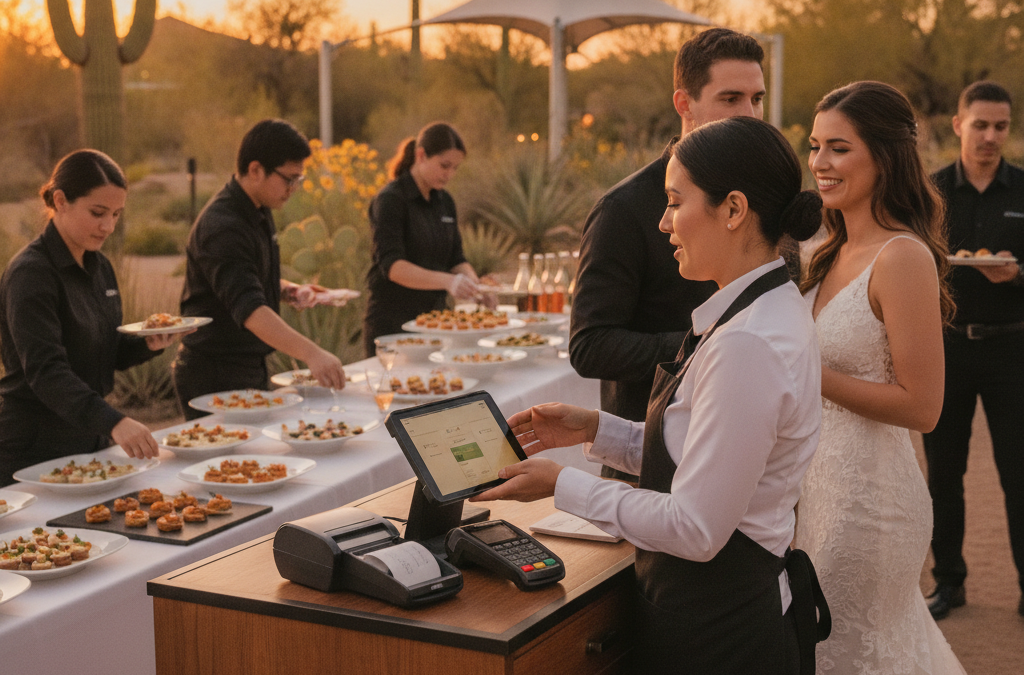
Event day is where a lot of caterers run into trouble. You’re at a venue — maybe a private estate in North Scottsdale, a banquet room in Mesa, or an outdoor venue in Gilbert with spotty cell service — and you need to collect a final balance or process an add-on charge right then.
This is where a wireless mobile terminal earns its keep. A good one runs on WiFi or 4G/5G, accepts chip, tap, and swipe, and — critically — has store-and-forward capability. That means if the connection drops, the terminal holds the transaction and processes it automatically once service is restored. You’re not stuck asking a client to wait or pull out a check.
The Clover Flex is a strong fit for catering and event vendors. It’s handheld, battery-powered, prints receipts, accepts all card types including contactless and Apple/Google Pay, and connects over both WiFi and cellular. If you’re running a larger operation with a team of servers or event staff, the Clover system also lets you track who processed what — which matters when you’re reconciling at the end of a busy event weekend. You can see the full Clover lineup here to compare models by use case.
The Gap Competitors Aren’t Covering: Large-Ticket Chargeback Risk for Caterers
Here’s something that almost none of the local competitor sites address for catering businesses specifically: large-ticket transactions carry real chargeback exposure, and caterers are more vulnerable than most.
Think about it. You charge $8,000 for a wedding reception. Two months later, the client disputes the charge — maybe the event didn’t meet expectations, maybe there was a miscommunication, or maybe they’re just trying to avoid paying. If your processing agreement isn’t set up correctly, and you don’t have proper documentation practices in place, that dispute can go against you — and you’re out $8,000 plus a chargeback fee.
A few things protect you here:
- Signed contracts and event agreements — have clients sign before any payment is collected
- Itemized receipts — document exactly what was provided and when
- Split billing — collecting a deposit up front and a final balance on event day creates a paper trail and reduces the size of any single disputed charge
- Tokenization — when you store a card on file for final billing, make sure your processor handles it through secure tokenization, not plain card storage
- Processor who knows your business — some processors flag caterers as higher-risk simply because of large average ticket sizes. You want a processor who understands the model and sets up your account accordingly, not one who freezes funds without warning
This is one area where working with a local merchant services rep — someone who actually knows how catering businesses operate in the Phoenix metro — makes a real difference over signing up for a self-serve national platform.
Zero Cost Processing: Worth It for Caterers?
With large event invoices, processing fees add up fast. A 2.5–3% fee on a $10,000 event is $250–$300 out of your pocket. That’s real money, especially if you’re doing 20 or 30 events a year.
A cash discount or surcharge program shifts that cost to clients who choose to pay by card, while clients who pay by cash, check, or ACH get the lower price. For catering businesses, this works particularly well because you have time before the event to communicate the pricing structure clearly — it’s not a surprise at the point of sale like it might be in a retail setting. Good Payments offers compliant Zero Cost Processing programs that are set up correctly under Arizona and card network rules, so you’re not creating compliance headaches for yourself down the road.
What to Look for in a Local Merchant Services Partner
Whether you’re based in Gilbert, operating across Maricopa County, or booking events from Chandler to Paradise Valley, the right payments partner for a catering business should offer:
- Virtual terminal or invoicing for remote deposit collection
- ACH as an option for large-balance clients
- A reliable mobile or wireless terminal with offline capability for event-day payments
- Clear guidance on chargeback protection and documentation best practices
- Transparent pricing — no surprise fees on large transactions
- No long-term contracts that lock you in if your business model shifts
- A real person to call if something goes sideways on a Saturday evening during an event
That last point matters more for catering than almost any other business type. Events don’t wait for Monday morning support tickets.
Frequently Asked Questions
Can I collect a deposit over the phone or online without a card-present terminal?
Yes. A virtual terminal lets you key in card details securely from any browser, or send clients a payment link they complete themselves. This is the standard approach for catering deposits and works well for any amount.
What happens if my wireless terminal loses signal at an outdoor venue in Gilbert or Scottsdale?
A terminal with store-and-forward technology holds the transaction locally and processes it automatically once connectivity is restored. This is a feature you should confirm before you commit to any mobile terminal — not all have it.
Is ACH a realistic option for collecting large event balances from clients?
Absolutely. Many corporate clients and high-end residential clients in the Phoenix metro prefer it. ACH fees are significantly lower than card fees, and for balances of $3,000 or more the savings are meaningful. You can offer it alongside card as a client choice.
How do I protect myself from chargebacks on large catering invoices?
Signed contracts, itemized receipts, split payments (deposit plus final balance), and a processor who sets up your account to match your business model are your main tools. Tokenized card-on-file storage also helps when you’re billing the final balance after the event.
Does Good Payments work with catering businesses across the Valley, not just Scottsdale?
Yes. Good Payments serves catering businesses, private event vendors, and hospitality operators across Maricopa County — including Gilbert, Mesa, Chandler, Phoenix, and Paradise Valley. If you’re operating anywhere in the East Valley or the broader Phoenix metro, reach out and we can walk through the right setup for your specific situation.
Ready to Set Up Payment Processing That Fits How You Actually Work?
Catering and private event businesses in Scottsdale and across the Valley deserve a payment setup built around how they operate — not a generic retail solution that creates headaches on event day. At Good Payments Merchant Services, I work directly with business owners to find the right combination of tools: virtual terminals for deposits, mobile solutions for event-day payments, ACH options for large invoices, and real chargeback protection built in from the start. No long-term contracts. No hidden fees. Just straightforward support from someone who picks up the phone.
Contact Good Payments today for a free rate analysis and consultation — and let’s make sure your payment setup is ready before the next event on your calendar.