

What’s the Best Payment Setup for a Scottsdale or Chandler Liquor Store or Wine Shop?
If you own a liquor store or wine shop in Scottsdale, Chandler, or anywhere across Maricopa County, you already know that your margins aren’t exactly generous. Rent is up, inventory costs are real, and every time a customer swipes a card — which is basically every transaction — you’re handing a slice to your processor. The good news is that a well-matched payment setup can take that sting down significantly, while also giving you the POS tools your business actually needs. Let’s break down what works, what doesn’t, and what to avoid.
Why Liquor Stores Get Burned by Generic Payment Processors
Here’s a frustration that comes up often with liquor store owners: they sign up with a national processor or a cheap flat-rate provider, everything looks fine for a few months, and then they notice the fees creeping up. Or worse, they find out mid-setup that their processor flags alcohol retail as elevated-risk and starts holding funds or adding reserves. That’s a real problem when you’re trying to keep your coolers stocked and your shelves rotated before the weekend rush.
The truth is, most of the big national names — and a lot of the smaller local processors that never really explain their rate structure — don’t specialize in retail liquor or wine. They’ll put you on a generic retail rate, skip any real conversation about your transaction mix, and leave you figuring out the rest. If your average ticket runs between $30 and $80, and you’re processing a solid volume, even a small rate difference per transaction compounds fast over a month.
Working with a local specialist who will actually review your statement, explain the interchange categories that hit your business hardest, and set up a pricing structure that fits your volume — that’s worth more than a flashy sign-up bonus from a processor you’ll never speak to again.
The Right POS System for a Liquor Store or Wine Shop in Arizona
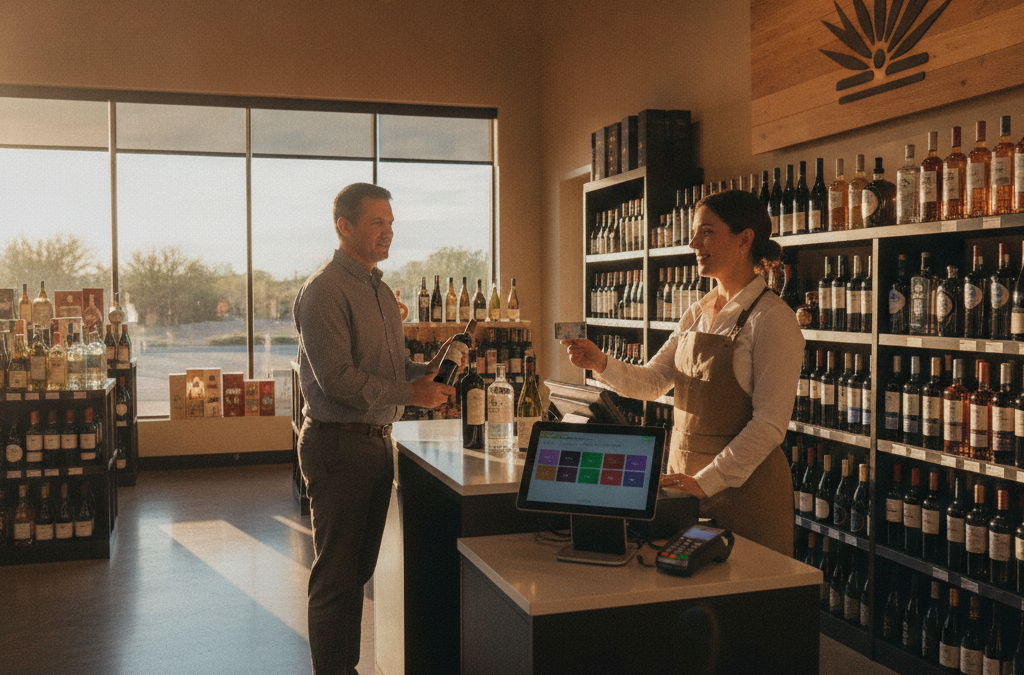
Your POS needs to do more than ring up sales. In a liquor store environment specifically, you need a system that handles high transaction speed (nobody wants a line at 5:30 on a Friday), inventory management across potentially hundreds of SKUs, and age verification prompts that keep your staff compliant without slowing everything down.
The Clover POS family is a strong fit for most liquor store and wine shop setups across the Valley. Here’s how the different devices map to different store types:
- Clover Station: Best for your main checkout counter. Full touchscreen, receipt printer, customer-facing display — it handles the volume and speed you need on a busy Saturday without hiccups. The inventory management tools are solid for tracking bottles, cases, and mixed packs.
- Clover Mini: Good option if you have a smaller footprint — a boutique wine shop in North Scottsdale or a neighborhood bottle shop where counter space is tight. It does everything the Station does in a more compact format.
- Clover Flex: Useful if you have a secondary checkout area, a tasting counter, or if your staff sometimes needs to ring someone up in the aisle during a busy period. Handheld, wireless, and still connected to your same inventory and reporting.
Clover’s App Market also gives you access to add-ons for age verification prompts, employee shift management, and loyalty programs — all relevant for a liquor or wine retail environment. You’re not locked into a one-size setup; you build it around your store.
How Zero Cost Processing Can Change the Math for High-Volume Retailers
This is the section most of your competitors — and most generic processors — either skip entirely or gloss over. For a liquor store in Chandler or Scottsdale processing $50,000 or more per month in card sales, your monthly processing fees could easily run $1,200–$2,000 or higher depending on your current rate. That’s real money leaving your business every single month.
A Zero Cost Processing program — either a cash discount or a compliant surcharge program — passes that cost to the card-paying customer rather than absorbing it yourself. Done correctly and compliantly, this is completely legal in Arizona and is increasingly common in retail, particularly in higher-volume categories like liquor and grocery.
The difference between cash discount and surcharge matters, and it matters for your signage, your customer communication, and your compliance posture. A cash discount program offers a discount to customers who pay with cash. A surcharge program adds a line item to card transactions. Both can effectively eliminate your processing fees, but they’re implemented differently and come with different disclosure requirements. This is exactly the kind of nuance that a local specialist walks you through — not something you want to figure out on your own after the fact.
Age Verification, Compliance, and What Your POS Should Handle
This is a gap that the big national processors and generic POS companies rarely address for liquor retailers specifically. Age verification isn’t just a best practice — it’s a legal requirement, and a POS system that doesn’t prompt your cashiers at the right moment puts your license at risk.
Clover and several CardPointe-integrated setups allow you to configure ID check prompts that trigger automatically on flagged product categories. Your staff gets the reminder on screen before the transaction completes. It’s a small thing operationally, but it matters enormously from a liability standpoint — especially during snowbird season when Scottsdale and Gilbert see significantly higher foot traffic and newer staff are often brought on.
If you’re running a wine shop that also does tastings, or a bottle shop that hosts events, you want a system flexible enough to handle both retail sales and event-style transactions without forcing you to manage two separate setups.
What to Look for in a Local Payment Partner for Your Liquor or Wine Business
A few things matter a lot more than most processors will tell you upfront:
- No long-term contracts. You shouldn’t be locked in for three years if the service isn’t working for you. Ask specifically about early termination fees before you sign anything.
- Transparent pricing. Ask for an interchange-plus rate quote and a full fee schedule. If a processor won’t show you that clearly, walk away.
- Next-day funding. Liquor retail runs on tight cash flow. Waiting 2–3 days for your deposits to clear creates unnecessary stress when you need to reorder inventory.
- Someone who picks up the phone. When your terminal goes down on a Friday afternoon, you need a local contact — not a national support queue with a 45-minute hold time.
- Experience with your industry. Ask whether they’ve worked with other liquor retailers or wine shops in the Phoenix metro. The specifics of your business matter.
At Good Payments Merchant Services, we work with retail merchants across Scottsdale, Chandler, Gilbert, Tempe, Mesa, and the broader Phoenix metro. We’re not a faceless processor — you’re talking to Zoltan Hardi directly, and if something isn’t right with your setup, we fix it. That’s the difference between a local partner and a 1-800 number.
Frequently Asked Questions: Liquor Store and Wine Shop Payment Processing in Arizona
Is a liquor store considered high-risk for payment processing?
Some processors flag alcohol retail as elevated-risk, particularly high-volume stores or those with online sales. In practice, a well-established brick-and-mortar liquor store with good processing history is not treated the same as a truly high-risk merchant category. Working with a processor who understands the distinction matters — you shouldn’t be paying high-risk rates if your business doesn’t warrant them.
Can I use Square or Stripe for my liquor store?
You can, but both Square and Stripe have been known to hold funds or terminate accounts in alcohol-related retail without much warning. Flat-rate pricing also tends to be expensive for higher-volume stores. A dedicated merchant account through a processor who specializes in retail gives you more stability, better rates at volume, and actual support when something goes wrong.
How much can Zero Cost Processing actually save my store?
That depends on your monthly card volume and current effective rate. For a store processing $60,000 per month at a 2.5% effective rate, that’s $1,500 per month — $18,000 per year — in processing fees. A properly implemented Zero Cost Processing program can eliminate the majority of that cost. Contact us for a free rate analysis specific to your numbers.
Does Clover POS support wine and spirits inventory management?
Yes. Clover handles multi-SKU retail inventory well, including product categories, pricing tiers, and low-stock alerts. For more advanced wine-specific inventory (vintage tracking, bin locations, etc.), there are third-party integrations available through Clover’s App Market that extend those capabilities without replacing your core POS.
What if I already have a processor and I’m mid-contract?
You may have options. Some contracts have provisions that allow switching if the processor materially changes their terms or fees. Even if you’re stuck until your contract ends, we can review your current statement now, show you what you’d save, and have a plan ready to implement the moment you’re free. Many merchants across Chandler and Scottsdale have made the switch and recouped their savings quickly.
Ready to Get Your Payment Setup Right?
If you’re running a liquor store or wine shop in Scottsdale, Chandler, or anywhere across Maricopa County and you’re not sure whether your current payment setup is actually working for you — let’s find out. A free rate analysis costs you nothing and takes about 15 minutes. You’ll walk away knowing exactly where your money is going and what a better setup would look like for your specific business.
Reach out to Good Payments Merchant Services today and let’s talk through your setup. No pressure, no jargon — just a straight conversation about what makes sense for your store.