


How Should a Scottsdale or Glendale Hair Salon, Barbershop, or Nail Studio Set Up Payment Processing?
If you own or manage a hair salon, barbershop, or nail studio in Scottsdale or Glendale, you need a payment setup that handles tipping cleanly, collects deposits for appointments, and keeps booth renters’ money separate from your own — all without eating up a big chunk of every service ticket in processing fees. The good news is that getting this right isn’t complicated once you know what to look for. The bad news is that most generic processors — and even some well-known local ones — set up beauty businesses the same way they’d set up a hardware store, and that creates problems fast.
This guide covers exactly what a salon or barbershop in the Phoenix metro should expect from a payment setup, what to ask before you sign anything, and how to make sure your system actually fits the way you work.
Why Beauty Businesses Have Unique Payment Needs
Most payment processors treat every service business the same. But a hair salon in North Scottsdale or a nail studio near Glendale’s Westgate district has a very specific mix of needs that a one-size-fits-all terminal can’t handle well:
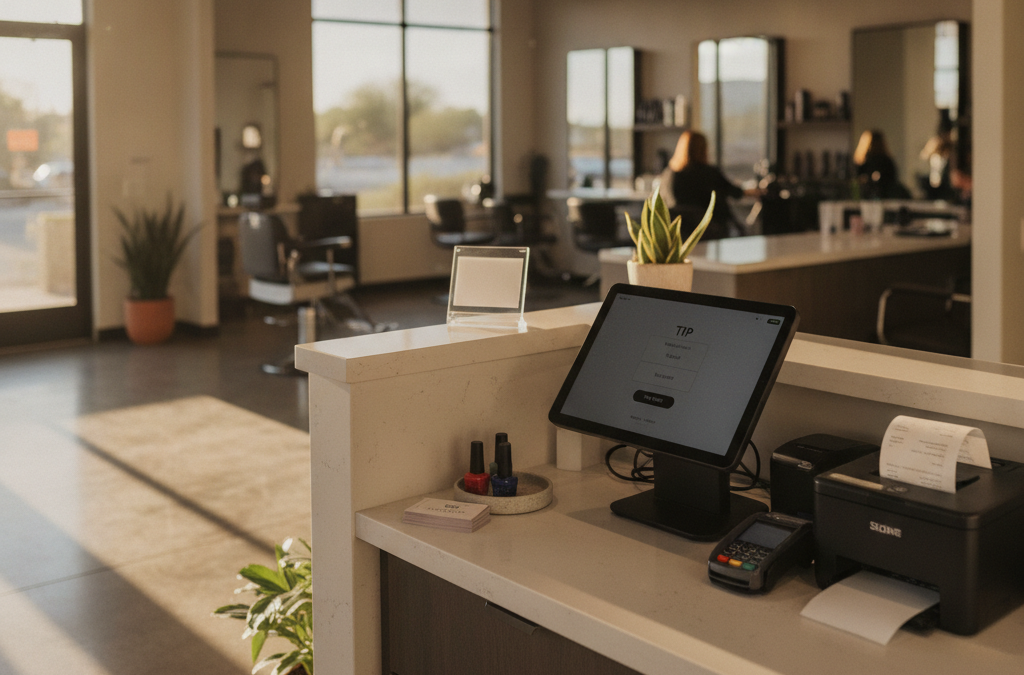
- Tipping on card transactions — Clients tip at checkout, often on a touchscreen. If your system doesn’t make this easy and accurate, stylists end up shortchanged or you’re reconciling tip discrepancies every week.
- Appointment deposits and no-show fees — Collecting a deposit online or over the phone when someone books is essential for protecting your chair time, especially during busy snowbird season when high-end salons in Scottsdale fill up fast.
- Booth rental and multi-stylist environments — If you rent chairs to independent stylists, their card transactions need to be separate from yours. Mixing revenue streams creates a bookkeeping mess and potential tax headaches.
- Split service tickets — One client gets a color, a cut, and a gloss treatment from two different people. How your system handles splitting and assigning those tickets matters.
- Gift cards and loyalty — Salons live on repeat clients. A POS that supports gift card programs and simple loyalty rewards keeps clients coming back.
These aren’t exotic features — they’re the basics for any busy beauty business. But many processors in Maricopa County still hand salons a basic countertop terminal and call it a day. That’s where things go sideways.
The Right POS Setup for a Salon or Barbershop
For most full-service salons and barbershops, a Clover POS system is worth a serious look. Here’s how the hardware line-up maps to different salon types:
Clover Station — Full-Service Salons and Multi-Chair Shops
The Clover Station is a full countertop system with a customer-facing display, making tipping at checkout natural and easy. It handles employee management, tracks individual stylist performance, runs gift cards, and integrates with salon-specific apps from the Clover App Market. If you have a front desk managing check-in, checkout, and retail product sales, the Station fits that workflow well.
Clover Mini — Boutique Salons and Single-Operator Studios
For a smaller footprint — a two-chair suite in Old Town Scottsdale, for example, or a solo nail tech in a studio — the Clover Mini gives you most of what the Station does in a much more compact package. It still supports tipping, gift cards, and inventory for retail products, without taking over your whole counter.
Clover Flex — Mobile Stylists and Chair Renters
If you have stylists who work the floor and want to check out clients right at the chair, the Clover Flex is a handheld device with a built-in printer that does exactly that. It’s also a solid option for booth renters who want their own device tied to their own account.
The Booth Rental Problem Nobody Talks About
This is one of the biggest gaps you’ll find when looking at how competitors and generic processors handle salon setups. Booth rental is extremely common across Phoenix and the surrounding Valley — a salon owner leases chair space to independent stylists, and each stylist runs their own business, takes their own clients, and keeps their own money.
The problem comes when everyone is running cards through the same merchant account. That creates commingled funds, which gets messy for taxes, for liability, and frankly for trust between the salon owner and the renters.
The clean solution is a separate merchant account for each booth renter, or a platform that clearly separates transactions by stylist. At Good Payments, we can set up individual accounts for renters who want their own processing, or configure a shared system with clear reporting separations. Either way, you’re not left trying to figure out whose money is whose at the end of the month.
How a Cash Discount Program Can Save a Salon Real Money
Processing fees add up fast in a salon environment. If your average ticket is $80 and you’re running 30 transactions a day, you’re processing over $2,000 a day — and a standard 2.5–3% rate means you’re handing $50–$60 a day back to the processor. That’s $1,500 a month or more, just in fees.
A Zero Cost Processing program — either a cash discount or a card surcharge structure — can eliminate most or all of that. Under a cash discount model, you post a slightly higher service price and offer a discount to clients who pay cash. Clients who pay with a card pay the posted price; you keep the full amount, and your processor absorbs the processing cost from the program structure.
Done correctly and with proper signage, this is fully compliant and very common in the beauty industry. Done sloppily — without clear disclosures or properly structured pricing — it creates customer confusion and potential compliance issues. A local rep who actually knows the rules makes a big difference here. We set these up for salons across the Phoenix metro regularly and can walk you through exactly how it looks at your front desk.
Collecting Deposits and Booking Fees Online
No-shows cost salons money. The ability to require a card on file or collect a deposit when someone books online is essential — particularly during peak tourist and snowbird season, when salons in Scottsdale and Paradise Valley are booked out weeks in advance and a last-minute cancellation is a real financial hit.
If you’re using an online booking platform, you want a payment processor whose gateway integrates cleanly with it. Many booking platforms (Vagaro, Boulevard, Booksy, and others) have their own built-in processing, but that’s often more expensive per transaction than setting up a dedicated merchant account. We can walk you through whether it makes sense to use the processor built into your booking software or keep processing separate and connect via integration.
For salons that take deposits or charge cancellation fees by phone, a virtual terminal lets you key in a card number without the client physically being present — securely and compliantly.
What to Watch Out for When Choosing a Processor
Whether you’re a first-time salon owner in Glendale or you’ve been running a shop in North Scottsdale for years and are just tired of your current processor, here’s what to look for:
- No long-term contracts. You should never be locked in for three years with early termination fees. Good Payments does not require long-term commitments.
- Transparent pricing. Ask for the full rate schedule in writing before you sign. If someone quotes you a rate but won’t show you what other fees apply, that’s a red flag.
- Tip adjustment support. Confirm that tip adjustments are handled properly and that your stylists see accurate numbers on their end-of-day reports.
- Local support that picks up the phone. When your system goes down at 11am on a Saturday with a full book of appointments, you need someone who answers — not a national call center queue.
- Next-day funding. Cash flow matters. Look for a processor that can fund your account the next business day.
Frequently Asked Questions
Can each stylist in my Scottsdale salon have their own merchant account?
Yes — if you have booth renters operating as independent businesses, they can and ideally should have their own merchant accounts. We can set these up individually so each stylist’s funds go directly to their own bank account.
How does tipping work on a Clover system at checkout?
Clover’s customer-facing display prompts the client to add a tip at checkout — you can customize preset tip percentages or let them enter a custom amount. Tips are tracked by employee, making end-of-day reconciliation straightforward.
Can I charge a cancellation fee if someone no-shows at my Glendale barbershop?
Yes, if you have a card on file for the client. With a properly configured merchant account and virtual terminal access, you can charge a stored card for a cancellation or no-show fee, provided you disclosed that policy at the time of booking.
Is a cash discount program legal in Arizona?
Yes. Arizona does not prohibit cash discount or surcharge programs at the state level. You do need to follow card network rules around proper disclosure and signage, which we handle for every business we set up on these programs.
What if I’m already locked into a contract with another processor?
It depends on your contract terms and what it would cost to exit early. Sometimes the savings from switching outweigh the exit fee; sometimes it makes sense to wait. We’ll give you an honest read on your current statement and help you figure out the best timing — no pressure either way.
Ready to Set Up Payment Processing That Actually Fits Your Salon?
Good Payments Merchant Services works with salons, barbershops, nail studios, and beauty businesses across Scottsdale, Glendale, Phoenix, and the rest of the Valley. Zoltan Hardi and the team know the beauty industry’s quirks — tipping, booth rental, deposits, retail product sales — and we’ll put together a setup that fits how your business actually runs, not how a national processor thinks it should.
No long-term contracts. No hidden fees. Local support that answers the phone. Reach out today for a free rate analysis and let’s figure out what payment processing should actually cost your salon.