


How Should a Scottsdale or Phoenix Florist, Gift Basket, or Seasonal Pop-Up Shop Set Up Payment Processing?
If you run a flower shop, gift basket operation, or seasonal pop-up in Scottsdale or the broader Phoenix metro, payment processing probably isn’t your favorite topic — but it deserves serious attention. Your business doesn’t fit neatly into a single category. You might have a storefront in North Scottsdale for most of the year, then pivot to outdoor markets and holiday pop-ups in Old Town or Gilbert during peak season. You take large orders over the phone, deliver across Maricopa County, and sometimes need to swipe a card in the middle of a parking lot at a craft fair. A payment setup that only works in one of those situations isn’t really a payment setup — it’s a gap waiting to cause a problem.
The good news: getting this right isn’t complicated once you understand what your business actually needs. Let’s walk through it.
Why Florists and Gift Businesses Have Unusual Payment Needs
Most payment processors — especially the big national ones — are built around businesses with predictable, consistent volume. A florist or seasonal pop-up in the Phoenix area is anything but that. You might process $4,000 in a slow July week and $40,000 in the two weeks before Valentine’s Day or Mother’s Day. That kind of volume swing can actually trigger holds or reserves with processors that aren’t prepared for it, which is a nightmare when you’re trying to pay your suppliers and staff during your busiest stretch.
On top of that, you’re likely collecting payments through multiple channels at once: in-store, over the phone, online orders, delivery drivers running a card on-site, and outdoor market booths. If your payment setup doesn’t cover all of those without requiring four different apps or accounts, things get messy fast.
What Does a Good Payment Setup Actually Look Like for This Type of Business?
Start with a Flexible POS That Travels With You
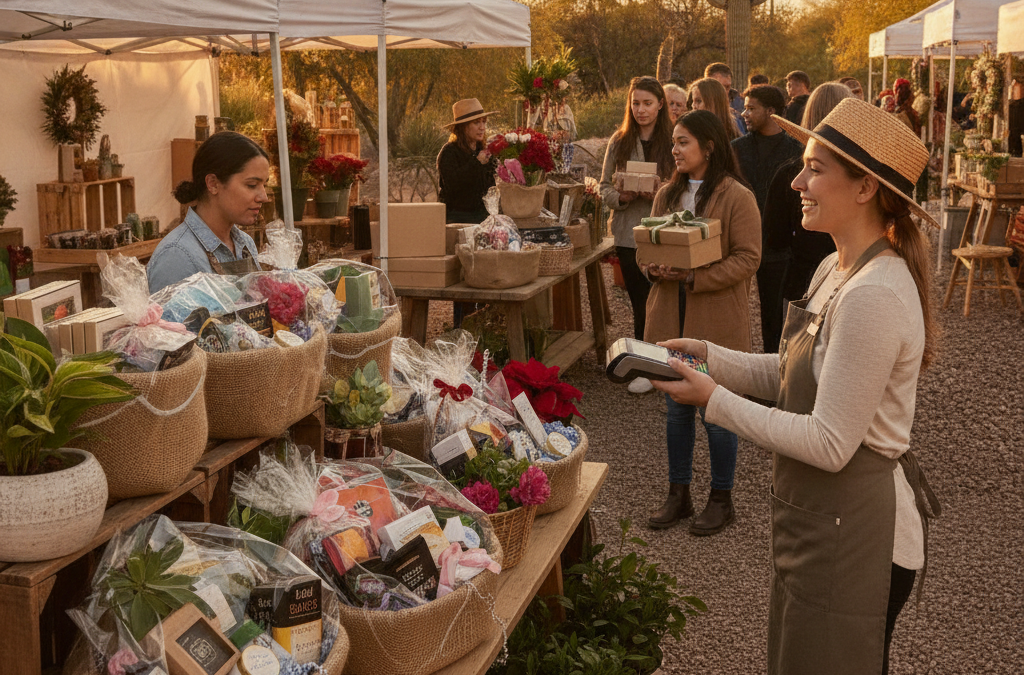
If you have a physical location — even a seasonal one — a countertop terminal or full POS makes sense for the front desk. But for a business that also does outdoor markets, delivery runs, or pop-up events, you need something portable. The Clover Flex is worth a close look here. It’s a handheld device that runs on WiFi or cellular, accepts chip, tap, and swipe, prints receipts, tracks inventory, and keeps a full transaction history — all in a device small enough to tuck in an apron pocket.
For pure storefront operations that don’t move around, the Clover Mini is a clean countertop option that handles sales quickly without taking up much counter space. If you need full inventory management, employee time tracking, and reporting across a busier shop, the Clover Station makes more sense.
The point is: one device, one account, one reporting dashboard — not a patchwork of tools that don’t talk to each other.
Plan for Offline Processing Before You Need It
This is the one thing that almost nobody talks about, and it can save your day at an outdoor market. WiFi at venue-hosted events in Scottsdale or Tempe is unreliable at best. Cellular signals at some locations in the Valley drop at the worst times. You need a terminal or POS device that supports store-and-forward processing — meaning it queues transactions locally when there’s no connection and submits them automatically once connectivity is restored.
If you’re vending at markets like the Old Town Scottsdale Farmers Market or pop-up holiday events in Gilbert or North Scottsdale, this isn’t optional. It’s essential. Ask your processor specifically whether their mobile devices support offline mode before you sign anything.
Don’t Ignore Phone and Online Orders
A significant portion of florist revenue comes from phone orders — customers calling to arrange delivery for a wedding, funeral, or last-minute gift. You need a way to key in card numbers securely without writing them on a sticky note. A virtual terminal — essentially a secure web-based form you can open on any computer — handles this cleanly. If you’re also taking orders through your website, you’ll want an e-commerce gateway that connects to your existing site without requiring a full rebuild.
Recurring billing is worth considering too if you serve corporate accounts, restaurants, or event venues on a regular delivery schedule. Setting those clients up on ACH payments (bank-to-bank transfers) instead of card transactions can reduce your per-transaction fees significantly on larger, predictable invoices.
The Snowbird and Seasonal Swing Problem — and Why Your Processor Needs to Understand It
Florists and gift businesses in the Scottsdale and Phoenix area deal with a seasonal volume curve that’s more extreme than almost any other retail category. October through April brings snowbird traffic, corporate events, holiday gifting, and wedding season all at once. June through September is a different world. A national processor that sees your account spike to ten times your normal volume in February may flag it for review or freeze your deposits at exactly the wrong moment.
Working with a local payments partner who understands the Valley’s seasonal business cycle — and who you can actually call when something goes wrong — is a real advantage here. When you’re dealing with a Mother’s Day volume surge and your funds suddenly go on hold, you don’t want to spend forty-five minutes navigating a 1-800 number. You want someone who picks up the phone and knows your account.
Zero Cost Processing: Worth Considering for Seasonal and Event-Based Sales
Processing fees add up fast during a holiday rush. On a $150 floral arrangement, a 2.7% swipe fee is over $4 — not enormous on a single transaction, but meaningful when you’re running 200 transactions over Valentine’s weekend. A cash discount or surcharge program passes the processing cost to card-paying customers while offering a small discount to cash payers. Done correctly and transparently — with proper signage and disclosure — this is a legitimate and increasingly common practice across Arizona retail.
It’s not right for every business. If your clientele skews toward high-end buyers in DC Ranch or Gainey Ranch who expect a frictionless checkout experience, adding a surcharge might create friction you don’t want. But for a pop-up booth at a community market in Gilbert or Tempe where margins are thinner, it’s worth at least understanding how it works before you decide.
What to Watch Out for When Choosing a Processor
- Long-term contracts: A seasonal or growing business shouldn’t be locked into a three-year agreement with an early termination fee. Look for month-to-month arrangements.
- Volume-based holds: Ask directly how your processor handles sudden volume spikes. Get the answer in writing if possible.
- Equipment rental fees: Some providers bury ongoing rental fees into your monthly statement for equipment you could have purchased or received free on a qualifying plan.
- Separate apps for each sales channel: If your in-store, mobile, and online payments all report to different dashboards, you’ll waste time reconciling them. Ask for a unified reporting view.
- Next-day or same-day funding: During high-volume stretches, waiting two or three days for funds to settle creates real cash flow stress. Ask about funding timelines upfront.
Frequently Asked Questions
Can I use the same payment account for my storefront and my outdoor market booth?
Yes, and you should. A properly set up merchant account with the right equipment lets you run transactions from a fixed countertop terminal, a handheld mobile device, or an online gateway — all under one account with unified reporting. You don’t need separate accounts for each channel.
What happens if my card reader loses signal at an outdoor market in Scottsdale or Gilbert?
If your device supports store-and-forward (offline processing), it will queue the transaction and submit it automatically when connectivity returns. Not all devices support this feature, so confirm it before you show up at your first outdoor event. It’s a must-have for any vendor doing outdoor markets in the Valley.
Do florists in Phoenix typically get flagged for high-risk processing?
Standard floral and gift retail is not considered high-risk, but dramatic volume spikes around holidays can trigger automated fraud reviews with some processors. Being upfront with your processor about your seasonal volume pattern — and choosing one who understands it — prevents most of these issues before they happen.
Is Square good enough for a florist or pop-up gift shop?
Square is easy to start with and fine for very low-volume casual selling. But as your business grows, the flat-rate pricing becomes expensive compared to interchange-plus pricing, and the lack of a local support contact becomes a real frustration when you have a problem on your busiest weekend of the year. You also have no advocate if Square freezes your account — which does happen to seasonal businesses with atypical volume patterns.
How do I handle phone orders and corporate gift accounts securely?
A virtual terminal lets you key in card numbers through a secure, encrypted web interface — no physical card required. For corporate accounts on regular delivery schedules, ACH payments are often cheaper and more reliable than running a card every time. Both options are available through Good Payments without needing separate software.
Ready to Set Up Payments That Actually Work for Your Flower Shop or Pop-Up?
Whether you’re running a full-service florist in North Scottsdale, launching a seasonal gift pop-up for the holidays, or selling at markets across the Phoenix metro, Good Payments Merchant Services can put together a payment setup that fits how your business actually operates — not how a national processor assumes it does. No long-term contracts, no hidden fees, and a local contact who picks up the phone when something needs attention.
Reach out for a free rate analysis and let’s make sure your busiest season runs without a single payment hiccup.