What’s the Best Way for a Scottsdale or Chandler Retail Business to Accept Payments During Pop-Up Events and Craft Fairs?
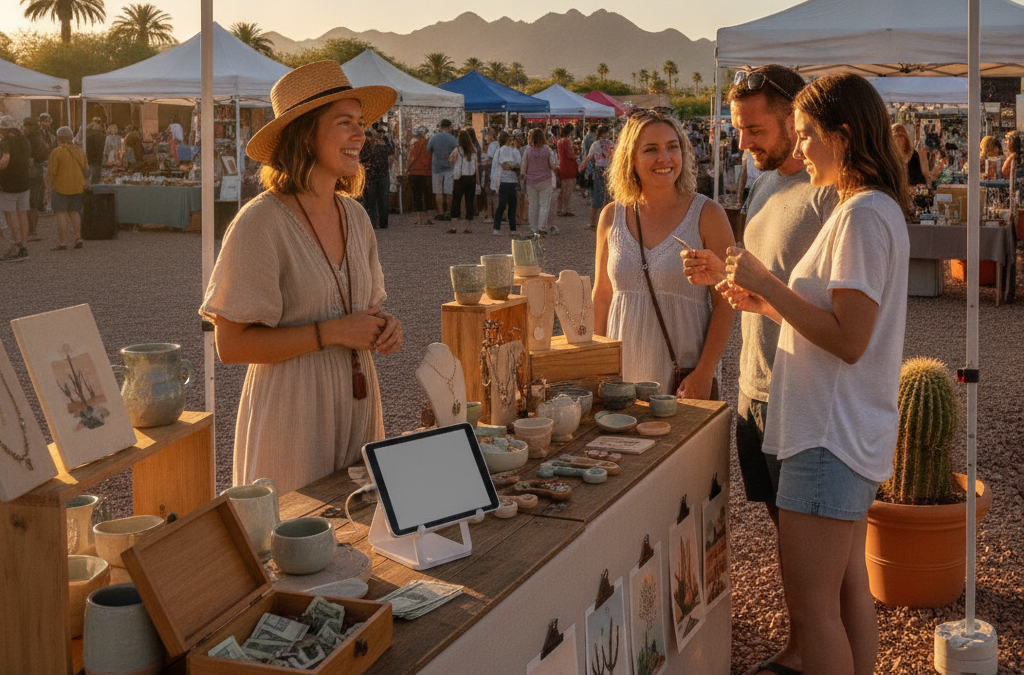
If you’re setting up a booth at the Old Town Scottsdale Farmers Market, the Chandler Ostrich Festival, or one of the dozens of weekend craft fairs that run through Maricopa County from October through April, the short answer is this: you need a mobile payment solution that works without depending on a stable WiFi connection, settles funds fast, and doesn’t cost you a chunk of your weekend sales in processing fees. What you don’t need is a clunky setup cobbled together at the last minute — or a payment app that freezes when the venue’s shared WiFi goes down.
This guide is specifically for small retailers, artisans, and makers who do brick-and-mortar sales part of the time but also run pop-up booths, market stalls, or craft fair tables throughout the Valley of the Sun. Let’s break down what actually works.
Why Pop-Up Payment Processing Is Its Own Problem
Running a pop-up isn’t the same as running a storefront, and your payment setup shouldn’t be treated that way either. At a fixed retail location, you’ve got a stable internet connection, a counter, a power outlet, and time to troubleshoot. At a craft fair tent in Gilbert or a pop-up market in Tempe, you’re working with whatever connectivity you can get, a folding table, and a line of customers who are not going to wait around while you restart an app.
The specific challenges that trip up pop-up vendors:
- Connectivity gaps. Shared venue WiFi is unreliable. If your payment terminal can’t fall back to 5G or LTE — or store transactions offline — you’ll lose sales.
- Speed at peak hours. Craft fairs get busy in waves. A slow checkout kills momentum and loses you customers who walk off.
- Battery life and portability. Hauling a full countertop POS system to a tent is not realistic. You need something handheld or compact.
- Fee bleed on low-margin items. If you’re selling $15 handmade candles or $30 jewelry, a flat-rate processor eating 2.6% + 10¢ per transaction adds up across a weekend.
- Next-day funding. You front the booth fee, inventory costs, and travel — you want your weekend’s revenue in your account Monday morning, not Friday.
The Right Hardware for Event and Market Selling
Not every payment device is suited for life outside a storefront. Here’s how the main options shake out for Phoenix metro pop-up vendors.
Clover Flex — The Best All-Around Option for Most Pop-Up Sellers
The Clover Flex is a handheld device that runs on WiFi or 4G/LTE, prints receipts directly, handles chip, swipe, tap, and mobile wallets, and has a battery built for full-day events. It’s the closest thing to a portable full-featured POS you can get without dragging a tablet and separate reader everywhere.
What makes it a good fit for craft fair sellers specifically:
- Built-in receipt printer — no separate Bluetooth printer to manage
- Cellular backup so you’re not dependent on venue WiFi
- Inventory management so you can track what sold across a weekend
- Employee-level permissions if you have a helper working the booth with you
If you already use a Clover Station or Mini at your storefront, the Flex ties into the same account — same inventory, same reporting, same customer data. That matters if you’re a Scottsdale boutique that also does Old Town pop-up nights or DC Ranch community events.
Clover Go — The Lightweight Backup or Starter Option
The Clover Go is a small card reader that pairs with your phone via Bluetooth. It accepts chip and contactless payments and works well as a secondary device or for very early-stage vendors who aren’t ready to invest in a full handheld terminal. It doesn’t print receipts natively and doesn’t have cellular fallback on its own — it depends on your phone’s data connection. For a high-volume event day, most sellers outgrow it quickly, but it’s a reasonable low-cost entry point.
Wireless Standalone Terminals
If you’re not interested in the Clover ecosystem and just need a reliable device that takes cards, a wireless mobile terminal running on 4G is a straightforward option. These connect directly to the cellular network, require no phone pairing, accept all card types including contactless, and are built for all-day use. They’re popular with craft vendors who want something simple and durable without managing apps.
The Feature Competitors Don’t Talk About: Offline Mode
This is the gap most local competitors and national processors gloss over in their content — and it’s one of the most important features for outdoor event sellers in the Phoenix metro.
Outdoor markets, parking lot pop-ups, and festival grounds often have spotty connectivity. If your payment device requires a live internet connection for every transaction, you will hit a wall at some point during a busy event day. The better hardware options — including certain Clover devices and dedicated wireless terminals — support store-and-forward mode, which means transactions are queued locally and submitted automatically when the connection restores.
There is a caveat worth knowing: in offline mode, the processor can’t verify cards in real time, so there’s a small theoretical risk of a declined card going undetected until sync. In practice, for small to mid-ticket sales at craft fairs, this risk is minimal — and far less costly than losing sales entirely because your reader won’t connect. Ask your payments provider specifically how their offline mode works and what the transaction limits are before your first event.
Zero Cost Processing at Events — Does It Make Sense?
A lot of craft fair and pop-up vendors are now asking about zero cost processing — passing the processing fee to the customer as either a cash discount or a surcharge. If you’re selling $20–$80 handmade or specialty goods, trimming 2–3% off each card transaction can mean a meaningful difference across a weekend’s sales.
Zero cost processing programs are legal in Arizona and increasingly common at markets and pop-ups across Chandler, Mesa, and Gilbert. The key compliance points: cash discount programs require you to post a regular price and show the discount for cash payment. Surcharge programs require proper signage and disclosure before the transaction. Neither is complicated — it’s mostly about having the right signage at your booth and using hardware that handles the math automatically.
Not every buyer at a craft fair will love it, but most are used to seeing it at small vendors by now. If you’re doing consistent event volume, it’s worth a conversation.
Funding Speed Matters More at Events Than People Realize
Here’s something to think about if you’re doing multiple weekends in a row — which is common during snowbird season from November through March when Phoenix metro craft markets are running nearly every weekend. You’re paying booth fees, restocking inventory, and covering travel between events. Waiting 2–3 business days for your weekend deposits puts you in a constant cash flow squeeze.
Good Payments offers next-day funding on qualifying accounts, which means the money you take at a Saturday and Sunday event can hit your account by Monday or Tuesday. For vendors doing the circuit — Scottsdale, Tempe, Mesa, and Gilbert markets on rotation — that’s the difference between smooth operations and constantly bridging gaps out of pocket.
What to Avoid: The Flat-Rate App Trap
Square is the default choice most craft fair vendors default to because it’s easy to set up. And for someone doing one event a year, it’s fine. But if you’re doing regular events, selling higher-ticket items, or processing meaningful monthly volume, flat-rate pricing (Square charges 2.6% + 10¢ per tap/swipe) is almost certainly more expensive than interchange-plus pricing from a local provider.
Square also doesn’t give you a dedicated account rep. If something goes wrong mid-event — a frozen app, a dispute, a device issue — you’re on your own with a support queue. That’s a real problem when you’re standing in a booth in Chandler with a line of customers and a device that won’t cooperate.
Frequently Asked Questions
Do I need a separate merchant account for pop-up events, or can I use my existing one?
You can use your existing merchant account for pop-up sales as long as your account is set up to support card-present transactions. If you currently only process online or over the phone, you’ll want to talk to your provider about adding a mobile or in-person terminal to your existing account before your first event.
What’s the best connectivity option for outdoor events in the Phoenix metro?
Cellular (4G/LTE or 5G) is the most reliable option for outdoor markets and craft fairs in the Valley of the Sun. Venue-provided WiFi is inconsistent. Devices with built-in cellular — like the Clover Flex or a dedicated wireless terminal — are a safer bet than relying on your phone’s hotspot all day.
Can I accept Apple Pay and Google Pay at a pop-up booth?
Yes — any terminal or handheld device that supports NFC contactless payments will accept Apple Pay, Google Pay, and tap-to-pay cards. This is essentially standard on all current hardware options and is actually faster at checkout than chip or swipe for customers who have it set up on their phone.
What happens if my payment device dies mid-event?
This is a real concern for all-day events. The Clover Flex has solid battery life for a full event day, but it’s worth bringing a portable battery bank as backup. If you’re using a phone-paired reader, your phone battery is the limiting factor. Having a backup charging solution is easier than dealing with the lost sales if your device goes dark at 2pm on a Saturday.
Is it worth getting a dedicated payments setup just for events, or should I use what I have in my store?
If you’re doing events regularly, yes — having a dedicated mobile device makes sense. Pulling your countertop terminal out of your store to use at events is a hassle, leaves your store without a payment system, and a countertop device isn’t designed for booth use anyway. A Clover Flex or wireless terminal that syncs with your main account gives you the flexibility to run both without disruption.
Ready to Set Up the Right Payment System for Your Next Event?
Whether you’re doing your first craft fair booth in Chandler or you’re a seasoned Scottsdale market vendor looking for a better setup, Good Payments Merchant Services can put together a solution that actually fits how you sell — with no long-term contracts, no hidden fees, and a real person to call when something comes up. Request a free consultation here and we’ll walk through your event schedule and figure out the right hardware and pricing structure for your situation.