


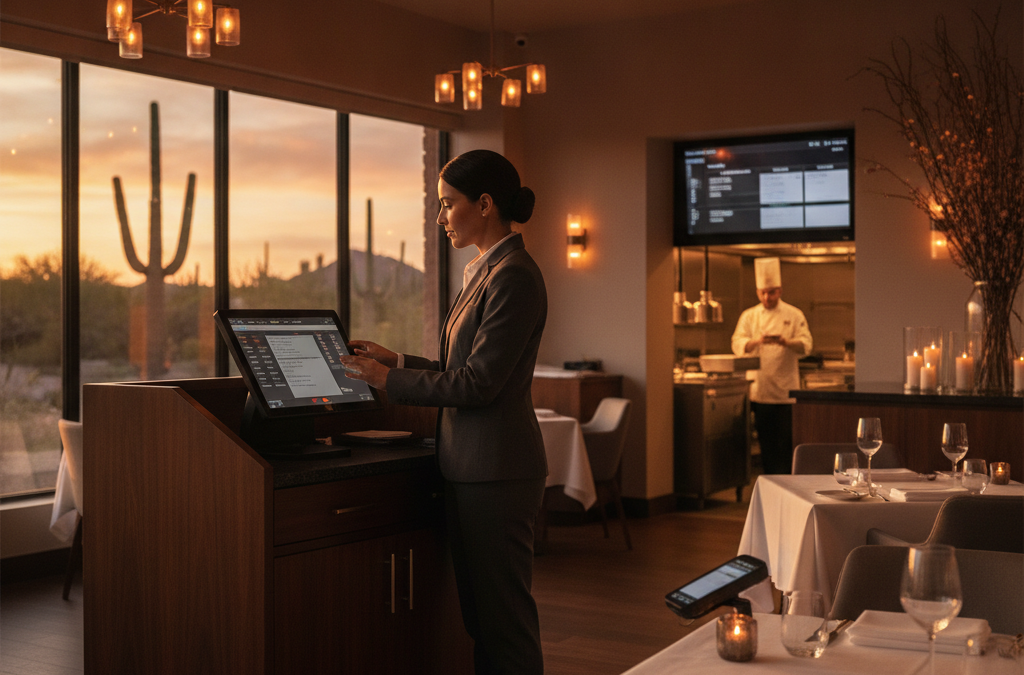
What’s the Best POS System for a Scottsdale or North Scottsdale Fine Dining Restaurant?
If you run a white-tablecloth restaurant in Scottsdale — or anywhere along the North Scottsdale corridor from Gainey Ranch up through Troon North — the short answer is: you need a POS system built for table service, not a glorified cash register. The right setup handles tableside payments without disrupting the guest experience, manages complex tip workflows, integrates with your kitchen, and gives you the reporting you actually need at the end of a Friday night. This guide walks you through what matters, what to skip, and why the generic advice floating around online doesn’t always apply to an upscale dining environment.
Why Fine Dining Has Different POS Requirements Than Other Restaurants
Most POS content online is written for fast-casual or quick-service restaurants — the kind where speed of transaction is everything and the average check is under $20. Fine dining is a completely different animal. Your average check might be $80, $120, or more per person. Tables turn slowly by design. Guests expect their server to bring the terminal to them, not wave them over to a counter. Split checks are common. Wine pairings, prix fixe menus, and multi-course tasting experiences all require flexible item management that a basic Square setup simply isn’t designed for.
On top of that, Scottsdale’s restaurant scene is driven heavily by tourism and seasonal swings. Snowbird season from October through April floods neighborhoods like DC Ranch, Paradise Valley, and Old Town Scottsdale with high-spending visitors who expect the same polished experience they get at top restaurants in other major cities. Then summer hits, covers drop, and you need your labor and inventory reporting to be tight. Your POS has to work well in both modes.
What to Actually Look for in a Fine Dining POS
Before we get into specific systems, here’s what an upscale restaurant genuinely needs from a POS — regardless of brand:
- Tableside payment terminals. Guests should never have to hand their card to a server who disappears with it. A handheld device that processes payment at the table is the standard expectation at any serious restaurant.
- Flexible tip management. The system should allow guests to add a tip during payment — and your end-of-night reporting should make tip distribution and payroll reconciliation straightforward, not a spreadsheet nightmare.
- Course and modifier management. You need to fire appetizers, hold mains, and modify courses without confusion in the kitchen. A good POS ties directly into your kitchen display system (KDS) and keeps your team coordinated.
- Split checks and seat-based ordering. Some systems handle this well. Others make it painful. Ask for a live demo before you commit.
- Inventory tracking for high-value items. If you’re pouring a $180 bottle of wine, you want that tracked — not just in a spreadsheet you update manually every week.
- Reliable uptime and offline processing. If your internet hiccups on a Saturday night with a full dining room, your system needs to keep working and sync when connectivity returns.
How Clover Stacks Up for Upscale Scottsdale Restaurants
The Clover POS family is one of the most flexible systems available for full-service restaurants. Here’s how the hardware maps to a fine dining environment:
- Clover Station: Your anchor terminal — ideal at the host stand or bar for check management, order entry, and end-of-shift reporting. The large screen and full keyboard make it fast for your front-of-house team.
- Clover Mini: Works well as a secondary station in a bar area or for servers who need to ring in orders and access the system without walking back to the main station every time.
- Clover Flex: This is the tableside game-changer. It’s a handheld device that accepts chip, tap, and swipe payments right at the table. Guests add their tip, confirm the amount, and you’re done — no card ever leaves their sight. For a North Scottsdale fine dining room, this is essentially mandatory.
Clover’s App Market also gives you access to restaurant-specific tools: OpenTable integration, kitchen display system apps, loyalty programs, and detailed labor reporting. You can build a setup that actually fits your operation instead of forcing your operation to fit the software.
Toast vs. Clover: An Honest Look for Fine Dining Owners
You’ve probably seen Toast ads. It’s worth being straight with you about the tradeoffs instead of just talking it down.
Toast is a restaurant-specific POS with solid kitchen integration and a strong feature set for full-service dining. If you’re locked into the Toast ecosystem and it’s working for you, that’s a legitimate setup. But there are real reasons Scottsdale restaurant owners come to us after a Toast experience:
- Toast typically locks you into long-term contracts with early termination fees. If your volume changes — and it will, because that’s Scottsdale — getting out is expensive.
- Their proprietary hardware means you’re buying into their ecosystem entirely. You can’t mix and match.
- Processing rates through Toast are not always competitive. When you’re doing $50,000 or $80,000 per month in card volume, even a small rate difference compounds fast.
- Support is handled through a national call center. There’s no local rep who knows your restaurant and picks up when something goes wrong on a Friday night.
Clover through Good Payments gives you hardware flexibility, competitive processing rates, no long-term contracts, and a local contact who actually knows what a prix fixe service looks like at a Gainey Ranch steakhouse.
The Gap Most Competitors Don’t Address: Processing Costs at High Average Ticket Sizes
Here’s something almost none of the local merchant services competitors explain clearly: processing costs behave differently at high average ticket sizes. When a table of four drops $600 including wine, the effective dollar amount of your processing fee on that single transaction is real money. At 2.7% flat rate, that’s over $16 on one check. Multiply that across a full Saturday night and it adds up.
For high-volume fine dining, interchange-plus pricing almost always beats flat-rate pricing — but it requires working with a processor who’s transparent about what that structure looks like. It’s also worth having a conversation about zero cost processing options like cash discount or surcharge programs. Some upscale restaurants do implement these successfully; others feel it doesn’t align with their brand. That’s a business decision you should make with full information, not because a processor pushed you into it.
What you should never be doing is paying flat-rate pricing on a high-ticket, high-volume restaurant without at least comparing it to interchange-plus. We’ll run that comparison for you at no cost — no commitment required.
Frequently Asked Questions
Can I use Clover Flex for tableside payments in a fine dining restaurant?
Yes — and for most upscale table-service restaurants in Scottsdale, it’s one of the best options available. The Clover Flex is a handheld device that handles chip, tap, and swipe payments at the table. Guests sign and tip on the screen, and the transaction processes instantly. It pairs with your main Clover Station through WiFi, so everything stays in sync.
Is Toast the best POS for fine dining, or are there better options?
Toast has strong restaurant-specific features, but it comes with long-term contracts, proprietary hardware, and pricing that isn’t always competitive for high-volume restaurants. Clover through a local processor like Good Payments gives you comparable functionality with more flexibility and no long-term contract requirement. The right answer depends on your volume, your team’s needs, and your priorities — and it’s worth comparing both before signing anything.
How does tip management work on a restaurant POS system?
Good restaurant POS systems — including Clover — let guests add a tip during the payment step, either on a handheld terminal at the table or at a counter. At end of shift, the system generates a tip report that shows total tips collected, which makes distribution and payroll reconciliation much cleaner. You should ask any POS vendor specifically how tip pooling, tip-out structures, and payroll exports work before you commit.
What happens if my internet goes down during service?
Clover systems include offline processing capability — the terminal continues to accept payments and stores the transaction data locally, then syncs when connectivity is restored. For a busy North Scottsdale restaurant on a Saturday night, this is a non-negotiable feature. Confirm offline processing is enabled and tested before you go live with any new system.
Are there merchant services providers in Scottsdale who specialize in restaurants?
Yes. Good Payments Merchant Services is based in Scottsdale and works with full-service restaurants, fine dining concepts, and hospitality businesses across the Phoenix metro. Unlike national processors, you get a local rep who understands the seasonal dynamics of the Valley restaurant market and can actually help you troubleshoot when something goes wrong.
Ready to Find the Right Setup for Your Restaurant?
If you’re opening a new fine dining concept, upgrading from an outdated system, or just tired of paying too much in processing fees without getting the support you deserve, let’s talk. Good Payments Merchant Services works with upscale restaurants across Scottsdale, Paradise Valley, Phoenix, and the surrounding Valley — and we’ll do a free rate analysis and POS recommendation with no pressure and no long-term commitment required.
Reach out through our contact page or call (480) 745-0981. We’ll figure out what actually makes sense for your restaurant — not just what’s easiest for us to sell.