

What’s the Best POS System for a Scottsdale Food Truck or Mobile Vendor?
The short answer: you need a POS system that’s lightweight, battery-powered, works reliably on cellular or WiFi, and won’t freeze up on you when there’s a line of hungry customers waiting. If you’re running a food truck, a pop-up booth, or any kind of mobile vending operation in Scottsdale — whether that’s at a weekend market, a corporate event in North Scottsdale, or a block party in Gilbert — a countertop terminal bolted to a desk isn’t going to cut it. Here’s what actually works, and what to watch out for.
Why Most Generic Advice About Food Truck POS Falls Short
If you’ve searched this topic online, you’ve probably landed on articles from Square or one of the big national processors that make it sound simple: download an app, plug in a card reader, you’re done. And honestly, for a part-time hobby vendor doing a few hundred dollars a week, maybe that’s enough. But if you’re running a real food truck operation — pulling lunch rushes in the Loop 101 corridor, working festivals in Old Town Scottsdale, or parking outside breweries in Tempe — you need something built for real volume and real-world conditions.
Square is fine for getting started. But it has flat-rate pricing that gets expensive as your revenue grows, limited offline capabilities, and almost no live customer support when something breaks mid-service. When you’re in the middle of a two-hour lunch rush and your reader stops responding, you don’t want to be on hold with a call center.
Most of the local competitor sites in the Valley don’t address food truck and mobile vendor payment setups in any real depth. You’ll find a bullet point or two about “mobile payments,” but no practical guidance on what hardware to use, how offline processing actually works, or how to structure your costs so card fees don’t eat your margins. That’s exactly what this article is here to fix.
The Hardware Question: What Device Actually Fits a Food Truck?
Let’s talk hardware, because this is where most mobile vendors get it wrong — either by choosing something too small to manage orders efficiently, or something too bulky to work in a tight truck window.
For most Scottsdale food truck and mobile vendors, one of two Clover devices will be the right fit:
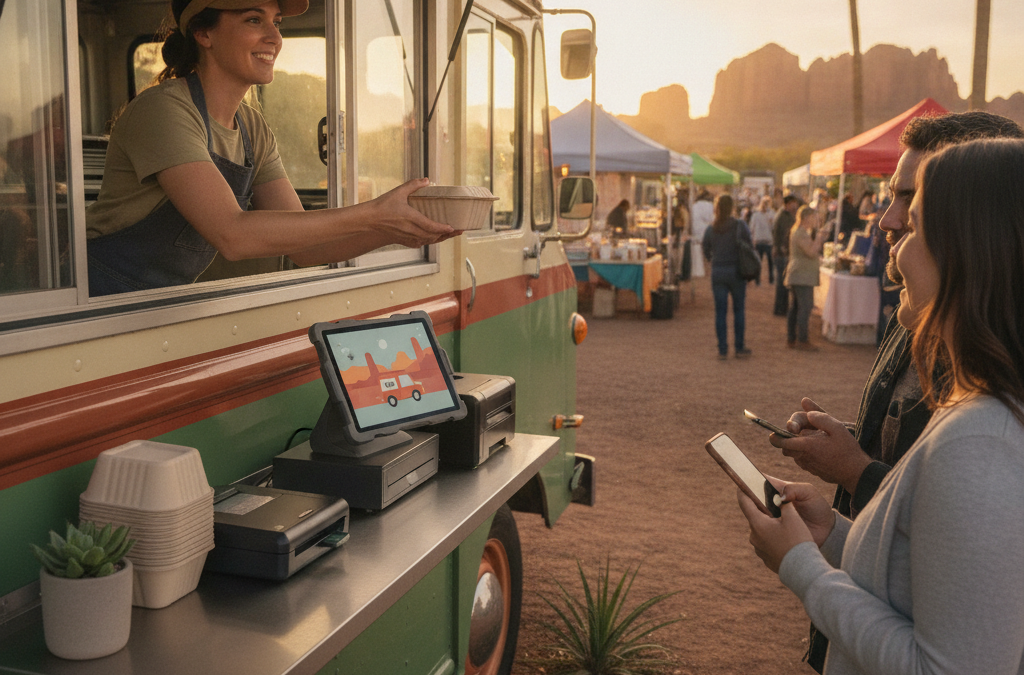
- Clover Flex: This is the workhorse for food trucks. It’s a handheld, all-in-one device with a built-in receipt printer, customer-facing screen, barcode scanner, and runs on WiFi or 4G/5G cellular. It accepts chip, swipe, tap, and mobile wallets like Apple Pay and Google Pay. The Flex can run your full menu, track modifiers (extra guac, no onions), and manage tickets. It’s durable, fits in a truck window, and holds a charge through a full service. For most mobile food vendors, this is the top recommendation.
- Clover Go: This is the lighter, simpler option — a compact card reader that pairs with your smartphone via Bluetooth. It’s chip, swipe, and tap capable and works well as a backup device or for low-volume mobile operations like a single vendor at a farmers market. It doesn’t have a built-in printer, so you’d handle receipts digitally.
If you’re parking your truck in one location regularly — say, a fixed lunch spot in Chandler or a permanent spot at a food truck park — the Clover Mini is also worth considering. It’s a compact countertop unit with a customer-facing display and full POS functionality, without the bulk of the Clover Station. You can learn more about the full Clover hardware lineup at our Clover POS page.
The Offline Problem: What Happens When You Lose Signal?
This is the section that almost nobody in the local payments space covers, and it’s one of the most important questions for any mobile merchant in the Valley.
Scottsdale has generally solid cellular coverage, but signal is not guaranteed everywhere. Outdoor festivals in Maricopa County, events in remote parts of North Scottsdale or Cave Creek, or even a tucked-away parking lot can have dead zones or congested networks. If your POS system can’t process when you’re offline, you stop making money.
The solution is store-and-forward processing. This means your terminal or device captures and encrypts the transaction locally when there’s no connection, then transmits it automatically once you’re back online. Not every provider or device supports this — and some that claim to have it have restrictions on transaction amounts or time limits that make it impractical.
When you’re evaluating any wireless or mobile payment solution, ask your provider directly: Does this device support store-and-forward offline processing? What’s the maximum transaction amount it will store offline? How long can it hold transactions before syncing? Those are the questions that matter at a food festival in Gilbert when 200 people want to order at the same time and the venue WiFi is overloaded.
Our wireless and mobile payment solutions are configured specifically to handle these real-world conditions, including offline processing for mobile vendors across the Phoenix metro.
Controlling Your Costs: Why Zero Cost Processing Makes Sense for Food Trucks
Margins in the food business are already tight. Card processing fees — typically 2.5% to 3.5% per transaction — can quietly take a significant bite out of what’s left after ingredients, labor, fuel, and commissary fees. For a food truck doing $20,000 a month in card sales, that’s $500 to $700 a month going straight to processing fees.
A cash discount program is one way to offset that. Here’s how it works: you post a standard menu price that applies to cash customers. Customers who pay by card pay a small additional amount — typically 3% to 4% — that covers your processing costs. The result is that your card processing is effectively offset, and your margin on card sales improves significantly.
This is legal, increasingly common, and works well in food truck environments where the price structure is already built around a menu board. Customers see it, understand it, and most simply pay by card without blinking. Some choose to pay cash — which is also great for your cash flow.
It’s not the right fit for every business or every customer base, but for food trucks watching their margins closely, it’s worth understanding. Get the full breakdown at our Zero Cost Processing page.
Other Features to Look for as a Mobile Vendor
Beyond hardware and connectivity, here are the features that matter most for food trucks and mobile vendors operating in and around Scottsdale:
- Menu management: You should be able to update your menu, add daily specials, and 86 items you’ve sold out of — right from the device or remotely from your phone. This matters if you’re running a rotating menu or different items at different events.
- Tip prompting: Your device should prompt customers for a tip on the customer-facing screen, with preset percentage options. This is standard on the Clover Flex and significantly increases your tip income without any awkward conversations.
- Next-day funding: You need your money fast. Look for next-day or same-day deposit options so you’re not waiting three to five business days after a big event weekend.
- Reporting: Even as a one-truck operation, you want to see your sales by item, by day, and by event so you know what’s working. Cloud-based reporting you can access from your phone matters here.
- No long-term contracts: Mobile businesses evolve fast. Don’t lock yourself into a three-year processing contract you can’t get out of if your business changes or you find better pricing.
The Snowbird Season Factor for Valley Food Vendors
If you’ve been running a truck in the Phoenix metro for more than a year, you already know the swing. October through April is a completely different business than June through August. Snowbird season brings massive foot traffic to Old Town Scottsdale, Glendale, and the East Valley — events, markets, festivals, and weekend rushes that can double or triple a slow summer week.
Your payment setup needs to handle that volume without going down during peak hours. The worst thing that can happen at a packed Saturday market is your reader erroring out and forming a long line. Make sure you’ve tested your hardware under load before the season kicks in, and ask your processor what their uptime and failover approach looks like.
Frequently Asked Questions
Can I use my existing Square reader if I’m already set up with it?
You can, but if you’re doing real volume, Square’s flat-rate pricing becomes costly and their offline capabilities are limited. It’s worth doing a side-by-side cost comparison before your next busy season to see if switching saves you money.
Do I need a separate merchant account as a food truck, or can I use a payment app?
Payment apps like Square or PayPal aggregate your funds through their own accounts, which means they can hold or freeze funds if they flag your account. A dedicated merchant account gives you more stability, faster deposits, and better dispute protection — especially as your volume grows.
What happens if my food truck’s cellular signal drops mid-transaction?
With store-and-forward enabled, the transaction is captured and held securely on the device, then transmitted automatically once signal is restored. Not all devices or providers support this — make sure yours does before you rely on it at a high-traffic outdoor event.
How much does a Clover Flex cost for a food truck?
Hardware pricing varies depending on your processing plan. On qualifying processing agreements, POS equipment is available at no upfront cost. We don’t publish specific pricing here — reach out for a free quote based on your actual volume and business type.
Do cash discount programs work at food trucks, or do customers push back?
They work well in food truck settings because pricing is already posted on a menu board. As long as signage is clear and the price difference is reasonable, most customers accept it without issue. Some will choose to pay cash, which is a win either way.
Ready to Get Your Food Truck Set Up Right?
If you’re running a food truck, pop-up booth, or mobile vending operation anywhere in Scottsdale, Phoenix, Mesa, Gilbert, Glendale, or across Maricopa County, let’s talk through what actually makes sense for your setup. There’s no one-size-fits-all answer, and you shouldn’t have to figure it out alone by reading product pages from processors who’ve never set foot in a food truck.
I’m Zoltan Hardi, and I work directly with mobile merchants across the Valley to find the right hardware, pricing structure, and processing setup for how they actually operate — not a generic package off a shelf. There are no long-term contracts, no surprise fees, and I’m available when you have a question.
Request a free consultation or rate analysis here and we’ll get your mobile payment setup working as hard as your truck does.