


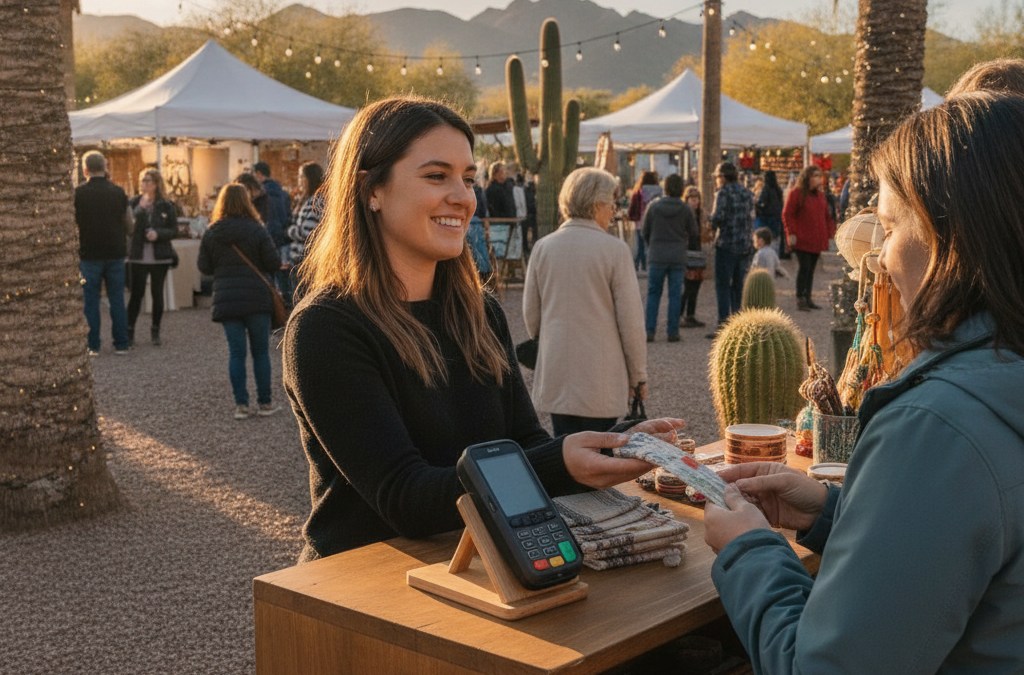
What’s the Best Way for a Glendale or Scottsdale Business to Accept Payments at Seasonal Events and Temporary Locations?
The short answer: you need a mobile payment setup that’s reliable, easy to carry, and doesn’t saddle you with a full-time monthly bill for a part-time selling situation. Glendale hosts a packed calendar of seasonal events — everything from stadium-area markets near State Farm Stadium to holiday vendor fairs and spring training crowds. Scottsdale brings its own wave of snowbird-season foot traffic, art festivals, and pop-up markets in Old Town and along the Loop 101 corridor. If your business shows up at these events even a handful of times a year, your payment setup needs to match how you actually sell.
This is one area where a lot of local merchants get burned — either by overpaying for hardware they don’t need year-round, or by cobbling together a free app that drops the connection right when the line is 12 people deep.
Why Seasonal Selling Has Unique Payment Challenges
Most payment guides are written for businesses with a fixed location — a storefront, a restaurant, an office. Seasonal and event-based sellers have a completely different set of problems:
- Connectivity is unpredictable. Event venues, fairgrounds, parking lots, and outdoor markets often have weak or shared WiFi. If your payment terminal depends entirely on a steady connection, you’ll hit dead spots at the worst possible moments.
- You need speed at peak times. A slow or unreliable checkout experience during a busy holiday market or spring training weekend in the West Valley doesn’t just cost you that one sale — it kills your line and your reputation.
- Equipment cost has to make sense for the volume. Paying a high monthly fee for a POS system you only use October through March doesn’t pencil out for most small businesses.
- Setup and teardown need to be fast. Nobody wants to spend 45 minutes configuring a payment terminal in a vendor tent while customers walk by.
What Actually Works: Mobile and Wireless Payment Options for Valley Events
For most seasonal sellers in the Phoenix metro — whether you’re vending at a Glendale holiday market, an Old Town Scottsdale art walk, a Tempe festival, or a Peoria community fair — the right answer is usually one of two things: a cellular-enabled wireless terminal or a compact mobile POS device like the Clover Flex or Clover Go.
Wireless Terminals with 4G/5G Connectivity
A standalone wireless terminal that runs on its own cellular data connection is the most reliable option for outdoor events where you can’t count on the venue’s WiFi. These terminals process chip cards, tap-to-pay (Apple Pay, Google Pay), and swipe — and they run independently of any network you don’t control. If a card swipe can’t connect in the moment, store-and-forward mode lets the terminal hold the transaction and process it automatically once the connection restores. That’s a feature worth asking about specifically — not every provider enables it by default.
You can learn more about the wireless and mobile options available through Good Payments at our wireless and mobile payment solutions page.
Clover Flex and Clover Go for Event Sellers
The Clover Flex is a handheld POS that handles payments, receipts (printed or emailed), basic inventory, and even employee clock-in — all in one device you can hold in your hand or set on a countertop. It connects via WiFi or cellular and is a solid choice if you’re doing moderate sales volume at events and want a more complete system than a bare card reader. The Clover Go is smaller and pairs with your phone or tablet — a good fit if you’re keeping things minimal and your transaction volume is lower.
Neither device requires a fixed location. Both travel with you, which is exactly the point. If you’re curious about the full Clover lineup and which model makes sense for your selling style, the Clover Family page breaks it down clearly.
The Gap Most Local Processors Don’t Talk About: Seasonal Pricing Flexibility
Here’s something you won’t find spelled out on most competitor sites: what happens to your monthly fees during the months you’re not selling?
If you’re a seasonal vendor in Maricopa County — someone who does the snowbird-season markets from November through March and then slows way down through the Arizona summer — a flat monthly software or terminal rental fee during your off months is pure waste. Some processors build in flexible plans that adjust for low-volume periods, while others just keep charging regardless. This is a question you should ask before you sign anything, and it’s one that most of the national processors and even some local ones don’t have a clean answer for.
At Good Payments, we work with merchants specifically on structuring accounts that fit their actual selling patterns — not a one-size-fits-all plan that assumes you’re open 12 months a year, 6 days a week.
What About Just Using Square for Events?
Square is an easy starting point, and for very low-volume sellers it’s fine. But there are real limitations worth knowing:
- Square’s flat-rate pricing (typically 2.6% + 10¢ per swipe) sounds simple, but at higher transaction volumes it gets expensive fast compared to interchange-plus pricing through a merchant account.
- Square has a history of account holds and sudden fund freezes — especially for merchants with irregular or seasonal volume patterns, which looks “unusual” to their automated risk systems.
- Customer support is largely self-service. If something goes wrong mid-event in Surprise or Chandler on a Saturday afternoon, you’re on your own with a help article.
That’s not to say Square is the wrong tool in every situation — it’s just that once you’re doing meaningful volume at events, the economics and the support model both start to work against you.
Zero Cost Processing at Events: Does It Work?
A lot of seasonal vendors are interested in passing processing costs to customers through a cash discount or surcharge program — and it can absolutely work at events, provided it’s set up correctly and you’re following state and card brand compliance rules. You display a cash price and a card price, customers choose, and your effective processing cost drops significantly or goes to zero. For high-volume event days, the savings add up fast.
The key is having it configured properly from the start — signage, receipt language, and program structure all have to be done right. You can read more about how these programs work at the Zero Cost Processing page.
Practical Checklist Before Your Next Event
- Does your terminal have its own cellular connection, or does it depend on venue WiFi?
- Is store-and-forward mode enabled on your device?
- Is your battery fully charged, and do you have a backup power source?
- Are you set up for tap-to-pay (contactless)? A lot of customers — especially during busy snowbird season — prefer it for speed.
- Do you know your processing rates? Flat-rate vs. interchange-plus can make a meaningful difference on a high-volume event day.
- Is there a real person you can call if something goes wrong on-site?
Frequently Asked Questions
Can I use my existing merchant account for seasonal or event-only selling?
Yes, in most cases. If you already have a merchant account, talk to your provider about adding a mobile or wireless terminal. The bigger issue is whether your account pricing and monthly fees make sense for irregular volume. If you’re being charged a high monthly minimum during your off-season, it’s worth renegotiating or switching.
What happens if I lose internet during a busy event in Glendale or Scottsdale?
If your terminal supports store-and-forward processing, it holds the transaction locally and submits it once connectivity is restored. Not all terminals or providers enable this by default — confirm it’s active before the event, not during.
Do I need a separate merchant account for events, or can I use my main business account?
Typically you can use your main account. You’ll just need a terminal or device that’s mobile-capable. That said, if your event selling is a different business type than your primary operation, it’s worth a conversation with your processor to make sure your account is classified correctly.
Is it worth buying a terminal outright for seasonal events, or should I rent?
If you’re selling at events regularly — even just 10 to 15 weekends a year — owning your hardware usually makes more financial sense than paying a monthly rental fee. The upfront cost is often offset within a few months. Ask about free equipment on qualifying plans, which can eliminate that upfront cost entirely.
What’s the fastest way to get set up before an upcoming event?
A straightforward merchant account application, approved and funded, can typically be set up within a few business days when you work with a local provider who handles the process directly. The more complex your situation, the longer it takes — so don’t wait until the week before your event to start.
Ready to Set Up Payments That Actually Travel With Your Business?
Whether you’re gearing up for Glendale’s holiday market season, staking out a booth at an Old Town Scottsdale event, or planning a run of weekend pop-ups across the East Valley, Good Payments can put together a mobile payment setup that fits how you actually sell — without locking you into a contract that doesn’t make sense for a seasonal business.
Reach out through the contact page for a free rate review and a straightforward conversation about what you need. No pressure, no sales pitch — just a local rep who picks up the phone and knows the Valley.