What’s the Best Way for a Mesa or Scottsdale Nonprofit to Accept Donations and Payments?
If you run a nonprofit in Mesa, Scottsdale, or anywhere else in the Phoenix metro, the answer is straightforward: you need a merchant account and payment setup built around your actual workflows — not a generic small-business solution that was never designed with charitable organizations in mind. Whether you’re processing online donations, collecting event registration fees, selling merchandise at a fundraiser, or billing recurring donors each month, there’s a right way to set this up that keeps your costs low and your donor experience clean. The wrong setup means you’re quietly losing a percentage of every donated dollar to unnecessary fees — money that should be funding your mission.
Why Nonprofits Have Different Payment Needs Than Regular Businesses
Most merchant services providers think about payment processing in terms of retail sales or restaurant tickets. But nonprofits deal with a different mix: one-time donations, recurring giving programs, event ticket sales, grant-funded purchases, and sometimes merchandise or program fees — all under one roof. Your payment setup needs to handle all of that without creating a bookkeeping nightmare or charging you retail rates on every transaction.
There are a few things that make nonprofit payment processing unique:
- Donors expect a smooth, trustworthy experience. If your online donation page looks clunky or asks for too many steps, people abandon it. That’s a lost donation you’ll never get back.
- Recurring giving is everything for cash flow. Monthly donors are the backbone of most nonprofits. You need a system that handles automatic recurring billing without requiring your staff to manually process it every month.
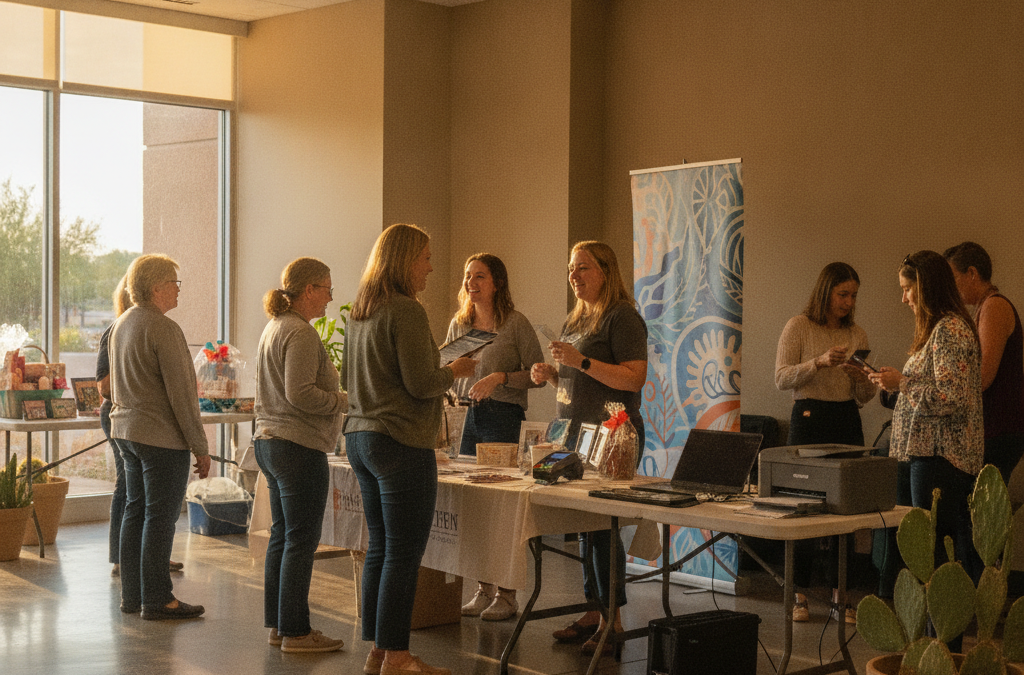
- Events create burst volume. A gala in North Scottsdale or a fundraising walk in Mesa might generate more transactions in one evening than your entire previous month. Your setup needs to handle that without hiccups.
- Fees eat into mission dollars. Every percentage point you pay in processing fees is money not going toward your programs. This is why nonprofits should be asking about every fee on their statement — not just accepting whatever rate they’re quoted.
The Gap Most Local Processors Aren’t Filling
Here’s something worth knowing: most of the merchant services providers you’ll find in the Phoenix area focus almost entirely on restaurants, retail shops, and contractors. Very few have built out content, pricing structures, or service models specifically for nonprofits. That means if you call a generic processor, you’re likely getting a cookie-cutter merchant account with retail rates — not a solution that accounts for the fact that you’re a 501(c)(3) with specific needs around donation pages, recurring billing, and in-person event processing.
At Good Payments, we work with organizations across Maricopa County — including nonprofits in Mesa, Chandler, Gilbert, Tempe, and Scottsdale — and we know these situations require a more thoughtful setup. That starts with understanding what you’re actually doing with payments before recommending any equipment or software.
Online Donations: Get a Virtual Terminal or Hosted Payment Page
If you’re collecting donations through your website, you need a payment gateway that’s integrated with your site and designed for clean, mobile-friendly donor experiences. A virtual terminal also lets your staff key in donations taken by phone without needing a card reader present.
The e-commerce and virtual terminal options we set up for nonprofits typically include a secure hosted payment page (so you’re not storing card data on your own server), support for custom donation amounts, and the ability to set up recurring billing at the donor’s chosen interval — weekly, monthly, or annually.
This is significantly different from just embedding a PayPal button on your site. PayPal and similar platforms are convenient, but their rates for nonprofits aren’t always as competitive as they appear once you factor in all the fees. And if a donor has a question or a charge dispute, you’re dealing with a 1-800 number — not someone who actually knows your organization.
Recurring Giving: ACH Is Underused and Undervalued
Here’s something most nonprofits don’t realize: when a recurring donor gives $100 a month via credit card, you might be paying $2.50–$3.50 in processing fees on that transaction every single month. Over a year, that’s $30–$42 on a single $1,200 annual gift. Multiply that across your donor base and it adds up fast.
ACH bank transfers — where the donation comes directly from the donor’s bank account — typically cost a fraction of what credit card processing costs. For recurring giving programs, ACH is often the smarter choice, especially for higher-value monthly donors who are comfortable setting up a bank transfer. It’s not right for every donor or every situation, but it’s a legitimate option that most nonprofits never even know they have.
We can set up ACH processing alongside your card processing so you can offer donors the option — and keep more of each gift in the process.
In-Person Events: Mobile and Wireless Processing That Actually Works
If your nonprofit hosts fundraising events — galas, auctions, walk-a-thons, farmers markets, outdoor festivals — you need payment hardware that works reliably in the field. That means WiFi or 5G connectivity, not a system that chokes when a hundred people try to check in at once.
For events in Scottsdale’s resort corridor, outdoor venues in Mesa or Gilbert, or pop-up fundraisers around the Valley of the Sun, a compact wireless terminal or a Clover Flex gives your volunteers or staff the ability to accept chip cards, contactless payments, and mobile wallets anywhere on-site. Some setups also include store-and-forward capability — so if you lose signal briefly, transactions queue and process automatically when connectivity is restored.
You can learn more about wireless and mobile payment options that work well for event-based organizations.
Should Your Nonprofit Consider a Zero Cost Processing Program?
Cash discount and surcharge programs — where a small fee is added to card transactions, effectively passing processing costs to the payer — are increasingly common among small businesses. For nonprofits, this is a more nuanced question.
In a retail or restaurant context, surcharging is straightforward. For donations, it requires more care. Some donors are fine with a small processing fee added at checkout; others find it off-putting. The right answer depends on your donor base and how your donation forms are structured. What we’d suggest: have that conversation with your processor before deciding, rather than just enabling surcharging by default. We walk through this with every nonprofit we work with rather than pushing a one-size-fits-all answer.
You can read more about how these programs work at our Zero Cost Processing page if you want the full breakdown.
What to Ask Any Processor Before Signing Up
Whether you’re talking to a local provider in Scottsdale or a national platform, these are the questions every nonprofit should ask:
- Do you have experience working with 501(c)(3) organizations specifically?
- What are your rates for card-present vs. card-not-present transactions, and are there nonprofit-specific rates available?
- Can you support recurring billing and ACH transfers in the same account?
- Do you offer a hosted donation page, or will we need a developer to integrate a gateway?
- Are there long-term contract requirements or early termination fees?
- Who do we call when something goes wrong at a fundraising event on a Saturday night?
That last question matters more than most nonprofits realize. With a national processor or a software-only platform, your Saturday-night support is a chatbot and a help article. With a local provider, it’s a phone call to someone who knows your account.
Frequently Asked Questions: Nonprofit Payment Processing in Mesa and Scottsdale
Can a nonprofit get lower processing rates than a regular business?
Some card networks offer reduced interchange rates for registered 501(c)(3) organizations on qualifying transactions. Whether you actually get those rates depends on how your merchant account is set up and whether your processor passes them through. This is worth asking about specifically — not every processor applies nonprofit interchange rates automatically.
Do we need separate merchant accounts for event sales and online donations?
Not necessarily. A single well-structured merchant account can typically handle both, with different terminals or payment pages for each use case. The key is making sure your account is set up for both card-present and card-not-present transactions from the start.
Is PayPal Giving Fund good enough for our donation page?
PayPal Giving Fund is free for registered nonprofits on donations made through PayPal’s platform, which is genuinely useful. The limitation is that you’re dependent on PayPal’s platform and ecosystem. If you want a branded, customizable donation experience embedded in your own website, a dedicated payment gateway gives you more control — and usually integrates better with your CRM or donor management software.
How do we handle recurring donors who have a card on file that expires?
A good payment gateway includes account updater services — these automatically refresh expired or replaced card information using network-level data, so your recurring charges don’t fail silently. This is a feature worth specifically asking about. It can dramatically reduce the number of lapsed recurring donors due to payment failures.
We’re a small nonprofit with low monthly volume. Is it worth setting up a real merchant account?
It depends on your trajectory. If you’re processing under a few thousand dollars a month and just need a simple donation button, a platform like PayPal or Stripe might be enough for now. But if you’re running events, building a recurring giving program, or expecting to grow, setting up a proper merchant account early saves you from having to migrate later — and usually saves money on fees once your volume picks up.
Ready to Set Up Payments That Work for Your Organization?
If you run a nonprofit in Mesa, Scottsdale, Chandler, Gilbert, Tempe, or anywhere in the Phoenix metro, we’d be glad to walk through your current setup, look at what you’re paying, and show you what a better-structured account would look like. No pressure, no long sales pitch — just an honest conversation about what makes sense for your organization. Reach out to Good Payments Merchant Services and let’s talk through it together.